

Paperwork can quietly destroy a therapist’s well-being. Between back-to-back sessions, evolving compliance requirements, and the sheer narrative weight of mental health documentation, clinicians are spending hours each week doing work that has nothing to do with actually helping people. That’s not a minor inconvenience; it’s a systemic problem.
AI therapy notes and AI patient records are emerging as genuine solutions, giving clinicians smarter ways to document care without compromising the clinical precision that quality records demand. Let’s break down exactly how.
Understanding AI Therapy Notes and AI Patient Records
Before jumping into benefits, you need a clear picture of what these tools actually are, and why the timing matters.
The Technology Driving AI Therapy Notes
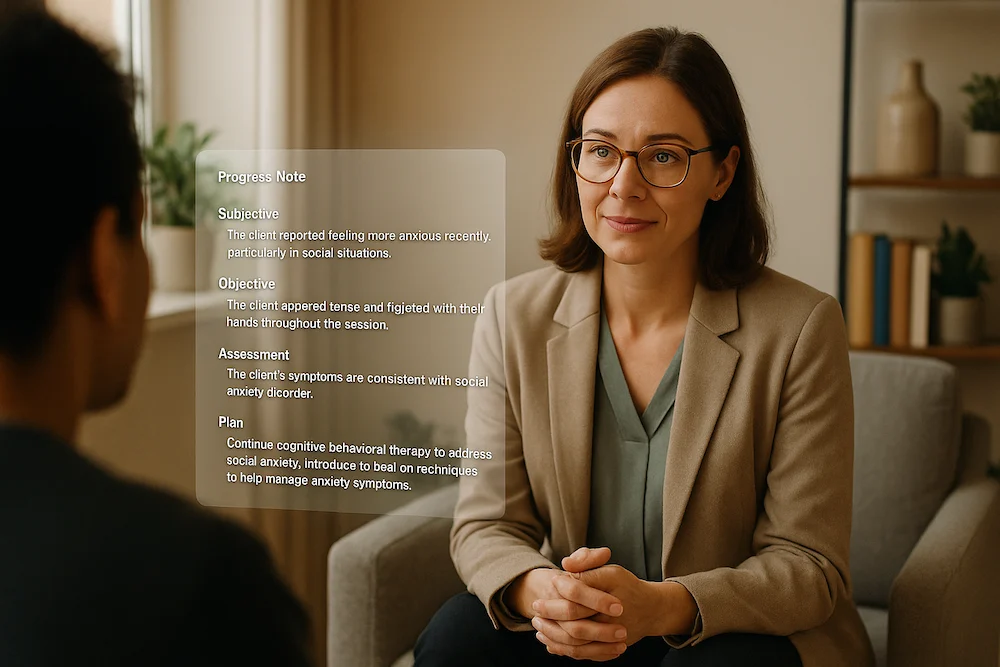
At their core, AI therapy notes rely on natural language processing and speech-to-text technology to take raw session content and convert it into structured, usable clinical documentation. Some tools transcribe voice dictations directly. Others generate complete SOAP, DAP, or BIRP notes from brief clinician summaries.
The distinction matters: there’s a real difference between basic template tools, ambient documentation systems that listen during sessions, and post-session tools where the clinician inputs notes for AI to restructure and refine.
So now you know what these tools do. But why does any of it matter urgently right now?
Why Mental Health Documentation Is Broken
The American Medical Association found that 20.9% of physicians reported spending more than eight hours on EHR tasks outside normal working hours. Mental health clinicians experience this same pressure, often worse, given how narrative-intensive therapy documentation tends to be compared to other specialties.
Where AI Fits Naturally Into Your Clinical Workflow
Therapy note automation can enter the documentation lifecycle at multiple points: intake paperwork, session notes, treatment planning, progress tracking, and discharge summaries.
The practical starting point is identifying where your burden is heaviest and addressing that first, often with the help of an AI therapy note generator that streamlines documentation from the outset.
One thing needs to be said clearly: AI assists clinical work, it doesn’t replace clinical judgment. You still determine what’s accurate, what the diagnosis means, and what the treatment plan should reflect. What AI handles is the structural drafting, the formatting, and the organizing, so those tasks take minutes instead of consuming your evening.
Key Ways AI Therapy Notes Strengthen Clinical Documentation
Knowing where AI fits is a useful context. Seeing what it actually changes is where things get compelling.
Converting Raw Session Content Into Audit-Ready Notes
AI therapy notes take free-text or voice input and produce structured, formatted documentation. Dictate a quick post-session summary, and the tool separates subjective client reports from objective clinical observations, tightens assessment language, and suggests plan elements that support medical necessity documentation.
The clinician reviews, refines, and signs every single time. No shortcuts, no bypassing clinical accountability.
Reclaiming Time Without Losing Clinical Depth
What used to take 15–20 minutes per note can realistically become a 3–5 minute review. Research found that Nabla users reduced documentation time by nearly 10% compared to usual care. That might sound modest in isolation, but multiply it across a full caseload week after week, and you’re talking about hours returned to actual clinical work, or simply to rest.
Clinicians can also configure preferred phrasing and theoretical orientation, so AI output reflects their voice rather than producing something that feels generic and impersonal.
Building Consistency, Completeness, and Compliance Into Every Note
Inconsistent documentation across clinicians in a group practice isn’t just an administrative headache; it’s a liability.
Automated clinical documentation supports consistent inclusion of mental status exams, risk assessments, and diagnosis codes, even when time pressure is real, and those elements are easy to skip.
AI can flag missing fields before signing and catch internal contradictions, like a narrative describing low risk while a checkbox indicates high risk. That kind of built-in quality control meaningfully reduces audit exposure.
Data Quality: The Underappreciated Win
Automation only earns trust when accuracy backs it up. That’s why data quality deserves its own focus.
Catching the Errors and Omissions That Slip Through
AI flags incomplete required fields before a note is finalized. It detects internal inconsistencies and can prompt follow-up on pending items like labs or consultation requests.
For psychiatrists and PMHNPs managing the complex overlap between medication management and therapy, that extra layer of prompting is genuinely valuable; it reduces the chance that something important gets overlooked during a heavy clinic day.
Standardizing Language While Keeping Your Clinical Voice Intact
Using style preferences and custom prompts, AI in mental health records can reflect your specific theoretical orientation, CBT, EMDR, family systems, trauma-informed approaches, whatever grounds your practice.
The output isn’t supposed to sound generic. It’s supposed to sound like you drafted it on a day when you had more time. Culturally sensitive, non-pathologizing language can be built into templates from the start, ensuring your documentation reflects your values consistently.
Ethical and Legal Foundations You Cannot Skip
Better documentation quality is compelling. But using AI confidently in clinical practice requires understanding the ethical and legal terrain, not as an afterthought, but as a foundation.
HIPAA, Encryption, and Business Associate Agreements
“HIPAA-compliant” carries a specific meaning: encryption at rest and in transit, access controls, audit logs, and a signed Business Associate Agreement with any vendor handling protected health information.
Before you input a single client detail into any platform, confirm that a BAA is in place. Then ask directly: how long is data retained, and is it used to train AI models? These aren’t paranoid questions; they’re due diligence.
Having the Informed Consent Conversation With Clients
Your clients deserve to know if AI is involved in structuring their documentation. Consent language should clearly explain what AI does, what it doesn’t retain, and what options clients have if they’re uncomfortable. Approached with a trauma-informed mindset, transparent, direct, and without pressure, this conversation builds trust rather than eroding it.
Frequently Asked Questions
Can AI therapy notes genuinely be HIPAA compliant?
Yes, when the vendor provides a signed BAA, encryption, and clear data retention policies. Always verify before inputting any protected health information.
Will an ai therapy note generator produce generic, cookie-cutter notes?
Quality tools allow you to set style preferences, preferred clinical language, and theoretical orientation. The output should reflect your clinical voice, not a one-size-fits-all template.
Does AI documentation increase or reduce legal risk?
When notes are more complete and consistent, risk generally decreases. But only if clinicians carefully review every AI-generated note before signing. Unreviewed inaccuracies create liability, reviewing closely protects you.
What should clients be told about AI in their records?
Be direct: AI helps structure documentation, their information is HIPAA-protected, and their clinician reviews everything before it enters their official record.
Final Thoughts
AI therapy notes and AI patient records aren’t replacing clinical skill. They’re protecting it. When documentation takes less time and produces cleaner, more defensible records, clinicians have more capacity for actual client care, for supervision, for rest.
Start with one area of your workflow, verify HIPAA compliance thoroughly, and measure the difference over a few weeks. Good documentation has always mattered deeply in mental health practice. Now, there are genuinely better tools to help you do it well, without burning out in the process.