

No irrigation decision carries more weight in Southern California than this one.
The state has been alternating between drought restrictions and mandatory cutbacks for most of the past decade. Water bills here run 40 to 60 percent above the national average. And a poorly designed system wastes hundreds of dollars per season while stressing the landscape every August when it’s already under pressure from triple-digit heat. The right setup, designed around the actual property, cuts outdoor water use by 30 to 50 percent.
Here’s what this comparison actually covers: how each system works, where each one genuinely wins, what real installation costs look like in the LA and Ventura County market, and the specific conditions that make the choice obvious.
How Drip Irrigation Works
Drip irrigation delivers water directly to the root zone of individual plants through flexible tubing and small emitters. Slow delivery. Typically 0.5 to 2 gallons per hour per emitter. The water soaks into the soil rather than hitting a surface and running off.
Low pressure runs it. Usually 15 to 30 PSI through a main supply line that branches into smaller distribution lines positioned close to each plant. Emitters go at or near the base. Timers run long cycles with long gaps between them, which pushes roots to grow deep into the soil rather than staying shallow where a week of 100-degree heat can kill them.
Here’s the core efficiency advantage: water never leaves the ground as airborne spray. On a hot August afternoon in the San Fernando Valley or Ventura County, a sprinkler system loses 30 percent or more of its output to evaporation before the water reaches the root zone. Drip loses almost none of it.
How Sprinkler Systems Work
Sprinkler systems push water through heads that spray in fixed patterns across the surface. Rotary heads reach 15 to 30 feet. Fixed spray heads cover 5 to 15. Pop-up rotors pull below grade when the system shuts off, which is what keeps them out of the way of lawnmowers and anything else rolling across the yard.
Higher operating pressure, typically 30 to 50 PSI, and cycles measured in minutes rather than hours. The broad coverage is actually the entire point. Sprinklers are designed to serve large, continuous turf surfaces efficiently, and there’s no practical way to replace 2,500 square feet of lawn irrigation with individual emitters. The hardware count alone would make it cost-prohibitive.
Smart controllers have closed some of the gap. A system connected to local weather station data and programmed to adjust run times based on evapotranspiration wastes substantially less than an old timer running the same schedule regardless of whether it rained in Thousand Oaks the night before. But the physics of spray evaporation doesn’t change regardless of how smart the controller is. The water still goes up before it comes down.
The Honest Comparison
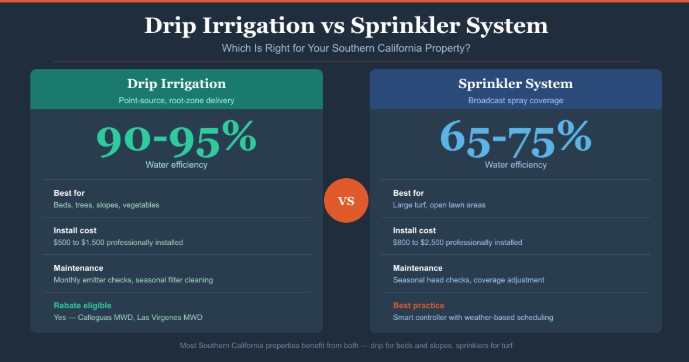
Water Efficiency
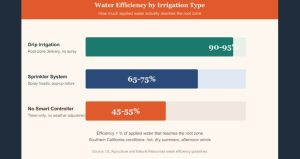
Drip wins, and it is not close. Efficiency rates for drip run 90 to 95 percent, meaning almost every gallon applied gets to the root zone. Sprinklers under good conditions hit 65 to 75 percent. Put a sprinkler on a slope, run it during an afternoon Ventura County wind, or aim it into direct July sun, and that number drops to 50 percent or worse.
For a property in the Conejo Valley or west Los Angeles with water bills already running $150 or more per month during summer, the difference across a single irrigation season lands in the hundreds of dollars. And drip systems qualify for rebates through several Southern California water districts, including Calleguas Municipal and Las Virgenes Municipal, which reduces the effective installation cost from the start.
Coverage and Plant Types
Sprinklers win this one. A large lawn, 2,000 square feet or more, can’t be economically irrigated with individual emitters. The hardware count and installation labor make it impractical for broad turf. Sprinklers cover large flat surfaces evenly with far less equipment.
Drip is the better answer for planting beds, vegetable gardens, shrubs, trees, and any plant material that benefits from water delivered to the root rather than broadcast across a surface. It’s also the right call for slopes, where spray irrigation runs off before it soaks in. (Anyone who’s watched a sprinkler running on a hillside in Thousand Oaks or Moorpark has seen exactly this problem.)
Most residential properties in the region have both types of plantings. Separate zones for each is the professional standard.
Installation Cost
A professionally installed drip system for a mid-size planting area in the LA or Ventura County market runs $500 to $1,500 depending on zone count and emitter density. Sprinkler systems for a comparable area run $800 to $2,500 installed, with larger lawns pushing significantly higher.
DIY drip kits start around $50 to $150 for small areas. DIY sprinkler installation involves trenching for PVC pipe, pressure testing, and backflow preventer installation. It’s more complex than drip and carries a higher risk of coverage and pressure errors that show up later as dead patches in the lawn.
Over time, drip typically recovers the installation cost within two to three seasons in Southern California, where outdoor irrigation accounts for 50 to 70 percent of residential water use.
Maintenance
Thing is, drip requires more active management. Emitters clog, particularly with hard water. Southern California water has mineral content high enough to partially block emitters within a season or two without a filter at the connection point. Lines get damaged during landscaping work near the surface. Filters need cleaning once or twice a season.
A homeowner who checks the system once a month catches problems before plants show stress. One who installs drip and forgets about it usually discovers the issues when the landscape starts struggling in July.
Sprinkler systems require seasonal adjustments, head cleaning, and occasional head replacement. Broken heads are visible. Coverage gaps show up as dry patches in the lawn and are easy to identify. The maintenance is more intuitive, which is one reason sprinklers remain the dominant choice in the region even with higher water use.
Both systems benefit from a smart controller. Running a full cycle after a rainstorm or at the same frequency regardless of heat wastes water every time. A controller that reads local weather station data and adjusts automatically eliminates most of that waste.
Which Is Better for Southern California?
For mixed residential properties, which is most of the region, the real answer is both.
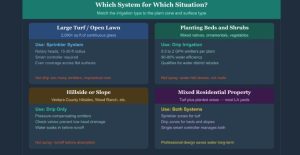
Turf and large open ground: sprinkler system on a smart controller with weather-based scheduling. Planting beds, vegetable gardens, native plantings, fruit trees, slopes, any area where conservation is the priority: drip.
The common mistake is installing one system type across the entire property. An all-sprinkler setup wastes water in planted beds and on slopes. An all-drip setup won’t cover turf. Matching zones to their plant conditions is what actually works over a decade of Southern California summers.
When a Hybrid Approach Makes the Most Sense
Full irrigation renovations are the best shot at doing this correctly. Start from scratch, design the zones right, and a hybrid setup reduces total water use substantially while keeping the lawn alive through six months of Southern California dry heat.
One smart controller manages both. Each zone adjusts independently based on weather data, plant type, and the actual soil conditions in that specific part of the yard. That is exactly what professional irrigation services typically recommend and install for Southern California residential properties. Get the design right once and it runs for years.
Getting the Right System for Your Property
There is no single right answer here. The plant mix, slope, soil type, water budget, and how much maintenance you are actually willing to do each month all push the decision in different directions. Both systems work well when matched to the right application. Neither is better in every situation.
For homeowners considering a system upgrade or full installation, the benefits of residential and commercial irrigation solutions covers what a properly designed system delivers over time.
UC Agriculture and Natural Resources publishes California-specific irrigation research and water conservation guidelines relevant to LA and Ventura County properties. Bob Vila’s irrigation guides cover installation approaches and system comparisons at the homeowner level. And Gardening Know How offers practical guidance on matching irrigation methods to specific plant types.
Start with the plant mix on your property. Map the zones by type: turf versus planting beds versus slopes versus trees. Then choose the system that matches each zone. A property that has been irrigation-designed rather than just irrigation-installed uses significantly less water and holds up better through the long Southern California dry season.