


The role of a Product Owner is rapidly evolving from a simple backlog manager to a strategic visionary. As markets become more volatile and customer expectations soar, being a “bridge” between business and tech is no longer enough. You must become a value-driven leader who masters both empathy and data.
According to the 2025 State of Agile Report, 44% of organizations are prioritizing “customer-centricity” as their primary goal for digital transformation. Furthermore, research by LinkedIn Learning predicts that analytical thinking and AI literacy will be the most sought-after skills for product leaders by 2026.
1. Visionary Strategic Thinking
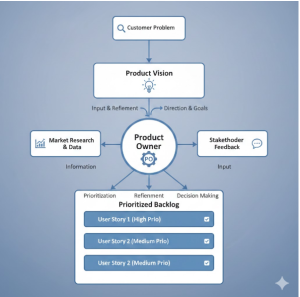
In 2026, a Product Owner (PO) must look beyond the next sprint. You aren’t just building features; you are solving problems. Strategic thinking involves understanding the “Why” behind every “What.”
- Market Analysis: You need to anticipate trends before they hit.
- Product Roadmap: Moving from a static list of tasks to a fluid, goal-oriented roadmap that adapts to market changes.
- Value Maximization: Every item in your backlog should have a clear ROI (Return on Investment).
2. Advanced Communication and Stakeholder Management
As a PO, you sit at the center of a complex web of stakeholders, customers, developers, marketing, and executives. By 2026, the ability to say “No” effectively will be your superpower.
- Conflict Resolution: Balancing the demands of a high-pressure CEO with the technical constraints of a dev team.
- Transparency: Keeping everyone in the loop regarding “Why” certain decisions were made.
- Active Listening: Truly understanding customer pain points rather than just following a checklist.
3. Data-Driven Decision Making
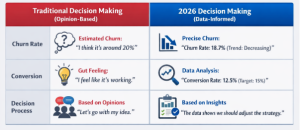
The era of “gut feeling” is over. Success in 2026 requires a deep dive into analytics. A great PO uses data to validate hypotheses and measure success.
| Skill Component | Importance in 2026 | Tools/Methods |
| A/B Testing | High | Optimizely, Google Optimize |
| User Analytics | Critical | Mixpanel, Hotjar |
| KPI Tracking | Essential | Burndown charts, Velocity, Net Promoter Score (NPS) |
4. Technical Literacy and AI Integration
You don’t need to write code, but you must understand how it’s built. With the rise of AI, POs in 2026 must know how to integrate machine learning and automation into their products.
- Understanding Technical Debt: Knowing when to slow down to fix the foundation so you can speed up later.
- AI Literacy: Understanding the capabilities and limitations of LLMs (Large Language Models) to enhance user experiences.
- Agile Proficiency: Deep knowledge of Scrum, Kanban, and Lean principles to keep the team lean and mean.
5. Mastery of Backlog Refinement
The backlog is the heartbeat of the product. A successful PO ensures the backlog is “DEEP” (Detailed appropriately, Estimated, Emergent, and Prioritized).
- User Story Mapping: Creating a visual representation of the user journey.
- Slicing Stories: Breaking down complex features into small, deliverable chunks of value.
- Prioritization Techniques: Using frameworks like MoSCoW (Must have, Should have, Could have, Won’t have) or the WSJF (Weighted Shortest Job First).
6. Empathy and Customer-Centricity
At the end of the day, products are built for people. Empathy is the skill that allows a PO to step into the user’s shoes.
- User Interviews: Conducting regular sessions to gather qualitative feedback.
- Persona Building: Creating detailed profiles of who is actually using the product.
- Design Thinking: Applying a human-centric approach to innovation.
7. Decisiveness and Ownership
The clue is in the name: Owner. You must take full accountability for the product’s success or failure. This requires the courage to make hard calls quickly.
- Speed over Perfection: In 2026, a “good” decision today is mostly better than a “perfect” decision next month.
- Empowerment: Trusting the Scrum team to handle the “How” while you focus on the “What.
How to Sharpen Your Skills for 2026
Knowing what skills you need is only half the battle. To stay competitive in the 2026 market, you need a proactive plan to improve.
Here are three practical ways to level up today:
- Get Certified: In a crowded job market, credibility is key. Opt for the CSPO certification course, which proves you have mastered the foundational frameworks.
- Practice Real-World Scenarios: Don’t wait for a crisis to practice your decision-making. Run “mock” sessions where you prioritize a messy backlog under a tight deadline, or role-play a difficult conversation where you have to say “No” to an aggressive stakeholder.
- Join Product Communities: You don’t have to learn in isolation. Join groups on LinkedIn, Slack, or local Meetups. Engaging with other Product Owners allows you to trade “war stories” and learn real-world shortcuts that you won’t find in any textbook.
Conclusion: Preparing for 2026
Becoming a top-tier Product Owner is a journey of continuous learning. The landscape of 2026 will be defined by rapid technological shifts and a relentless focus on the customer. By honing your strategic vision, mastering data, and leading with empathy, you won’t just manage a product; you will drive innovation.
Are you ready to lead? Start by auditing your current skill set. Identify one area, perhaps data analytics or stakeholder communication, and commit to improving it this month. The future of product management belongs to those who can bridge the gap between human needs and technical possibilities.