

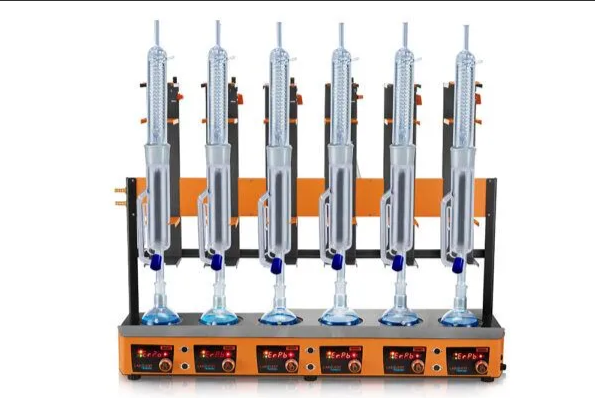
The Soxhlet Extraction apparatus is vital in the food and feed industries. It is specifically designed to extract soluble compounds from solid materials in an efficient manner. This method is highly valued for its accuracy and practicality. The apparatus allows researchers to separate desired substances without constant manual intervention. From food analysis to feed testing, the Soxhlet method remains a valuable resource for material research.
This guide explains the structure, functionality, applications, and advantages of the Soxhlet Extraction apparatus.
Understanding the Soxhlet Extraction Apparatus
The Soxhlet Extraction apparatus is a laboratory setup to extract specific compounds from a solid sample using a solvent. Unlike direct extraction methods, such as the Gutzeit Apparatus, this setup recycles the solvent multiple times, ensuring thorough and efficient separation.
Key Components
- Extraction Chamber: Houses the solid sample, packed in a porous material, such as a cellulose thimble.
- Condenser: It cools down the vapour and returns it to the liquid state.
- Round Bottom Flask: It holds the solvent and serves as the heating source during extraction.
- Siphon Tube: Siphons allow the solvent to be automatically recycled once filled in the extraction chamber.
How Does the Soxhlet Apparatus Work?
The process is straightforward: solvent evaporation, condensation, and recycling. Here’s the detailed step-by-step process of Soxhlet Extraction:
- Solvent Heating: The vaporisation is done by heating the solvent in the round-bottom flask.
- Condensation: The vapours moving into the condenser are cooled and transformed into the liquid phase.
- Extraction: The liquid solvent passes through the solid sample in the extraction chamber, dissolving the desired compounds.
- Siphoning: Once the solvent reaches a specific level, it is siphoned back into the round-bottom flask, along with the extracted compounds.
- Repetition: This cycle is repeated several times with increasing solvent concentration.
Applications of the Soxhlet Extraction Apparatus
The Soxhlet Extraction apparatus ensures reproducible and consistent results in several areas, simplifying the otherwise complicated sample preparation processes. The diversity of the Soxhlet technique makes it highly indispensable in several fields. Such fields include:
- Food Industry: In determining fat content in foodstuffs.
- Feed Industry: In assessing nutrient and fat content in animal feed.
Key Advantages of the Soxhlet Extraction Apparatus
The Soxhlet method offers several benefits, which make it a preferred choice in laboratories:
- Efficiency: Continuous recycling of the solvent ensures maximum extraction with minimal waste.
- Automation: Unlike manual methods, the apparatus requires minimal supervision once set up.
- Precision: Accurate separation of target compounds from complex matrices.
- Versatility: Adaptable to different solvents and solid materials.
These advantages have cemented its reputation as a gold standard for solvent extraction.
Best Practices for Using a Soxhlet Extraction Apparatus
To ensure optimal performance and accurate results, consider the following practices:
- Sample Preparation: Powder the solid sample to a fine and uniform size to improve its interaction with solvents. The cellulose thimble is cleaned in advance to prevent contamination.
- Solvent Selection: Select a solvent that effectively dissolves the target compound without interfering with the analysis. This includes boiling point, polarity, and toxicity considerations.
- Setup and Maintenance: Ensure tight seals between the components to prevent solvent loss. Regularly inspect the condenser and siphon tube for blockages or leaks.
Limitations of the Soxhlet Extraction Apparatus
While the Soxhlet method offers numerous advantages, it also has some limitations:
- Time-Intensive: The process requires several hours to complete, especially for high sample volumes.
- Solvent Dependency: The choice of solvent can significantly impact both the efficiency and safety of the extraction process.
- Energy Consumption: Prolonged heating increases energy usage, making it less eco-friendly than modern techniques, such as microwave-assisted extraction.
Comparing Soxhlet Extraction to Other Methods
This comparison highlights the advantages of the Soxhlet method, particularly for research requiring high precision and efficiency.
| Feature | Soxhlet Extraction | Liquid-Liquid Extraction | Supercritical Fluid Extraction |
| Automation | Semi-automatic | Manual | Fully automatic |
| Solvent Efficiency | High | Moderate | Low |
| Time Requirement | High | Low | Low |
| Sample Volume | Moderate to large | Small | Large |
| Cost | Moderate | Low | High |
Selecting the Right Soxhlet Extraction Apparatus
When choosing a Soxhlet apparatus, consider the following factors:
- Volume Requirements: Ensure the round-bottom flask and extraction chamber are compatible with your sample size.
- Material: High-quality borosilicate glass enhances durability and chemical resistance.
- Compliance: Opt for equipment from leading manufacturers, such as Borosil Scientific, to ensure it meets recognised standards, like IS 10640.
For labs requiring versatile solutions, apparatuses with interchangeable joints offer flexibility for varying experimental setups.
Future Trends in Soxhlet Extraction
Innovations in Soxhlet extraction are targeted to overcome its current limitations, which include:
-
Enhanced Material and Design: Advancements in Borosilicate 3.3 glass and durable joint designs make Soxhlet apparatuses more resistant to thermal stress and mechanical damage, ensuring longer operational life.
- Automation Enhancements: Minimising energy consumption and human intervention.
- Hybrid Systems: Combining Soxhlet principles with advanced methods like ultrasonic or microwave-assisted extraction.
These advancements promise to make the Soxhlet method even more efficient and sustainable.
Conclusion
The Soxhlet Extraction apparatus remains a vital tool in scientific research, offering precise and efficient separation of compounds. Its versatility makes it suitable for various industries, from food analysis to feed analysis. Researchers can maximise their potential by understanding its functionality and following best practices.
Whether you’re exploring the Soxhlet method or looking to expand your lab’s capabilities, explore what premium manufacturers like Borosil Scientific have to offer.