

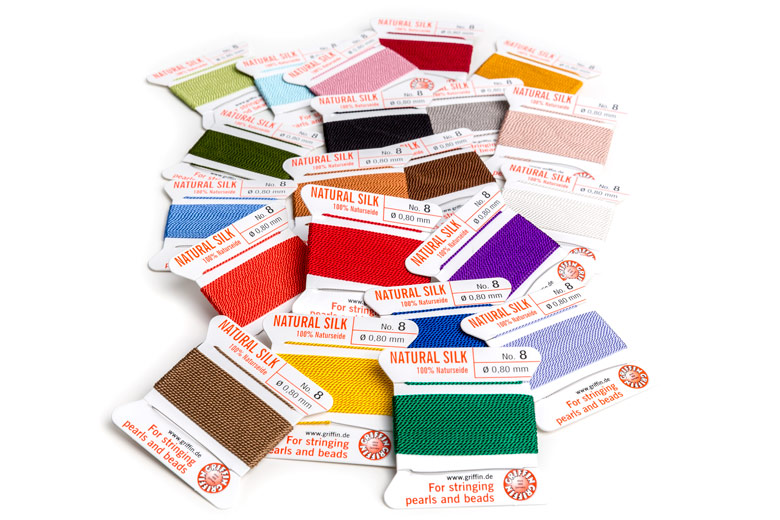
In jewellery making, most materials come and go. Tools get updated. Techniques evolve. But walk into a professional pearl stringing studio today and ask what cord is on the bench, and there’s a strong chance the answer is the same one it would have been fifty years ago: GRIFFIN Natural Silk. That kind of staying power doesn’t happen by accident. This article looks at what makes GRIFFIN’s 100% Natural Silk Bead Cord the default choice for serious jewellers, why no synthetic has fully replaced it for pearl work, and how to pick the right size for your next project.
150 Years of GRIFFIN Natural Silk: Why Nothing Has Replaced It
GRIFFIN was founded in 1866 in Schramberg, Germany, by Carl Schinle. The company’s core product was, and still is, a triple-twisted silk bead cord with a pre-attached needle. Five generations of the same family have overseen production since then, and the fundamental design of that original cord hasn’t been changed. That’s not inertia. It’s evidence.
In over 150 years of professional jewellers use across the world, the jewellery industry has tested GRIFFIN Natural Silk against every synthetic alternative that’s come to market. Nylon, polyester, elastic, wire and hybrid cords have all been evaluated and, for many applications, adopted. Yet for traditional pearl stringing and fine gemstone knotting, GRIFFIN Natural Silk has stayed the professional benchmark. The reasons are material, not sentimental.
- Natural protein structure: Silk is chemically compatible with the nacre of natural and cultured pearls. Unlike synthetic cords, it doesn’t degrade the pearl surface over time through chemical interaction.
- Drape and suppleness: Filament silk drapes naturally, allowing a knotted pearl necklace to move and fall correctly when worn. Synthetic cords, even high-quality ones, tend to hold a stiffer shape.
- Knot behaviour: Silk holds tight, clean overhand knots between beads without slipping. The Z-Twist triple construction positions each knot securely and consistently, maintaining even spacing across a strand.
- Longevity with proper care: A pearl necklace strung on GRIFFIN Natural Silk and worn regularly can last decades before needing restringing. That lifespan is hard to match with most alternatives.
The longevity of professional trust in this material is, in itself, a form of quality assurance that no laboratory test can fully replicate.
The Science of Triple-Twisted Filament Silk
Not all silk cord is the same, and in professional jewellery work the difference matters significantly. GRIFFIN Natural Silk is made exclusively from filament silk – thread drawn from the centre of the silkworm cocoon, where fibres are longest, most continuous and most lustrous. Spun silk, which uses shorter, broken fibres, produces a less consistent thread that’s more likely to pill and fray. Filament silk does neither.
GRIFFIN’s Z-Twist triple construction is the second critical element. The cord is twisted three times during manufacture under precisely controlled tension, giving the finished cord its characteristic round, smooth profile, each card comes 2 metres length and attached with a beading needle. It doesn’t fray at cut ends, doesn’t tangle in use and holds knots with consistent firmness regardless of size.
The practical consequences of this construction are visible at the bench:
- The cord passes through bead holes cleanly without catching or snagging
- Overhand knots tighten to a uniform, compact form that sits neatly against each bead
- The cord retains its round profile throughout a long strand, rather than flattening between beads as spun alternatives sometimes do
- The pre-attached stainless steel needle, included on every 2 metres card, threads through even the finest pearl holes without requiring doubling or separate needle threading
These aren’t minor conveniences. At a professional bench, where a single strand may involve forty or more individual knots, cord behaviour determines the quality and consistency of the finished piece.
Why GRIFFIN Natural Silk Is the Default for Pearl Jewellery Repair
Pearl necklace restringing is one of the most common repair requests in fine jewellery. A well-worn pearl necklace, strung and knotted correctly, typically needs restringing every two to five years depending on how often it’s worn. For a jeweller offering this service, cord selection isn’t a creative choice – it’s a technical and professional one.
GRIFFIN Natural Silk dominates professional repair work for three specific reasons. First, it’s what most fine pearl necklaces were originally strung on, so restringing with the same material preserves the original drape and character of the piece. Second, it comes in 13 precisely calibrated sizes from No. 0 (0.30mm) to No. 16 (1.05mm), allowing an exact match to virtually any pearl necklace regardless of origin or age. Third, its consistency across batches means a cord size used on a repair today will behave identically to the same size used on the original piece years earlier.
For jewellers who market their repair services as like-for-like professional work, GRIFFIN Natural Silk isn’t optional. It’s the standard.
Expert Tips: Choosing the Right GRIFFIN Silk Cord Size
The correct cord size is the largest diameter that passes through the bead hole twice – once in each direction when knotting – with slight resistance. A cord that goes through too freely won’t hold a knot snugly against the bead; one that’s too tight risks damaging the drill hole over time. As a starting reference:
- No. 0 (0.30mm): Tiny seed pearls, very fine freshwater pearl strands with narrow drill holes
- No. 1 (0.35mm): Very fine seed pearls and micro-drilled freshwater pearls
- No. 2 (0.45mm): Small freshwater pearls, delicate seed pearl strands
- No. 3 (0.50mm): Fine freshwater pearls, small drilled semi-precious beads
- No. 4 (0.60mm): Standard freshwater pearls, light gemstone beads
- No. 5 (0.65mm): Medium freshwater pearls, lighter cultured pearl strands
- No. 6 (0.70mm): Medium cultured Akoya pearls, standard gemstone beads
- No. 7 (0.75mm): Standard cultured Akoya pearls, medium-weight gemstone beads
- No. 8 (0.80mm): Larger Akoya pearls, most standard cultured pearl strands
- No. 10 (0.90mm): South Sea and larger cultured pearls, heavier gemstones
- No. 12 (0.98mm): Large South Sea pearls, heavy gemstone strands
- No. 14 (1.00mm) and No. 16 (1.05mm): Large South Sea, Baroque and oversized pearls
When working with an unfamiliar pearl, test two adjacent sizes before starting the strand. Thread both through a bead from the lot and check the fit. Go with the size that passes through with slight resistance but doesn’t need force. When you’re between sizes, always choose the larger one for better knot security.
Colour matching matters too, particularly in repair work. GRIFFIN Natural Silk comes in 21 colours. For pearl work, white, cream and beige cover the majority of applications. For coloured or dyed pearl strands, match the thread as closely as possible to the predominant tone of the pearl so the knots read as part of the strand, not as interruptions to it.
For the complete GRIFFIN Natural Silk range in all 21 colours and 13 sizes, visit https://www.griffin1866store.com/collections/carded-bead-cord-pack-of-10-pieces