

Most exhibitors spend months planning their product, their pitch, and their giveaways.
Then they spend 20 minutes picking a booth.
That order of priorities is backwards because the booth is the first thing every buyer, distributor, and decision-maker sees before they hear a single word from your team. And the choice between a pop-up booth and a modular system is not just a budget decision. It is a strategic one that affects how you show up at every event for the next three to five years.
Why This Decision Is More Important Than Most Exhibitors Realize
Here is what nobody tells first-time exhibitors: your booth is not a backdrop for your brand. It is the argument your brand makes before your team opens their mouth.
A buyer walking a busy trade show floor is making split-second decisions about which booths are worth slowing down for. A well-built, professionally presented booth signals that the company behind it is serious, established, and worth a conversation. A setup that looks temporary or pieced together signals the opposite and that signal is almost impossible to reverse once the buyer has already walked past.
The pop-up vs modular decision is where that signal gets set.
The Pop-Up Booth: Built for Speed, Consistency, and the Reality of a Full Event Calendar
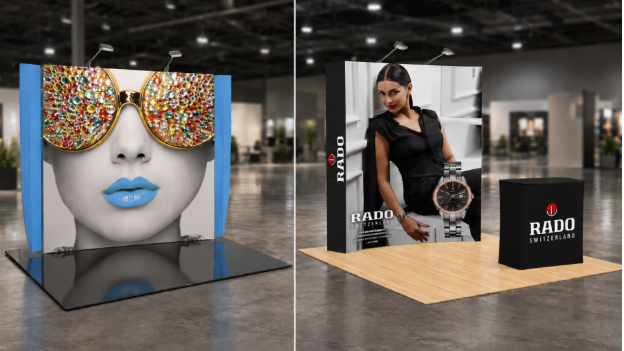
A pop-up booth is a complete branded display that one person can have standing in under 20 minutes without tools, without instructions, and without a second pair of hands.
The frame unfolds and locks into position on its own. The stretch fabric graphic, printed in full-color dye-sublimation, attaches directly to the frame and pulls tight across the surface. The result is a seamless, professional branded backdrop available in sizes from 8 feet wide to 20 feet wide that travels in a wheeled carry case fitting in most car trunks.
What makes pop-up booths the dominant choice for small and mid-size exhibitors is not just the setup speed. It is the consistency. The same booth that represents your brand at a trade show display in Toronto looks identical at an expo in Calgary six weeks later and a regional show in Halifax after that. Same graphic quality, same professional finish, same brand presentation, regardless of venue, city, or how exhausted your team is from the travel.
Where pop-up booths genuinely outperform modular systems:
- Standard 10ft booth allocations where a modular system’s flexibility goes completely unused
- Multi-city event schedules where transport weight and setup time directly affect operational costs
- Brands whose core visual asset is a strong backdrop graphic rather than physical product displays
- First-year exhibitors who need professional results without a five-figure upfront investment
The limitation that actually matters: A pop-up booth is a fixed configuration. The frame size you order is the frame size you have at every show, in every space, for as long as you use it. The moment your booth allocation changes, your product display needs grow, or your event presence needs to scale, the pop-up reaches its ceiling fast.
The Modular System: Built for Scale, Flexibility, and the Long Game
A modular booth system is built from interlocking components, fabric panels, aluminum connectors, shelving units, counter surfaces, and monitor mounts that assemble into different configurations depending on the event.
The same hardware that builds a 10×10 inline display at one show reconfigures into a 10×20 peninsula layout at the next, and a curved island exhibit at the show after that. No new purchase required. Just a different assembly.
This reconfigurability is what justifies the higher cost of modular systems for the right buyer. A company attending three or four major industry events per year with varying booth sizes is not paying for a single configuration. They are paying for an entire event presence system that adapts across every show on the calendar.
Modular systems also support accessories that pop-up booths cannot. Built-in product shelving at multiple heights. Locking storage below counter level. Integrated LED lighting that highlights specific display zones. Monitor mounts for product demo screens. These are the features that turn a booth from a branded backdrop into a fully functional sales environment and they matter enormously for companies displaying physical products that buyers need to see, touch, and interact with.
For exhibitors who also run outdoor activations, modular systems work naturally alongside a custom tent, with the custom tent providing protection from the elements and strong brand visibility, while the modular system creates a premium indoor environment at the same event.
Where modular systems justify every dollar of the higher investment:
- Booth allocations of 10×20 and above where configuration flexibility is actually used
- Product-driven companies where physical display at multiple heights drives purchase decisions
- Brands attending the same major annual shows for multiple years, the per-show cost drops significantly over time
- Organizations with a dedicated event team who manage setup as part of their core responsibilities
The limitation that actually matters
Modular systems require 2 to 4 people and 1 to 4 hours to set up depending on the configuration complexity. They ship in hard cases rather than carry bags. And for exhibitors attending standard 10ft booth shows, the flexibility advantage is never actually used which means the higher cost produces no additional return.
The Question That Cuts Through All of It
Forget the comparison table. Forget the feature lists.
Ask yourself one question: does my event strategy require the same booth to work differently at different shows?
If the answer is no, your booth space is consistent, your display needs are stable, and your team is small, a pop-up booth delivers professional results at a fraction of the cost and effort.
If the answer is yes, your booth sizes vary, your product display needs to evolve, and your events include major industry shows where premium presentation directly influences buyer perception, a modular system is the investment that pays back across a full event season.
The worst decision is choosing based on what looks more impressive in a product photo. Choose based on your actual event calendar, your actual team size, and the actual impression your brand needs to make on the specific floor you are walking onto.
That discipline of matching the tool to the job rather than the aspiration is what separates exhibitors who win on the trade show floor from the ones who spend a lot of money looking like they tried.