

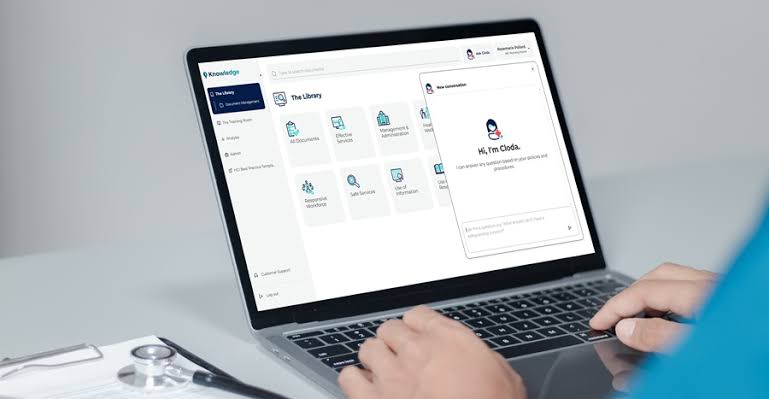
Healthcare administrative workflows are essentially a continuous fight against the ever-present unstructured data. Hospitals, clinics, and health insurance companies face the challenge of an overwhelming and disorganized influx of medical charts, hand-signed intake forms, legacy faxes, and clinical notes every single day. These documents, when arriving in bulk, result in a costly operational delay where a great deal of staff time is wasted, and patient care is compromised.
As a result, modern healthcare providers are stepping away from simple OCR-based document scanning. Instead, they are adopting new capabilities of Intelligent Document Processing Software (IDP). Besides just scanning documents, such enterprise software is also capable of reading medical documents on a human-level, understanding such documents at a very deep level so that they can initiate the processing of the documents’ workflow, such as filing, extracting key patient data, and even integrating the data directly into Electronic Health Records (EHR) and billing systems.
What is more, these systems significantly contribute to speeding up Automated Customer Onboarding (or patient registration). By instantly parsing insurance cards, identification documents, and medical histories right at the digital front door, they ensure that care delivery begins without administrative delays.
If your organization is looking to conquer healthcare document chaos, here are eight of the best processing platforms leading the industry.
1. ABBYY Document AI
ABBYY brings more than 35 years of document processing experience to every classification challenge, and that depth shows in the results. Rather than adapting a general-purpose model to documents, ABBYY built its technology specifically for the job, powering its intelligent document processing with purpose-built AI that combines best-of-breed models optimized for every step of the pipeline. Its multimodal classification analyzes both text and image features, so the platform recognizes and organizes mixed document types accurately, then routes each file to the right extraction model. You get 90% accuracy from day one, support for over 200 languages, and human-in-the-loop continuous learning that sharpens the models with every correction your team makes.
For mid-market and enterprise buyers, this combination of proven experience and purpose-built precision translates into reliable, explainable outcomes at scale. ABBYY processes structured, semi-structured, and unstructured documents with consistency you can trust in compliance-critical workflows. Industry analysts back this up: Gartner named ABBYY a Leader in its inaugural Magic Quadrant for Intelligent Document Processing Solutions, and IDC MarketScape, Everest Group, and Quadrant Knowledge Solutions have each recognized the company’s leadership as well. If you want a platform engineered specifically to classify and process documents at enterprise scale, ABBYY sets the standard.
2. Hyperscience (Hypercell)
Hyperscience approaches healthcare automation with a strict “Accuracy-First” philosophy, making it a premier choice for high-stakes clinical and billing pipelines. Operating on its flagship Hypercell platform, Hyperscience routinely delivers a 99.5% data extraction accuracy rate alongside up to 98% automation rates.
The platform is uniquely optimized to transcribe fields that leave traditional software completely stuck, such as messy physician handwriting, low-quality faxed documents, and crumpled receipts. At the structural level, Hypercell uses modular processing blocks to evaluate document layouts, dynamically separating composite patient files into specific classifications. If the AI encounters a deeply ambiguous or corrupted page, its intelligent exception routing immediately loops in a human reviewer, ensuring that compromised data never updates a patient’s medical profile.
3. Nanonets
Nanonets is an agile, template-free IDP platform trusted by major healthcare and pharmaceutical systems globally. What makes Nanonets highly effective for medical administrators is its advanced use of autonomous AI agents that handle document processing from ingestion to delivery without rigid configuration rules.
Nanonets easily reads varying payer layouts, instantly identifying patient eligibility and checking prior authorization rules against complex insurance guidelines. For patient intake, Nanonets acts as a central engine for Automated Customer Onboarding, instantly extracting data from insurance cards and referral records to pre-populate clinical software. Because it is completely HIPAA-compliant by design, all extraction happens securely within approved digital boundaries, reducing overall claim denials by up to 40%.
4. Kofax
Kofax TotalAgility is a deeply mature Intelligent Process Automation (IPA) platform built to manage intensive, high-volume document pipelines. It unifies cognitive capture, natural language processing (NLP), and native process orchestration within a secure cloud-ready architecture.
In a healthcare context, Kofax excels at extracting entity relationships and understanding the overall intent behind unstructured text communications. Whether an organization is receiving a legal medical record, a complex multi-page insurance claim, or an external physician referral email, Kofax classifies the content in real time. It automatically checks for sensitive personal health information (PHI) and applies precise data privacy and security settings across a fully verifiable audit trail.
5. Google Cloud Document AI
Google’s platform infuses world-class machine learning infrastructure into the healthcare document pipeline. Using foundational generative AI models, Google Document AI specializes in semantic classification, meaning it looks past the literal words on a page to comprehend the underlying medical context across dozens of native languages.
Google features an integrated “Active Learning” system. Whenever a medical clerk corrects a misclassified document or adjusts an extracted field, the underlying AI model absorbs that feedback and updates its training matrix in real time. This continuous learning loop makes it a highly scalable solution for large hospital networks that require their automation engines to become progressively sharper over time.
6. UiPath
For healthcare groups that want to link document sorting directly to automated digital workflows, UiPath is a natural market leader. Its Document Understanding tool seamlessly blends advanced machine learning models directly into UiPath’s extensive Robotic Process Automation (RPA) suite.
When a multi-page patient packet hits the system, UiPath reads the pages, splits the files into distinct document types, and extracts relevant text strings. From there, UiPath’s software “robots” instantly execute downstream administrative tasks, such as logging directly into legacy health portals to update a patient’s chart, submitting a clean claim to a payer, or initiating billing codes without a human having to touch a keyboard.
7. Microsoft Azure AI Document Intelligence
Deeply embedded within the enterprise Microsoft cloud ecosystem, Azure AI Document Intelligence uses advanced machine learning to transform unstructured health documentation into structured data assets. It is highly optimized for recognizing structural key-value pairs within standard medical forms, clinical scripts, and medical identification cards.
Because it is built directly on Azure, it provides native, friction-free connections to core enterprise repositories like SharePoint, Microsoft 365, and custom internal SQL databases. Once the system classifies an incoming document, the extracted data is piped directly into active databases, allowing doctors and care teams to view updated patient analytics on demand.
8. Rossum
Rossum stands out as an AI-first, layout-neutral document automation platform designed to master unstructured document chaos. Unlike legacy tools that require hours of template mapping for every different insurance provider or vendor, Rossum uses cognitive neural networks to locate data contextually.
This makes it exceptionally powerful for processing international medical supply bills, multi-page shipping manifests, and non-standard clinical intake paperwork. Rossum dramatically reduces the need for manual data cleanup, allowing healthcare administrative teams to maximize their straight-through processing rates and maintain accurate financial ledgers with minimal operational effort.
Conclusion
Making medical staff do manual data entry from old paperwork in today’s healthcare is not only a costly wastage of resources but also a factor that negatively affects the pace of patient care. With a purpose-built Intelligent Document Processing Software, healthcare systems can fully automate their intake pipelines. When you implement a solution that comprehends not only the visual structure of your documents but also the medical context, your healthcare organization stands to eliminate back-office inefficiencies, safeguard patient privacy, and ensure that your care delivery pipeline runs at full speed.
Frequently asked questions
Should we deploy document classification in the cloud or on-premises?
The right choice depends on your security posture, data residency rules, and IT resources. Cloud and API deployment give you fast setup, easy scaling, and lower maintenance overhead, which suits teams that want quick results. On-premises deployment keeps data inside your own infrastructure, an advantage for organizations with strict regulatory or sovereignty requirements. Vendors that offer cloud, on-premises, and containerized options let you adapt as your needs change, so you avoid locking yourself into a single model.
How does document classification fit into a broader intelligent automation or intelligent document processing (IDP) strategy?
Classification is the routing layer of intelligent document processing, sitting between document intake and data extraction. Once the system identifies and sorts each file, it assigns the right extraction model, validates the data, and passes clean information to your downstream automation. Treating classification as one stage in an end-to-end IDP pipeline, rather than a standalone tool, helps you raise straight-through processing rates and build a foundation for wider automation initiatives.
Can document classification software support multi-language and global operations?
Yes. Enterprise-grade platforms recognize and classify documents across many languages, with the strongest options supporting more than 200, so you can standardize processing across regions. This matters for global teams that handle invoices, contracts, and forms in different languages through a single workflow. When you evaluate vendors, confirm coverage for the specific languages your operations rely on and check that accuracy holds steady across all of them.