

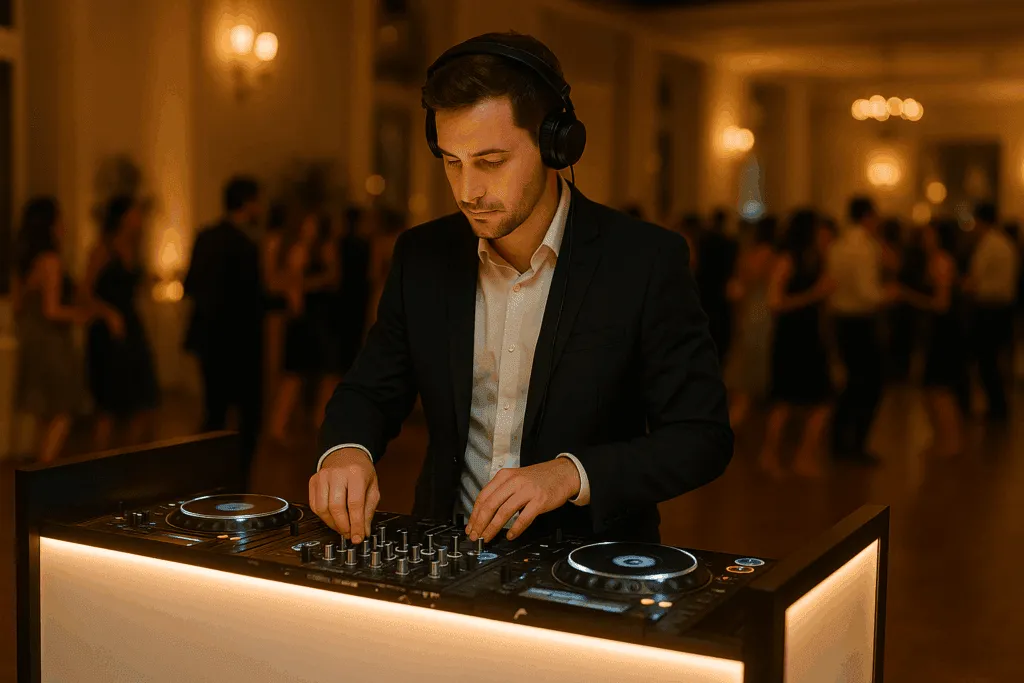
Corporate events rarely fail because the canapé selection was uninspired. They stumble when the energy in the room doesn’t shift at the right moments—when dinner drags, networking feels forced, or the “fun part” arrives with no runway. The best corporate DJs don’t just play tracks; they manage momentum. Think of them as the event’s pacing mechanism, quietly guiding guests from presentation mode to celebration mode without anyone feeling herded.
Below is how skilled DJs create that smooth transition—and what to look for if you want your next event to feel polished and genuinely enjoyable.
The DJ as the “energy conductor,” not background entertainment
A corporate event has multiple “rooms,” even if it’s all in one space: arrival, networking, content, awards, dinner, and social. Each segment needs its own energy level and sound profile. A good DJ understands that music isn’t a constant—it’s a variable you use to influence behaviour.
Arrival sets the tone faster than signage ever will
When guests walk in, they’re scanning: Is this formal? Relaxed? High-status? Comfortable? Music answers those questions instantly. The right arrival set achieves three things:
- Masks awkward silence while people find colleagues and settle in
- Establishes brand tone (modern, premium, playful, global, etc.)
- Keeps conversation easy by staying out of the vocal range and at a sensible volume
It’s subtle, but it matters. If the opening soundscape is off—too loud, too clubby, or too sleepy—you spend the rest of the night trying to correct the vibe.
Micro-transitions are where flow is won or lost
The most overlooked moments are the 60–90 second gaps: walking to seats, the pause after a keynote, resetting the stage for an award, staff clearing plates. These are the points where energy can leak out of the room.
Experienced DJs use “micro-transitions”—short, purposeful music cues—to smooth those seams. A clean instrumental swell as people take their seats. A confident stinger when an award winner is announced. A warm, steady bed during a photo moment. Done well, it feels like the event is running itself.
Designing a musical arc that matches the agenda
You wouldn’t schedule the CEO keynote right after the dessert course. Music deserves the same strategic thinking: it should follow an arc.
Formal segments need structure, not just silence
For presentations, panels, or awards, music should be used like punctuation. The DJ’s job is to:
- Support attention (minimal distraction during content)
- Create clear “chapter breaks” between segments
- Help stage management by cueing entrances/exits and keeping timing tight
This is where a DJ who can also act as a measured MC (or work closely with one) becomes invaluable. A confident voice on the mic is less about hype and more about clarity: who’s next, where to look, when to applaud, what’s happening now.
Dinner is a bridge, not a lull
Dinner is often where corporate events lose people. Guests are happy, but energy flattens. The solution isn’t blasting bangers over the starter—it’s building a bridge.
A capable DJ will gradually increase tempo and familiarity across courses, reading the room as they go. You want music that encourages conversation at first, then subtly raises the collective pulse so the post-dinner shift feels natural rather than abrupt.
Around this stage—when you’re planning how the night should move—it helps to review what strong corporate-focused DJs typically provide beyond a playlist. Resources like DJs for business events and corporate functions can be useful for understanding the different service levels, from low-key background sets to full production-style support, and what questions you should be asking before you book.
The technical side: sound, lighting, and timing are part of “flow”
Music choices matter, but flow often comes down to operations: what guests hear, when they hear it, and how cleanly changes happen.
Sound management is guest management
Corporate crowds are mixed: extroverts, introverts, different ages, different cultures, varying comfort with loud environments. A DJ who understands corporate etiquette controls volume like a dial, not a switch.
They’ll also plan for:
- Even coverage across the room (so one table isn’t in a speaker hotspot)
- Speech intelligibility (EQ, mic choice, and feedback control)
- Seamless handoffs between AV and DJ audio, avoiding dead air or sudden jumps
A common failure mode is treating speeches and music as separate systems. The best events unify them.
Lighting changes how “formal” a room feels
Want the room to stop feeling like a conference and start feeling social? Lighting does that in seconds. Even modest uplighting or a warmer wash can transform a space, especially after dinner. Good DJs coordinate lighting changes with the agenda: brighter and cleaner for awards; warmer and more dynamic for the social segment.
Timing: the DJ is often the unofficial stage manager
Corporate event schedules are living documents. Speakers run long, awards change order, the CEO wants five extra minutes. A seasoned DJ adapts without making the audience feel the change.
They’ll have flexible playlists, quick-access cue points, and the instincts to extend a segment (or tighten it) while keeping the atmosphere stable.
Reading the room: how the best DJs move people without forcing it
The hardest part isn’t playing “good music.” It’s playing the right music for this group, in this moment, while preserving professionalism.
Inclusivity beats niche cool
Corporate dance floors aren’t about impressing music nerds. They’re about creating a shared space where colleagues feel comfortable joining in. That usually means a mix of eras, genres, and cultural touchpoints—sequenced intelligently so it never sounds random.
The “permission to have fun” moment
People often need a cue that it’s acceptable to shift gears from work mode. That cue can be:
- the end of the last formal announcement, followed by an immediate musical lift
- a well-timed classic that signals familiarity and safety
- a brief, confident mic line (not cringe, not club-hype) that invites rather than pressures
When that moment lands, the dance floor becomes a social catalyst: teams mix, hierarchy softens, and the event delivers the relationship-building it was meant to create.
What to ask before you book a corporate DJ
One set of practical questions can prevent most disappointments:
- How do you handle transitions between speeches, awards, and music—do you work from a run-of-show?
- What’s your approach to volume and sound coverage in a mixed-use room?
- Can you provide clean mic audio and manage walk-on/walk-off cues?
- How do you build a set for a mixed demographic without losing momentum?
- What’s your contingency plan if the schedule changes on the night?
A corporate DJ’s real value shows up in those answers—because seamless flow is rarely accidental.
The takeaway: flow is engineered, not improvised
When a corporate event feels effortless, it’s usually because someone engineered the pacing. DJs sit at the crossroads of atmosphere, timing, and social energy. They translate an agenda into a lived experience—guiding guests from polite conversation to genuine connection, and from formal messaging to a night people actually remember.
If you want that “how did it feel so smooth?” effect, treat the DJ as part of your event’s choreography, not a last-minute add-on. That’s where seamless comes from.