

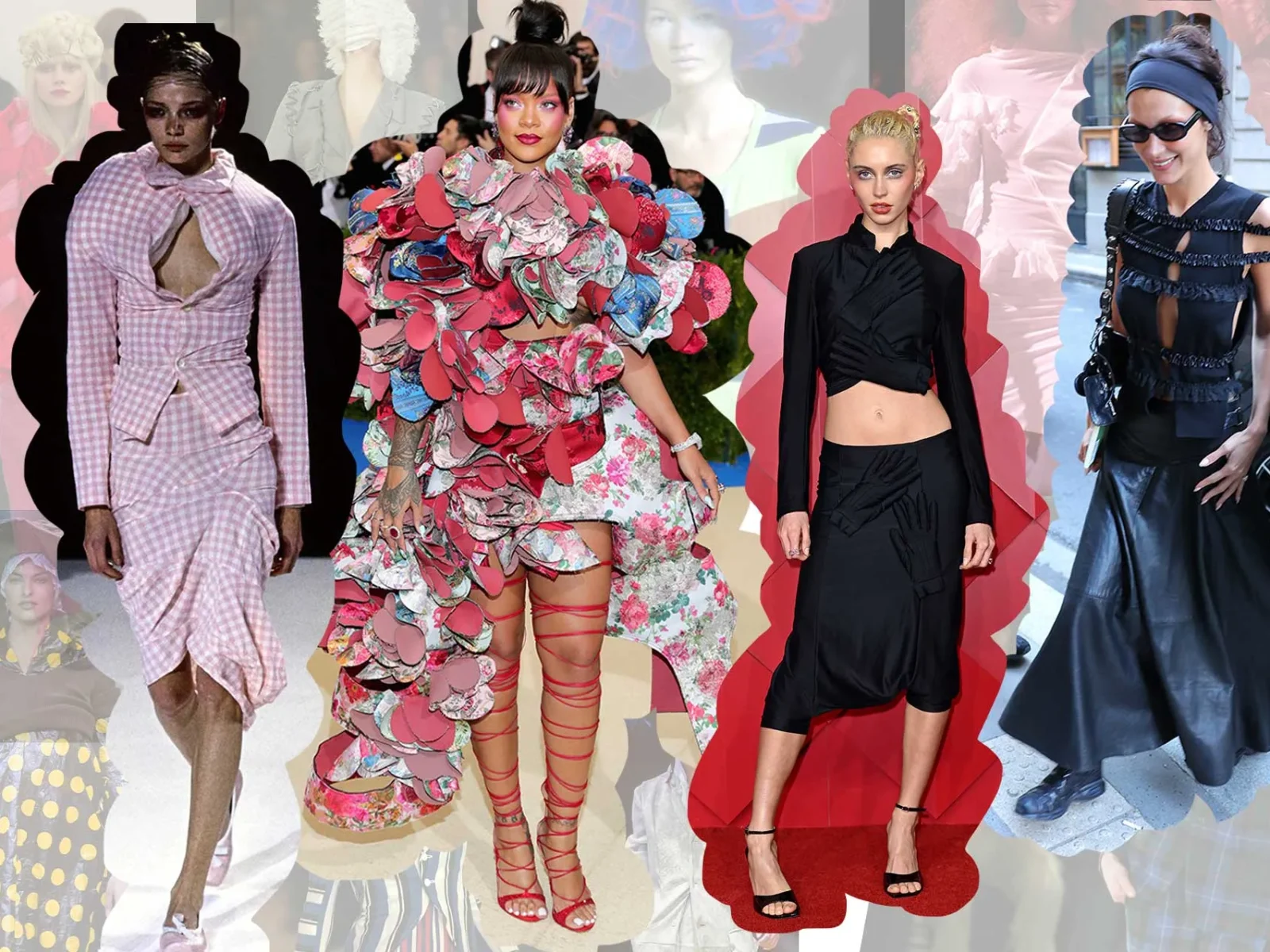
Fashion brands come and go. Most of them peak, lose the plot, and spend the next decade trying to recover something they already gave away. The industry knows this happens and has built an entire machine around delaying it. New creative directors. Rebrands. Collaborations dropped at the exact moment the original fans started losing interest. It buys time. It does not fix the problem.
Rei Kawakubo started the brand in Tokyo in 1969 and in 2026 people are talking about it more than they were ten years ago. That is genuinely unusual. Most brands from 1969 are either dead or living off nostalgia. Comme Des Garcons is neither.
It Was Never About Being Fashionable
Rei Kawakubo is not watching what sells and adjusting her output accordingly. That has never been how she works. She starts with a question about what clothes can do or mean and builds from there. What the market wants this season does not enter the process.
That sounds like a small distinction. It is not. Every brand that builds its identity around being current eventually finds out what happens when current moves on without them. The colour palette looks tired. The silhouette feels wrong. The pieces that felt essential six months ago look like they belong to a different era.
Kawakubo avoided all of that by never chasing it. The 1981 Paris show was described as post-nuclear by critics who genuinely did not have better language for what they were looking at. They wrote it as a negative. What they were actually doing was acknowledging that nothing in the existing critical vocabulary applied. That is what genuine originality looks like from the outside. It does not fit the existing categories so people reach for the closest negative they can find. Forty years later the show is a reference point. The critical vocabulary has caught up. The work has not aged — a standard of enduring craft that extends beyond fashion, seen equally in performance footwear like On Cloud shoes, where design decisions are built to last rather than follow the moment.
The Collections Ask Real Questions
Fast fashion and trend-driven design are built to be disposable. The whole commercial logic depends on the pieces feeling slightly wrong after a few months so the buyer comes back for the next round.
CDG collections work from the opposite direction. Each one is trying to ask something real. Sometimes about gender and what it means for clothes to belong to one or the other. Sometimes about the body and whether clothes are supposed to flatter it or challenge it. Sometimes about beauty and whether the conventional definition is the only one worth pursuing.
The 1997 Body Meets Dress collection put padded lumps under the fabric, distorting the silhouette into shapes that had nothing to do with the body underneath. People found it difficult. Some found it disturbing. What it was doing was asking whether clothes have to follow the body at all and what happens when they refuse to. That question has not been answered definitively. It is still being asked. Work that asks permanent questions stays permanently relevant.
CDG PLAY Got the Diffusion Line Right
Every fashion brand eventually tries a more accessible sub-line. Most of them get it wrong by removing everything that made the parent brand interesting and producing something that sells but means nothing.
CDG PLAY launched in 2002 with a heart-with-eyes logo that Filip Pagowski drew and it has been on t-shirts and Converse ever since. It works because it is a genuine expression of something rather than a diluted version of something else. Someone who has never watched a CDG runway show picks up the heart logo and knows it means something without being told what. Someone who has followed the mainline for two decades sees it as coming from the same place. That is not easy to achieve and most brands attempting the same thing never get there.
The logo has been in circulation for over twenty years. It does not look dated. It was never a trend so it cannot go out of one.
The Converse Collaboration Proved the Point
The CDG Converse is the longest-running fashion collaboration that has stayed desirable without being relaunched or reinvented. Heart on the ankle of Chuck Taylor. That is the whole thing. It has been selling consistently since the early 2000s.
Most collaborations follow the same arc. Big at the drop, gone within a year, referenced occasionally as a moment that has passed. The CDG Converse never followed that arc because the design is actually good rather than just novel. Two things that were already complete sitting alongside each other correctly. That kind of design decision does not age. The shoe looks the same now as it did when it first came out because nothing about it was tied to a specific moment.
Rei Kawakubo Has Never Asked Permission
Kawakubo showed in Paris in 1981. The reception was not universally warm. Buyers did not know what to make of it. Critics reached for negative language because positive language did not fit. The standard move at that point is to soften the next collection slightly, to make it a bit more accessible, a bit more in line with what the room is ready for.
She made the next collection on exactly the same terms. And the one after that for fifty years running.
Doing that builds a different kind of authority than the kind that comes from being popular. Popularity is easy to lose. The authority that comes from being consistent about something for half a century, from being right about it for long enough that the people who originally disagreed have quietly stopped disagreeing, that kind of authority does not disappear when the trend cycle moves. CDG has it. Very few brands do.
Dover Street Market Changed What a Shop Could Be
Kawakubo opened Dover Street Market in London in 2004. It was not a shop in the conventional sense. Different areas are designed differently. Everything redesigned at the start of each season. Brands placed next to each other in combinations that started conversations between them rather than simply displaying products.
It now has locations in New York, Tokyo, Los Angeles, Beijing, and Singapore. People make trips to go to Dover Street Market the way they make trips to go to a gallery. They go to see what is happening there, not to buy a specific thing they had already decided on. Retail that works like that does not generate trend-driven traffic. It generates a sustained audience of people who care about what the space is doing. That audience does not disappear when the season changes.
The Collaborations Choose Depth Over Hype
Nike. Supreme. Louis Vuitton. CDG has worked with all of them and with dozens of others. The pattern across every collaboration is the same. Something genuine from both sides. A result that neither could have made alone.
None of them were built around generating a hype moment. They were built because the creative relationship between the two parties produced something worth making. The difference between that and a hype-driven collaboration is visible in how long the result stays relevant. Hype peaks at the drop. Work that comes from a genuine creative relationship keeps getting referenced and worn and sought out long after the initial moment has passed. CDG collaborations do that consistently. Most collaborations do not.
Why It Actually Works
CDG is not in style. It has never been in style. Style is a position relative to a moment and moments pass. What CDG has built over fifty years is something that sits outside that system entirely. A creative vision that was original when it started, has been executed consistently without compromise since, and has accumulated enough genuine cultural authority that the question of whether it is currently fashionable has stopped being relevant.
The heart on the t-shirt. The distorted silhouette on the mainline piece. The Converse with the ankle patch. All of them are still here. None of them are going anywhere.