

Introduction
The journey from prototype to mass production is a critical juncture for hardware startups and procurement managers. A common, yet costly, pitfall at this stage is over-reliance on digital manufacturing platforms for complex processes like metal bending services. While convenient for prototypes, this model often leads to unpredictable cost escalations, inconsistent quality, and delays during scale-up. The core issue lies in the automated, broker-based model which struggles with the nuanced engineering required for precision sheet metal fabrication, especially in managing challenges like springback.
This article provides a strategic framework to move beyond simple platform quoting. It advocates for evaluating manufacturing partners based on direct factory capabilities, engineering depth, and certification systems to build a reliable, cost-effective supply chain. To make an informed choice, one must first understand the hidden factors that derail budgets and schedules.
What Are the Hidden Costs of Using Digital Brokers for Metal Bending Mass Production?
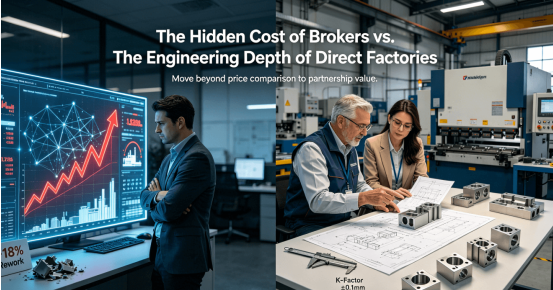
While digital brokers excel in prototyping speed, their model unravels under the demands of mass production, revealing a landscape of hidden expenses. The apparent convenience masks a “platform premium”—a markup of 20-30% added for matching and coordination services. More insidiously, the lack of expert-led manual DFM review at the quoting stage leads to catastrophic downstream costs. Without an engineer experienced in on demand metal bending scrutinizing the design for manufacturability, issues like suboptimal bend sequences or incorrect K-factors are missed.
This results in high scrap rates, costly rework, and material waste. A case in point involved an automotive components supplier facing an 18% rework rate on platform-sourced brackets, leading to six-figure annual losses. After switching to a direct manufacturer for metal bending that controlled the entire process, they achieved cost reductions of 20-30%, underscoring the value of transparency. The trend towards disintermediation for efficiency, as noted in McKinsey’s research on manufacturing’s future, validates this direct partnership approach.
How Does Springback Compensation Separate Amateur from Expert Metal Bending Services?
The fundamental challenge in precision sheet metal bending is springback—the tendency of metal to slightly return to its original shape after bending. While all software includes K-factor estimations, true expertise lies beyond presets. For custom metal bending service projects with tight tolerances or high-strength materials, automated calculations often fail. Expert process engineers separate themselves by combining empirical knowledge with physical simulation to manually calculate and compensate for springback, achieving consistent tolerances within ±0.1mm.
This deep, experiential mastery of material behavior and tooling interaction is typically found only within dedicated metal bending manufacturer teams, not dispersed across a platform’s network of subcontractors. The academic principle, as discussed in resources like MIT’s design and manufacturing courses, confirms that geometric precision is a core engineering challenge solved by controlled process knowledge, not software alone.
Beyond the Quote: What Should a True DFM Review Include for Complex Bending Projects?
A true Design for Manufacturability (DFM) review is a preventive engineering consultation, not an automated checklist.
Essential Components of a True DFM Review
A genuine DFM review for complex bends is a proactive engineering activity beyond automated checks. It is a cornerstone of value-added metal bending services.
- Design & Process Optimization
This technical pillar includes bend sequence simulation, K-factor optimization accounting for material grain, and fixture design advice, especially vital for successful low volume production sheet metal bending.
- Compatibility & Risk Assessment
It also requires pre-assessing finishing compatibility (e.g., post-bend coating) to prevent defects like cracking at bend radii, mitigating risks before manufacturing begins.
Case Study: Real-World Impact
The value is proven in practice. A medical device firm faced dimensional errors in a multi-bend part from a platform. An engineering-focused partner’s manual DFM pinpointed stress accumulation. By revising the bend sequence and tooling pre-production, scrap was eliminated, showcasing how deep analysis prevents costly changes and ensures success.
ISO 9001 vs. IATF 16949: Why Do Certifications Matter in Precision Sheet Metal Fabrication?
Quality certifications are not mere badges; they are proxies for a manufacturer’s systemic approach to defect avoidance. While ISO 9001 outlines a basic quality management system, industry-specific standards like IATF 16949 certified metal fabrication (automotive) and AS9100D (aerospace) are far more rigorous. They mandate proactive methodologies like Advanced Product Quality Planning (APQP) and Failure Mode and Effect Analysis (FMEA), requiring manufacturers to design and control their processes to prevent errors. For a hardware company in regulated sectors, choosing a partner with IATF 16949 means its systems for sheet metal fabrication are built for traceability, statistical process control, and continuous improvement—essential for complex, safety-critical bent and welded assemblies. Industry-leading manufacturers often hold multiple such certifications, forming the bedrock of their delivery reliability.
Case Study: How a Surgical Lamp Manufacturer Solved Precision Bending Tolerances and Saved $150,000 Annually
A Tier-1 surgical instrument manufacturer faced severe quality issues with a critical adjuster arm component. Sourced through a digital platform, the parts suffered from inconsistent tolerances (±0.25mm) and a 22% rejection rate after anodizing due to micro-cracks on bend lines. The root cause was the subcontractor’s inadequate springback compensation and use of standard tooling. The manufacturer switched to a direct partner with a background in AS9100D and ISO 13485 certified production.
The partner’s engineering team employed multi-physics simulation for precise springback compensation and used specialized urethane pad tooling to eliminate surface indentation. This integrated approach stabilized tolerances to within ±0.1mm and reduced the annual procurement cost by over $150,000, while ensuring production line stability. This case exemplifies the value of partnering with a metal bending manufacturer that controls the entire smart manufacturing ecosystem. Discover how precision bending is managed within a full-chain manufacturing process here.
A Practical Checklist: Evaluating Your Next Metal Bending Partner in 2026
Decision-makers should use this checklist to objectively compare platforms against top metal bending services from direct manufacturers.
Core Partner Evaluation Dimensions
This section assesses a partner’s foundational credentials. The critical first check is Ownership & Control—verifying it is a direct factory, not a broker, for full oversight. Integral to this is Engineering Depth, confirmed by the offer of a free, manual DFM review from in-house experts. Equally vital are its Quality Systems, evidenced by certifications (e.g., ISO 9001, IATF 16949) that signal a systemic, preventive quality approach.
Technical & Operational Capabilities
- Manufacturing Process & Capacity
This evaluates physical execution. Technical Capability is quantified by maximum bending tonnage, length, and material thickness. Process Control quality is ensured through protocols like First Article Inspection Reports (FAIR) and Coordinate Measuring Machine (CMM) validation.
- Service Flexibility & Scope
This examines operational policies. Flexibility is shown in the low volume production/prototype MOQ policy. End-to-End Ability is confirmed by offering in-house ancillary services (e.g., laser cutting, welding, finishing), which streamline production and enhance quality control.
Conclusion
In 2026, the paradigm for sourcing custom metal bending service is shifting from convenience to value and reliability. For hardware companies seeking predictable costs, top-tier precision, and supply chain transparency, bypassing intermediaries to build relationships with direct manufacturing partners is a strategic imperative. These partners, with deep engineering sedimentary deposits , rigorous quality systems, and full-process control, turn manufacturing challenges into product advantages. This approach not only avoids hidden costs but also builds a sustainable competitive edge through superior quality and partnership.
Author Bio
The author is an expert in precision manufacturing with over two decades of experience in complex metal component fabrication. The author’s manufacturing group, LS Manufacturing, holds ISO 9001, IATF 16949, AS9100D, and ISO 14001 certifications. It specializes in providing high-precision metal bending and manufacturing solutions from prototype to mass production through its integrated smart factory ecosystem for global hardware startups and enterprises.
Looking for a trustworthy manufacturing partner that provides deep engineering support and guarantees precise delivery for your next hardware project? Upload your 3D CAD files today to receive a free expert DFM review and a competitive factory-direct quote. Experience the difference firsthand.
FAQs
Q: What is the main advantage of using a direct factory over a platform like Xometry for metal bending?
A: The primary advantage is cost transparency and control. Direct factories eliminate the platform markup (often 20-30% for production volumes) and provide engineering insights that automated platforms cannot. A direct partner with in-house engineering can perform manual DFM analysis, accurately compensate for material springback, and control the entire process from blanking to bending and finishing, ensuring consistent quality and preventing costly late-stage changes. This leads to a lower total cost of ownership (TCO) and more predictable outcomes for production runs. Platforms, while excellent for prototyping speed, often rely on a network of subcontractors for bending, which can introduce variability in quality and communication delays.
Q: How can I ensure bending accuracy, especially for thin or high-strength materials?
A: Ensuring accuracy requires a combination of advanced equipment, skilled process engineering, and in-process monitoring. Key factors include: 1) Expert Springback Calculation: Experienced engineers must manually determine the K-factor and pre-compensate in the CNC program, as material properties vary. 2) Precision Tooling: Using sharp, well-maintained dies and specialized urethane pads can prevent surface indentation on materials like stainless steel or anodized aluminum. 3) Real-Time Monitoring: Modern press brakes with angle measurement systems automatically correct deviations during production. Partnering with a manufacturer that employs these practices and has certifications like IATF 16949 (which mandates process control) is the best guarantee for achieving tolerances as tight as ±0.1mm.
Q: What are the minimum order quantities (MOQ) typically offered by direct metal bending manufacturers?
A: MOQs vary significantly. Pure production shops may have high MOQs (e.g., 500+ pieces) to justify setup costs. However, forward-thinking manufacturers serving the hardware startup and R&D sector often offer much greater flexibility. Many now support low-volume production runs starting from 10-50 pieces, thanks to CNC quick-change tooling and flexible manufacturing cells. It’s crucial to clarify this upfront. The ideal partner should accommodate both prototyping needs and scale seamlessly into the thousands without requiring a disruptive supplier change.
Q: How do quality certifications like IATF 16949 impact the actual quality of bent sheet metal parts?
A: Certifications are a proxy for a systematic, preventive approach to quality, not just final inspection. IATF 16949, for example, mandates core tools like Advanced Product Quality Planning (APQR), Failure Mode and Effects Analysis (FMEA), and Statistical Process Control (SPC). For metal bending, this translates to: thorough process design before production begins, identifying and mitigating risks like cracking or springback variation, and continuously monitoring key parameters (tonnage, angle) during the run to prevent defects. This system-based approach, required by automotive and medical clients, delivers far greater consistency and first-pass yield compared to a shop that only does post-production inspection.
Q: What file format and information should I provide to get the most accurate quote for a custom metal bending project?
A: To receive a fast and accurate quote, provide a 3D CAD file (STEP or IGES preferred) along with a 2D drawing. The drawing should clearly specify: material type and grade, thickness, finish requirements, and all critical dimensions with tolerances. For the quote to be truly valuable, also share your target application, expected annual volume, and any critical performance needs (e.g., must withstand certain loads, mate with other assemblies). This context allows a skilled manufacturer to provide Design for Manufacturing (DFM) feedback that can optimize the part for cost, manufacturability, and function, turning a simple quote into a valuable engineering consultation.