

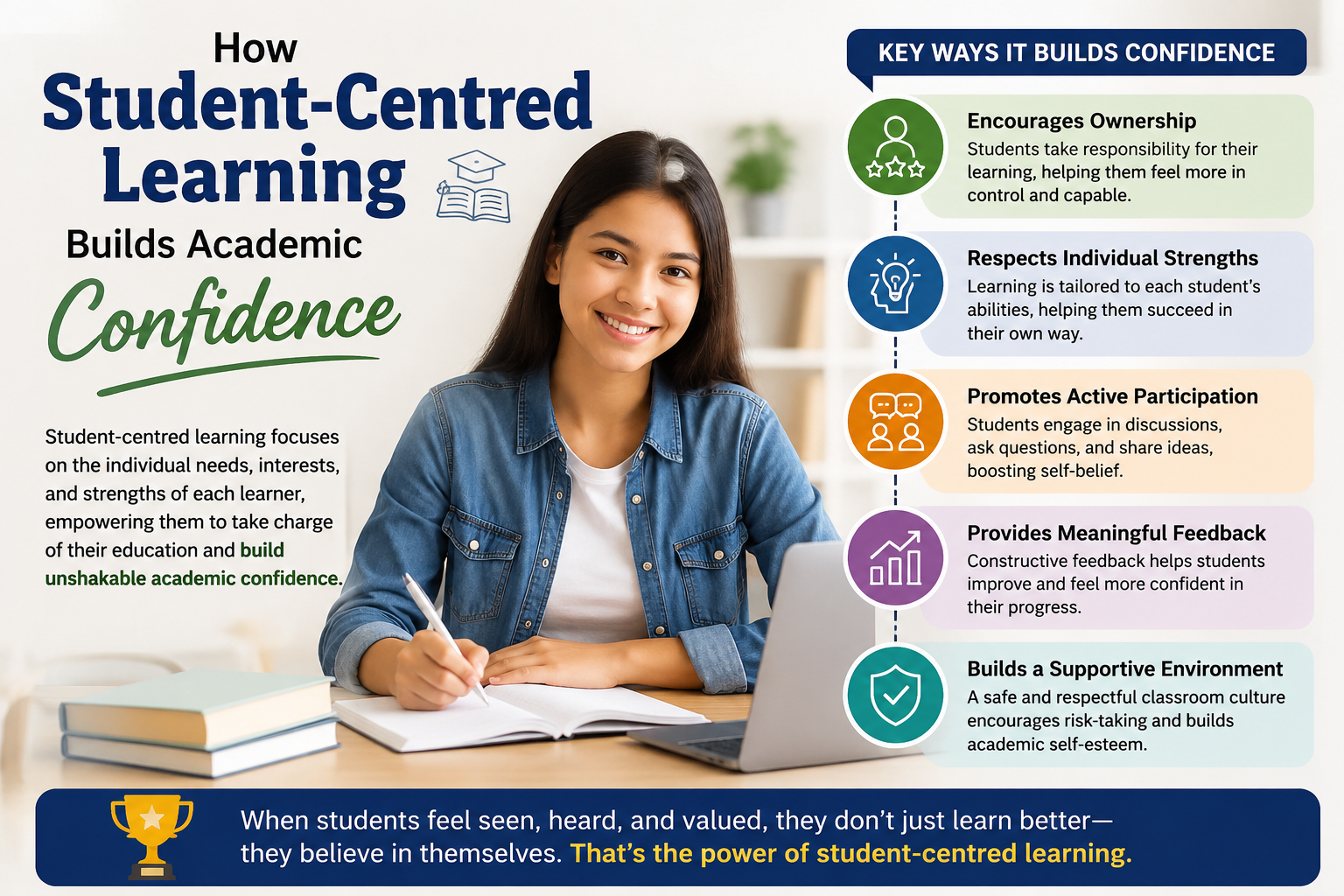
One cannot build confidence in learning in one day. It thrives under the support, encouragement, and active involvement of students in the learning process. Different children will learn differently, which means by appreciating these differences, educators are able to provide experiences that will enable students to engage with the learning experience more willingly. Children are more ready to develop new ideas and cope with academic obstacles when they trust in their abilities.
To most families considering a private school, student-centered learning is a factor as the learner becomes a central element of the learning process. Rather than passively acquiring knowledge through conventional teaching techniques, this model will motivate students to engage actively in the learning process, train their individuality and minds to think independently, and create self-confidence to reach their academic objectives.
Learning Becomes More Meaningful When Students Take Ownership
Student-centered learning will help to make the children more active participants as opposed to passive listeners. They are provided with a chance to ask questions, give ideas, and contribute to discussions in class. This interactive learning aids students in learning the concepts in a better way and makes learning an exciting activity as opposed to a boring chore.
Learning ownership also educates students to be responsible for their learning. They start to establish their personal objectives, monitor their success, and also know what they can do to achieve better. Students are more likely to be motivated to further learn and to be more confident to confront new challenges as they realize their own progress.
Personalised Guidance Strengthens Academic Confidence
All students are at different levels. Others learn fast, and others may need further elaboration of the learning or practical demonstrations. Student-centered learning enables instructors to customize the approach to their instructional direction, so that each child is supported and motivated in attaining their finest potential.
Instead of comparing the students to each other, teachers work on the improvement of each learner, starting with his or her initial position. A positive environment of achievement, frequent promotion, and realistic learning objectives establishes a constructive way of life in which the students feel nurtured. The practice allows lessening the fear of mistakes and promotes constant academic growth.
Building Confidence Through Active Participation
Academic confidence is boosted when the students are incited to use what they learn in ways that are meaningful. They do not merely memorize information but rather engage in discussions, group tasks, presentations, research projects, and problem-solving tasks. These are the experiences that enable students to showcase their knowledge while enhancing their communication and critical thinking abilities.
Parents like school that promotes active participation, usually a private school that allows the children to open up and give their ideas. The more students feel comfortable enough to contribute towards classroom activities, the more they gain confidence in their academic capabilities, decision-making skills, and self-belief.
Classroom Practices That Support Student-Centred Learning
Student-centered learning develops around daily application of teaching activities which foster participation, independence, and constant development. The approaches ensure that the students develop confidence and learning becomes significant and interesting.
- Goal Setting Promotes Ongoing Improvement
Students will be more motivated when they strive towards attainable and explicit learning objectives. Having personal goals helps them to remain focused and also acknowledge their personal progress in the learning process.
- Independent Learning Is Strengthened Through Reflection
Reflecting on work done enables students to know their strengths and weaknesses in their work. This practice promotes confidence in self-awareness and enables learners to be more confident in managing their academic process.
- Group Work Is a Confidence Builder
The collaboration with one another helps students to share ideas and solve problems collectively and learn through different viewpoints. Teamwork and communication skills are also enhanced by collaboration.
- Positive Feedback Spurs Development
Effective and constructive feedback enables students to know what they need to do better without becoming demoralized. Constant mentoring instills trust, coupled with motivating the students to keep on honing their skills.
- Real-World Learning Creates Better Understanding
Relating classroom activities to real-life situations makes students know the importance of whatever they are learning. Practicing the knowledge in real life makes it more engaging and reinforces the knowledge in the long term.
Developing Lifelong Learners Through Academic Confidence
Academic confidence not only enhances classroom performance. It teaches students to be independent learners who are not afraid of new ideas, are ready to adjust to new circumstances, and take challenges positively. Children gain confidence in themselves and get stronger to cope with failures and to pursue their objectives. Such a mentality promotes an attitude to lifelong learning and enables students to excel in various areas and grade levels.
Student-centered learning also equips children with future opportunities as they are made responsible, curious, as well as self-motivated. Rather than being given instruction based on the guidance of a teacher, the students are taught how to take control of their learning process, be critical, and determine the options available. These attributes are still useful years after school and aid students to excel at their further studies, jobs, and life overall with power and mission.
Conclusion
Student-centered learning helps develop academic confidence because students are focused on their learning process. By actively engaging, providing each form of guidance individually, giving meaningful feedback, and enabling them to own their learning process and take charge, children become more confident, motivated, and able to learn. This practice will not just transform academic performance, but will create the ability and mentality to succeed in life.
For families seeking an enriching educational experience, One World International School (OWIS) offers student-centered learning where all children are motivated to develop confidently, and families who prefer to have a rich learning experience. OWIS helps students to achieve their potential through skilled teachers, one-on-one instruction, and academic curricula that are recognized on the international level. Its internationally acclaimed IBDP program also provides highly qualified senior students with high-quality critical thinking, research, and independent learning skills to proceed to university and meet the competition in an ever-growing interconnected world.