

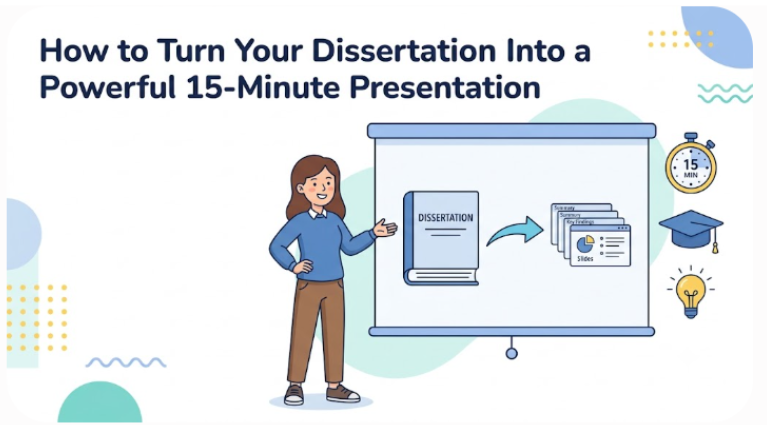
Your dissertation represents months—often years—of painstaking research, analysis, and late-night writing. Distilling all that hard work into a clear, convincing 15-minute presentation can feel overwhelming. Yet, it’s also your best opportunity to highlight the real value of your research and demonstrate your mastery of the subject.
Through our work providing dissertation writing services at Affordable Dissertation UK, we see the same pattern every year: the most successful presentations aren’t the ones packed with dozens of slides, but the ones built around a single, crystal-clear message.
Introduction
An international survey of doctoral candidates shows that the mock defence is the single most effective way to prepare, followed by a formal preparatory course; yet, only about a quarter (25% ) of candidates practise with a mock examination before their defence. (Lantsoght, 2022).
This dissertation presentation guide offers a practical and step-by-step approach to building a talk that captures the audience’s attention and shows them the worth of your work, whether you are preparing a master’s dissertation presentation or a doctoral defence.
How to Make a Dissertation Presentation Impactful
Plan Your Presentation with Purpose
Before you open PowerPoint or Keynote, take time to think through the structure and core message of your presentation. This preparatory phase is crucial for a successful defence or conference talk.
Define Your Core Message
Fifteen minutes is not enough to convey all the information about your dissertation. So, your task is to summarise the research. Write a 25-word summary of your work that answers the following questions: what did you find, and why does it matter? What is your work, and why is it important? This is a summary that will serve as the ‘beacon’ guiding your entire presentation.
For an oral dissertation presentation, instead of stating that your dissertation is about the connection between social media and adolescent mental health, you could state that “Restricting social media to 2 hours a day or less reduces by 34% anxiety symptoms in adolescents”.
Structure Your Presentation Logically
A clear, logical dissertation presentation format helps your audience follow your argument. A recommended structure for a 15-minute dissertation presentation includes:
- Introduction (2 minutes): Establish your research problem and state your research question clearly
- Literature Review (2 minutes): Highlight key studies and define the research gap
- Methodology (2 minutes): Summarise your research design and data collection methods
- Findings (5 minutes): Present your key results using visuals
- Discussion and Conclusion (4 minutes): Interpret findings and state implications
This structure mirrors your dissertation chapters, making it familiar to you and your examiners.
Understand What Examiners Look For
During a dissertation defense presentation, your committee evaluates the procedure more than your findings. They also assess your reasoning, and they want evidence that you understand why you made each decision and can defend it. Common dissertation presentation questions include:
- What led you to your research question?
- Why did you choose this particular methodology?
- What are the limitations of your approach?
- How does your research contribute to the field?
Anticipating these questions helps you prepare a more robust presentation.
Choose Effective Preparation Methods
Lantsoght (2022) examined how doctoral candidates prepare for their defence and the effectiveness of different preparation strategies. The research revealed the following preparation patterns among candidates:
| Preparation Method | Percentage of Candidates |
| Supervisor advice | 73% |
| Conference presentations | 71% |
| Internal seminars | 53% |
| Reading PhD advice books | 47% |
| Mock defence | 25% |
| Family advice | 10% |
| Viva preparation workshops | 7% |
Design Clear and Impactful Slides
The slides are not the presentation; they are a visual tool to help you present. These should be clear, concise, and visually interesting.
The structure of the dissertation presentation slides should carry the argument, not your script. . Each slide should convey one key idea. Key slides typically include:
- Title Slide: Your name, dissertation title, department, university, and date
- Introduction: Background, significance of the research problem, and research question
- Literature Review: Key studies and the research gap your work addresses
- Methodology: Research design, participants, and data collection methods
- Findings: Key results using charts, graphs, or tables
- Discussion: Interpretation of findings and connection to research question
- Conclusion: Implications and contribution to the field
- References: Brief list of key works cited
- Thank You and Questions: Open the floor for questions
Follow Best Practices for Slide Design
A polished presentation enhances your credibility.
- Minimise text: Avoid using long sentences; use bullet points or short phrases. A useful discipline is the 7×7 rule: limit the number of lines of text on a slide to seven, and limit the number of words on each line to seven.
- Use visuals: Make use of charts, graphs, and images to represent complex information more effectively than in text.
- Use consistency: Use a clean sans-serif font for readability; stick to the same style across your slides.
- Proofread carefully: Misspelt words, grammatical mistakes, and errors distract the panel and undermine an otherwise strong case.
Dissertation Presentation Examples
Example 1: Minimise Text (The 7×7 Rule in Action)
- Focus on key points; do not fill your slide with everything you know. See the dos and don’ts below.
Example 2: Use Visuals (Replacing Text-Heavy Data)
- Better to add a visual graph instead of detailed paragraphs. It looks catchy instead of boring. See the example below.
Example 3: Maintain Consistency and Proofread
- Do not make silly mistakes. Align your content properly and check every slide. Proofread it before submitting.
Deliver with Confidence and Authority
The delivery of the presentation is as important as its content. A well-practised and confident delivery will make a lasting impact.
Practise Thoroughly
Practice is essential to a good defence. Theo and Hambulo (2025) found that, when combined with institutional arrangements, structured rehearsal, skills training, and formative feedback from supervisors significantly reduced candidate anxiety and improved performance.
- Time yourself: Ensure your presentation fits comfortably within the 15-minute limit. Aim to finish about one minute early to allow for smooth transitions.
- Present to a practice audience: A mock defence with colleagues or friends provides valuable feedback on both content and delivery.
- Record yourself: Watching your recording helps you identify and adjust awkward phrasing or pacing issues.
Refine Your Delivery Style
When you deliver your research effectively, it is much more accessible and interesting.
- Talk with conviction: Do not be afraid to express yourself; be aware of and prepared for any setbacks, and be ready to answer questions candidly. It is OK to state, “I don’t know,” and then go on to suggest an approach or a direction for further research.
- Interact with the audience: Make eye contact with the panel; communicate clearly and directly to the panel. Do not read from the slides. Slides are for a visually oriented audience, not for a reading audience.
- Professionally conduct the Q&A meeting: treat it as a conversation rather than an interrogation.
Listen to the whole question carefully; Take time to think; then answer directly. If a question is not clear, it is acceptable to ask for more clarification.
It also helps to rehearse the three hardest dissertation presentation questions you hope nobody asks, usually about a sample size, an inconvenient result, or a methodological compromise. Answering those calmly, and acknowledging the limitation before the panel has to point it out, does more for your credibility than any slide.
Build a Professional Presence
Your conduct on the day frames your research. Dress professionally, and make your presentation free from distractions. Arrive early enough to check that technology is working and that the presentation displays correctly on the room’s screen.
Conclusion
Creating a 15-minute master’s dissertation presentation or a PhD dissertation defense presentation is a significant challenge, but it is also a powerful opportunity to showcase your scholarly achievement. For a second opinion before the day, online dissertation help from The Academic Papers UK would be a good option to get feedback on your presentation and its structure. The main ideas of the dissertation presentation guide are:
- Decide on a main message before creating the slides.
- Use the structure of your presentation to reflect the chapters of your dissertation. Use mock defences and preparatory courses, the best preparation methods.
- Create crisp, aesthetically pleasing PowerPoint slides to accompany speech(s). Be prepared and perform with assurance
Your examiners want you to be successful; they are invested in your progress as a researcher. Come into your defence with confidence, preparation and knowledge that you’ve done the work and that you know your research more than anyone in the room.
Looking for a last-minute tutor for your dissertation defence? Please feel free to reach out to our academic writing team for customised marking of your presentation slides and structure. Also reach out if you require a fully formatted PowerPoint dissertation presentation template.
Frequently Asked Questions (FAQs)
How long should a dissertation presentation be?
The average presentation for a dissertation is about 15 minutes and some institutions may permit 20-25 minutes. Please refer to the specific guidelines of your programme as these are final guidelines. When presenting at a conference, time is frequently a hard deadline.
How many slides should a dissertation presentation have?
A 15-minute presentation should use about 10-15 slides. This means you get about a minute to talk for each slide, and slightly more time for slides with your key findings and discussion points. Keep slides to no more than 15 – this can lead to rushing through content.
How to present dissertation findings effectively?
Present two or three key results rather than everything in your analysis. Use clear visuals (charts or graphs) and clearly state what the visual represents and how it supports your research question. Do not display raw data tables; instead, display summarised and interpreted data.
What questions are commonly asked after a dissertation presentation?
Your committee members will likely ask you questions regarding your methodology, the importance of your results, comparisons to previously published research, possible limitations of your study, and recommendations for further research. You’ll be able to confidently answer these kinds of questions if you prepare good answers to each of them.
What is the difference between a dissertation presentation and a viva?
A dissertation presentation is a 15-20 minute formal summary of your research to an audience. A viva voce (viva) is an oral examination of the candidate’s work, which may be quite lengthy (1–3 hours) and is usually conducted by a selected committee of examiners who ask the candidate detailed questions about his/her dissertation. The viva is normally held in private with the examination panel.