

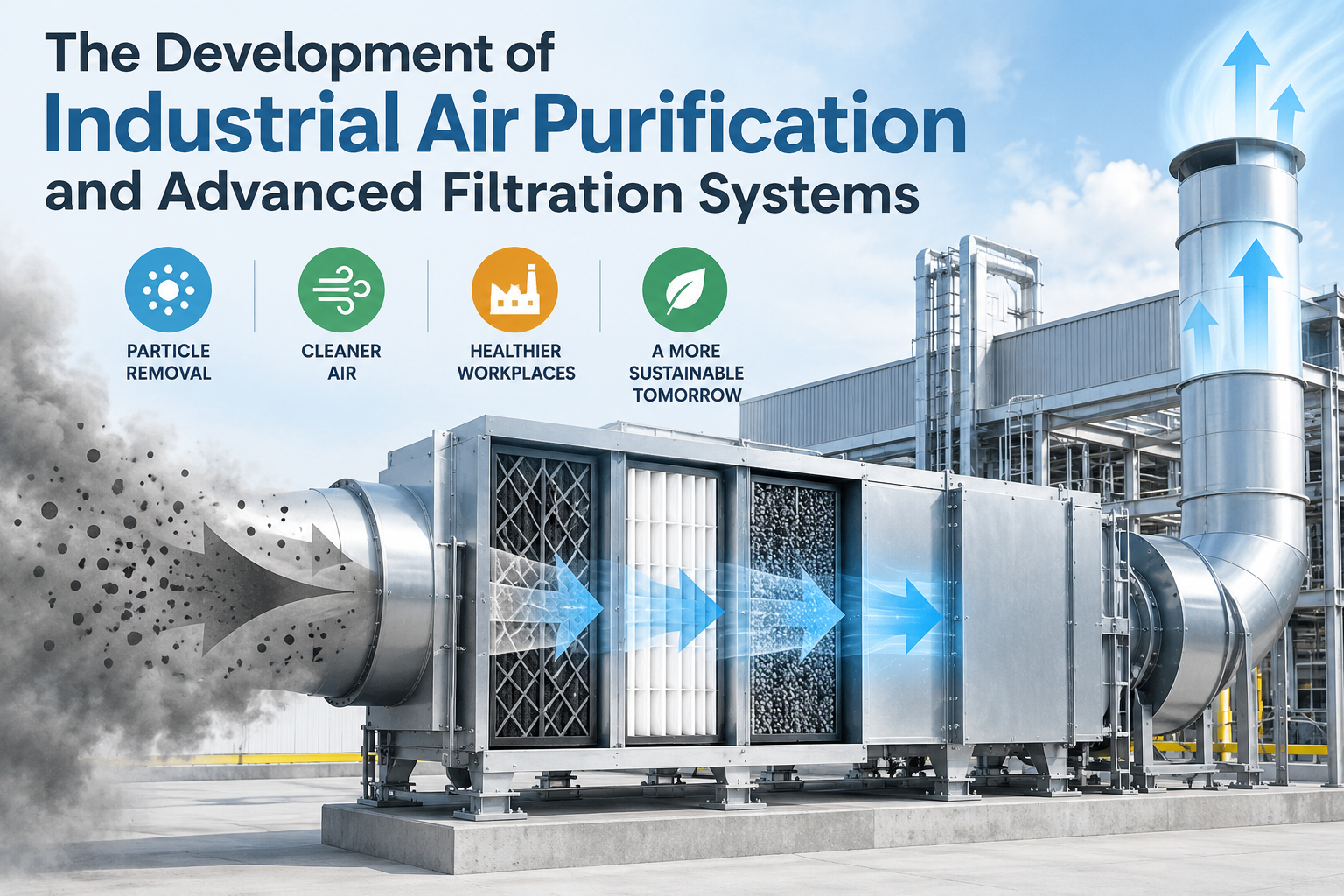
In today’s precision-driven industrial landscape, air quality directly impacts product quality, regulatory compliance, worker safety, and operational efficiency. From semiconductor cleanrooms and pharmaceutical production lines to food processing facilities and commercial HVAC systems, businesses in every industry are investing in more robust air management strategies. As contamination control standards become more stringent and energy costs continue to rise, the choice of filtration technology has become a key operational decision.
At the heart of nearly all modern industrial air purification systems is the HEPA Filter, a technology famous for its outstanding ability to trap microscopic airborne particles. Originating in the 1940s for nuclear research facilities, this high-efficiency filtration solution has evolved through decades of material and design innovation, expanding from specialized military and scientific use into mainstream industrial and commercial applications. It is still the world’s gold standard for high-efficiency particulate air control.
Performance? Efficiency Ratings and Standards
Modern high-efficiency filters are categorized by internationally recognized standards like ISO 29463 and EN 1822, which evaluate units based on their capacity to eliminate particles of the most penetrating size, usually 0.3 micrometers. Higher grade models have a minimum removal efficiency of 99.995% or better at this particle size. Premium grade units have a minimum removal efficiency of 99.97% at this particle size. Such performance guaranties the effective removal of the smallest of damaging particulates such as bacteria, fine dust and aerosolized contaminants from the airstream.
What differentiates professional-grade filtration solutions is not just raw efficiency, but the capability to provide that performance over time without excessive energy consumption. The lower pressure drop directly results in lower fan energy use, a major factor in the long-term cost of operation. Advanced manufacturing techniques, optimized pleat geometry, and high performance filter media all play a role in achieving the balance of maximum efficiency with minimal airflow resistance.
Custom Design for Different Industrial Applications
Industrial air filtration is not one size fits all. Each operating environment has different requirements on the equipment and solutions need to be engineered to suit the particular conditions.
In high temperature manufacturing processes such as powder coating, oven exhaust or industrial drying, filtration units must be constructed with heat resistant media and heavy duty frames that retain structural integrity at elevated temperatures. In pharmaceutical and biotech facilities, filters must comply with strict sanitary requirements, with non-shedding media and gel-seal designs to prevent bypass leakage and full compliance with GMP guidelines. In electronics manufacturing and cleanroom operations, anti-static properties are crucial to prevent electrostatic discharge from damaging sensitive components.
In addition to core filtration performance, installation, replacement and on-site testing ease are also key considerations. Modular frame designs, quick-change gasket systems, and compatibility with industry-standard testing methods help reduce downtime and simplify routine maintenance.
Maximizing Value With Proper Maintenance and System Design Even the highest quality filtration equipment will underperform without proper system design and regular maintenance. Pre-filtration is key to prolonging the service life of final-stage filters by removing larger dust particles before they reach the high-efficiency media. Monitoring differential pressure across the filter bank offers a dependable, data-driven approach to identifying the best time to replace filters, preventing premature replacement and ensuring sufficient airflow from the filter units.
Another important practice is regular integrity testing, usually by aerosol methods such as DOP or PAO. Such tests detect even minor leaks in the filter media or seal that may compromise cleanroom performance. Proactive testing and maintenance not only protects product quality but also allows facilities to plan maintenance budgets more accurately and avoid unplanned downtime.
What’s Next: Filtration Technology Innovations
The future of industrial air filtration will revolve around three key areas: energy efficiency, sustainability, and smart connectivity. Manufacturers are creating next-generation media with the same or better filtration performance but even lower airflow resistance, enabling facilities to shrink their carbon footprint and cut energy bills. There is also increasing demand for more environmentally friendly filter designs, including recyclable components and biodegradable media options.
Smart filtration systems are also on the rise, with IoT sensors continuously monitoring pressure drop, airflow and filter condition. These systems provide real-time performance data, enable predictive maintenance, and can be integrated into larger building management systems to fully automate air quality control.
Concluding Thoughts
With the progression of industrial processes and the continuing development of environmental and safety standards, dependable high-efficiency air filtration will continue to be a keystone of manufacturing and facility management in the modern era. When you invest in good filtration solutions, along with good system design and good maintenance practices, you will see a measurable return in the form of better product quality, regulatory compliance, energy savings and operational reliability over the long term.