

Two people order the same cardigan in the same size. One looks like they borrowed it from a much larger sibling. The other looks like it was made for them. Neither of them did anything wrong; they just have different proportions, and the cardigan’s cut suited one of them and not the other.
Cardigan fit is more forgiving than most garments because the front opens and the shape adjusts. But “forgiving” isn’t “irrelevant.” The three main cuts, oversized, fitted, and cropped, each do very different things to a silhouette. Here’s how to tell them apart, which one suits what you’re going for, and how to get the sizing right when you can’t try it on.
The three cuts, defined
Fitted. Follows the body’s line. Sleeves end at the wrist, hem sits at or just below the hip, shoulders match your actual shoulder points. Buttoned up, it works as a sweater; open, it’s a slim layer.
Oversized. Deliberately cut wide and often long. Dropped shoulders, sleeves that may need cuffing, hem anywhere from mid-hip to mid-thigh. The look is slouchy and relaxed.
Cropped. Hem ends at or above the natural waist. Usually fitted through the body. Designed to be worn with high-waisted bottoms or over dresses.
There are hybrids, like a cropped-but-boxy cut, but nearly everything falls into one of these three families.
Which fit does what?
Fitted lengthens and streamlines. It reads polished and is the safest choice for work or anything where you’d rather the knit be a supporting piece.
Oversized softens and adds volume up top. It’s the coziest option and the most casual. On its own it can swamp a smaller frame; paired with slim bottoms it becomes the classic ’90s proportion.
Cropped raises the visual waistline and shows off whatever’s underneath. It’s the most styling-dependent of the three, because it needs high-waisted bottoms or a dress to make sense.
How do you choose based on your body?
A few rules of thumb, none of them absolute:
- Shorter frames: fitted or cropped keeps proportions from being swallowed. If you want oversized, choose one that’s wide but not long.
- Taller frames: oversized and long duster cuts look intentional rather than accidental. Cropped can look very short.
- Broad shoulders: fitted with set-in sleeves, or oversized with dropped shoulders. Avoid a fitted cut with tight shoulders.
- Narrow shoulders: oversized with dropped shoulders can look like the cardigan is sliding off. Fitted is usually cleaner.
- Curvier figures: cropped over a high-waisted skirt or trousers is very flattering; a mid-hip fitted cut works too. Long oversized cuts can hide the waist entirely, which is fine if that’s the goal and frustrating if it isn’t.
The honest answer is that most people can wear all three with the right pairing. The rules above just tell you which one is easiest.
Does the pattern change the fit choice?
Yes, and this is the part people miss. An all-over pattern adds visual volume. A bold, high-contrast knit pattern in an oversized cut is a lot of sweater. The same pattern in a fitted cut is a statement that stays controlled.
For anyone shopping the current wave of nerdy cardigan sweaters with dense cryptid, horror, or occult motifs, a fitted or regular cut is the safer first purchase. Once you know how you like to wear the pattern, an oversized version becomes a deliberate choice rather than a gamble. Subtle two-tone patterns are more forgiving in any cut.
Measuring before you buy online
Cardigan size charts vary as much as any garment’s, and “oversized” means something different at every brand. Use this process:
- Find a cardigan or sweater you already own that fits the way you want this one to fit.
- Lay it flat and measure pit to pit, shoulder seam to shoulder seam, and collar to hem.
- Compare those numbers to the product’s garment measurements, not its body measurements.
- If the chart says “oversized fit,” expect the label size to run at least one size larger than your tee size.
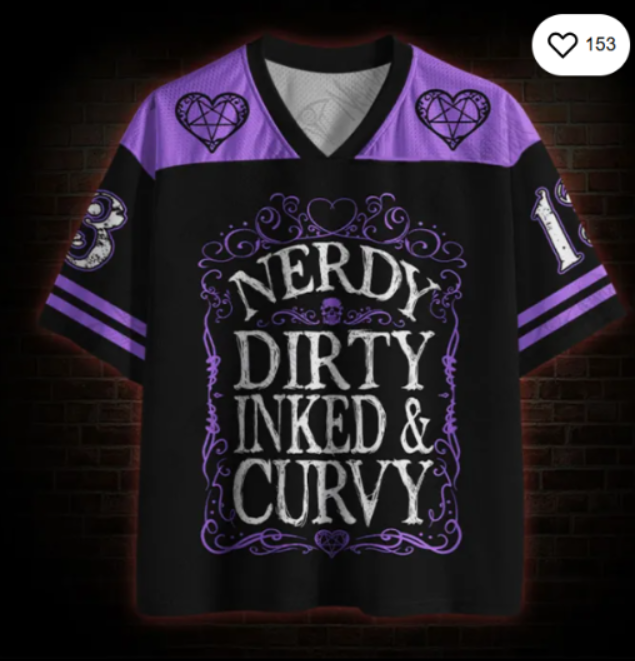
Knits also have stretch, which a woven or mesh top won’t give you in the same way; if you’re sizing a nerdy mesh jersey at the same time, treat it as its own decision, since a jersey and a knit rarely share a size. A cardigan that’s slightly snug in the chest at first will relax with a few wears; one that’s too big never shrinks back. When in doubt between two sizes for a fitted cut, go smaller. For oversized, go with what the chart says and trust the intended fit.
Sleeve length is the tell
If a cardigan’s sleeves end far past your wrists and the shoulder seams sit halfway down your arm, it’s not “oversized,” it’s too big. Real oversized cuts are designed so the drop shoulder sits intentionally and the sleeve can be cuffed once cleanly. Anything beyond that is a sizing error.
A quick test at home
Put the cardigan on over a fitted tee. Button the middle button. Look in a mirror from the side. If the front hangs straight without pulling at the button, the chest fits. If the hem sits where you expected it to based on the cut, the length works. Two seconds, one button.
The one to buy first
If you own no cardigans and want the piece with the widest range, get a fitted or regular cut in a mid-weight knit. It layers under jackets, works buttoned or open, passes at work, and pairs with everything. Add oversized for cozy weekends and cropped for skirts once you know what you reach for. Fit first, then variety.