

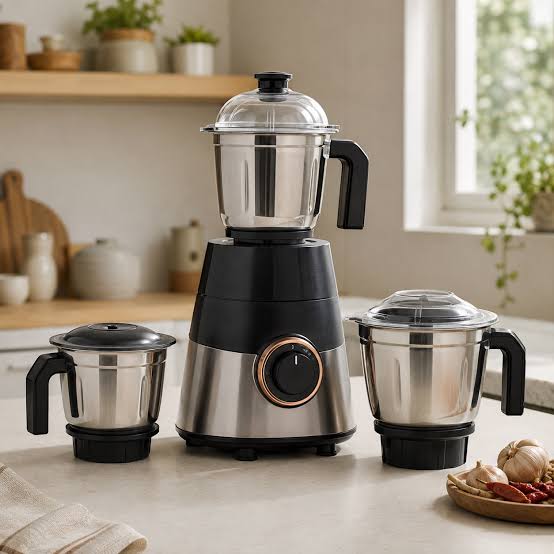
Nobody plans to replace a mixer grinder in three years. It just happens. The machine starts smelling slightly hot during batter grinding, then the jar coupling gets loose, then one morning it doesn’t start at all. A new one gets ordered, the same buying process plays out, and the cycle quietly repeats. What’s frustrating is that the machines lasting a decade in Indian kitchens aren’t special. They’re not from secret brands or premium categories most people can’t afford. They’re just built differently in ways that are completely visible at the point of purchase – assuming you know which things to actually look at.
The Motor Is Where the Decision Actually Lives
Jars crack. Blades dull. Gaskets harden and leak. Every single one of those things is a ₹100 to ₹500 fix depending on the brand. The motor is different. When a motor fails in a kitchen mixer grinder, the repair cost approaches the price of a new machine closely enough that most households just replace it. So the motor is where the decision actually lives, even if nobody frames it that way when they’re standing in a store.
Wattage gets the most attention and deserves the least. A 750-watt motor built with quality copper windings and proper thermal management will run reliably in a working Indian kitchen long after a 1000-watt motor assembled to a lower standard has given up. Heat is what kills motors. Not age, not usage volume. Heat that builds during sustained grinding on coconut and dal and dried spices, session after session, year after year.
Thermal overload protection is the feature worth asking about specifically. It’s a cutout that shuts the motor down before temperatures reach a damaging threshold. Reputable brands include it as standard. Some budget machines include a version calibrated too conservatively – it kicks in so early it interrupts normal use – and others don’t have effective protection at all. Neither of those is what you want. The product spec should list this clearly. If it doesn’t, treat the absence as information.
Pick the machine up in-store when you can. A motor housing that feels genuinely heavy when lifted is telling you something about the density of the copper windings inside. It’s not a scientific test. It’s just that cheap motors feel noticeably hollow in a way that good ones don’t. Once you’ve held both, the difference is obvious and immediately repeatable.
What Jar and Coupling Quality Looks Like in Practice
The coupling between the jar base and the motor spindle is a component that absorbs the full rotational force of the motor every time the machine runs. That’s a significant mechanical load, applied repeatedly, across years of daily use. On cheaper mixer grinder models it’s nylon or low-grade plastic that wears into imprecision and eventually strips entirely. On better ones it’s stainless steel or engineering-grade plastic that holds its geometry under load.
Test it in the store. Fit the jar onto the motor body and remove it five or six times. A coupling built properly clicks into place with a precision that feels mechanical, not approximate. There’s no wobble when it’s seated. A cheap one has a small but perceptible amount of play even brand new, which turns into a significant amount of play by year two, and a failure point not long after that. In a mixer grinder built to last, this should feel exact..
The Body and Feet Tell You More Than the Spec Sheet Does
A mixer grinder running at full speed on a hard counter is vibrating continuously. The machines that absorb that vibration last longer because they’re not shaking their own components loose from the outside in. Thick-walled ABS bodies, or housings that combine plastic and metal sections, distribute vibration rather than transmit it directly to the jar coupling and the motor mounts. Thin-bodied machines resonate. You can hear it. The sound is different – hollow, slightly amplified – and the machine tends to move across the counter during grinding.
Rubber feet. This sounds absurdly minor until you’ve watched a mixer grinder walk three inches across a wet kitchen counter during a grinding session. Good rubber feet are soft, grippy, and tall enough to actually absorb vibration before it reaches the surface. Poor ones are thin, hard, and essentially decorative. Press them with a finger in the store. The difference between a foot that compresses meaningfully and one that barely gives is the difference between a machine that stays put and one that doesn’t.
Ventilation slots are worth one quick look. They should be positioned to draw air across the motor during operation, not placed where they look symmetrical on the housing. A well-ventilated motor runs cooler. A cooler motor lasts longer. This is not complicated but it is invisible on a product listing.
The Brand Question Nobody Wants to Answer Directly
Service availability is the consideration that feels irrelevant when buying and becomes the most relevant thing two years later. A mixer grinder from a brand with actual service centres in your city, stocked spare parts, and a transparent repair price list is a genuinely different long-term investment from one routed through a national call centre with unpredictable turnaround times.
Before buying, call the service number. Ask what a motor brush replacement costs and how long it takes. That answer tells you more about the brand’s post-sale commitment than any warranty document does.
Conclusion
A mixer grinder that’s still running well in year ten wasn’t fortunate. It had a motor built for sustained heat load, a coupling that didn’t wear into imprecision, jars with enough material to survive years of thermal cycling, and a body that absorbed rather than amplified its own vibration. None of that is hidden. It’s all there at the point of purchase, in the weight of the housing, the feel of the coupling, the flex of the jar wall. The buyers replacing machines every three or four years mostly aren’t buying inferior brands. They’re buying without looking at the things that actually determine how long a machine lasts. The information doesn’t change. It just needs knowing where to find it.