

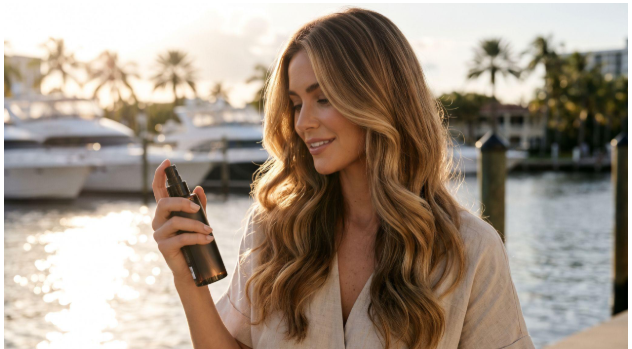
The “skinification of hair” has shifted preventative photoprotection from a seasonal beach afterthought into one of 2026’s defining beauty standards. Just as daily facial SPF is non-negotiable for preserving collagen, cosmetic chemists and master stylists now treat solar defense as essential for maintaining hair elasticity, gloss, and color longevity.
Yet a common styling habit undermines this routine before you even step outside: applying a multi-tasking prep product to damp hair and immediately blasting it with a blow-dryer or 400°F flat iron. While thermal protectants and solar filters both shield the hair shaft, their active ingredients behave differently under extreme temperatures. Understanding how thermal energy interacts with UV-absorbing molecules is the key to keeping your hair resilient, vibrant, and frizz-free all year.
How Solar Radiation Breaks Down Hair Fiber Architecture
Sunlight alters hair integrity through two distinct wavelengths: UVB rays degrade structural keratin proteins and weaken disulfide bonds, while UVA rays oxidize natural melanin and artificial color pigments. Over time, this photochemical reaction strips the hair’s protective outer lipid layer, leaving strands porous, brittle, and prone to dullness.
Because hair fibers consist of non-living keratinized cells, they cannot regenerate once compromised by environmental stress. On the outermost surface of a healthy cuticle lies a microscopic fatty acid monolayer known as 18-methyleicosanoic acid (18-MEA). This covalently bound lipid shield gives virgin hair its natural water repellency, smooth slip, and light-reflecting shine.
Research in hair lipidomics published in the International Journal of Cosmetic Science demonstrates that prolonged exposure to ultraviolet and visible light triggers widespread photo-oxidation, stripping away up to 90% of this protective 18-MEA barrier over a single sunny season. Without that hydrophobic lipid coat:
- Cuticle scales lift and catch against neighboring strands, causing mechanical tangling and split ends.
- Internal moisture escapes rapidly, leaving mid-lengths feeling rough and straw-like.
- Salon color molecules—especially cool blonde toners and rich brunette glosses—oxidize into unwanted brassy or faded tones.
In high-UV coastal regions like Fort Lauderdale, Florida, this cumulative wear accelerates dramatically. Intense year-round sunlight reflects off ocean water and sand, compounding the effects of salt air and subtropical humidity on color-treated strands and lightweight hair extensions.
The Thermal Conflict: Why Hot Tools Degrade Solar Filters
Most blow-dryers, curling wands, and ceramic flat irons operate between 350°F and 450°F, exceeding the thermal stability threshold of many lightweight UV-absorbing compounds. Exposing damp-applied solar filters to direct hot-tool plates can evaporate or chemically alter those active ingredients before they ever encounter daylight.
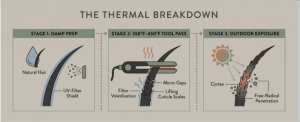
When you rely solely on a pre-blowout product to guard against midday sun, three overlapping mechanisms weaken your defense:
- Filter Volatilization and Breakdown:Many traditional organic UV absorbers—such as ethylhexyl methoxycinnamate—are formulated to sit comfortably at ambient outdoor temperatures. When pressed directly between 410°F titanium or ceramic plates, volatile components can flash off or degrade structurally, leaving behind minimal solar filtering capacity.
- Cuticle Expansion and Micro-Gaps:Rapidly heating damp hair forces residual water inside the cortex to expand, temporarily lifting the overlapping cuticle scales. This physical shift fractures any continuous protective film into microscopic gaps, creating uneven weak points where UV rays penetrate easily.
- Compounded Free-Radical Stress:High-temperature styling already weakens internal hydrogen and disulfide bonds. Stepping into direct sunlight immediately afterward introduces reactive oxygen species (free radicals) to an already sensitized fiber, accelerating protein loss and breakage along fragile ends.
Pre-Heat Thermal Shields vs. Post-Heat Solar Barriers
Thermal protectants and finishing UV mists serve distinct chemical purposes on the hair shaft. Thermal shields use heat-dispersing silicones and copolymers to slow heat conduction and reduce brush friction, whereas post-styling solar barriers rely on photostable UV absorbers and antioxidants to neutralize solar radiation.
| Feature | Pre-Heat Thermal Protectant | Post-Heat Finishing UV Mist |
| Primary Active Ingredients | Dimethicone, cyclopentasiloxane, hydrolyzed proteins, heat-activated copolymers | Polyquaternium-59, Polysilicone-15, sunflower sprout extract, plant esters |
| Application Stage | Towel-dried, damp hair prior to blow-drying | Dry, fully styled hair after hot tools are finished |
| Temperature Tolerance | Engineered to withstand 350°F to 450°F tool contact | Formulated for ambient outdoor temperatures and UV exposure |
| Structural Benefit | Slows thermal transfer, prevents moisture flash-boiling, adds brush slip | Absorbs UVA/UVB rays, blocks free radicals, prevents pigment oxidation |
Stylist Perspective: Marina Vogel, Founder & Elite Stylist at MaVo Hairlounge
“Clients often assume that if their blow-dry cream mentions UV filters on the bottle, they are completely covered for a weekend on the boat or an afternoon outdoors. In reality, high-heat round-brushing and flat-ironing break down much of that initial barrier before you even walk out the door.
At our studio—widely recognized as the best hair salon in Fort Lauderdale—we teach clients to treat heat defense and solar defense as two separate steps. That distinction is critical if you invest in lived-in dimensional color or wear lightweight everyday extensions. Because extension hair does not receive natural scalp oils to replenish lost lipids, layering a weightless UV finishing mist after styling is the single easiest way to keep wefts soft, glossy, and true to tone.”
The Two-Step Stylist Protocol for Layering Heat and Sun Defense
Building a reliable defense against both hot tools and sunlight requires separating your thermal prep from your final solar shield. Applying each product at the right stage of your styling routine keeps hair lightweight, bouncy, and protected without greasy buildup.
- Prime Damp Hair with a Thermal Buffer:Start on towel-dried strands by applying a lightweight heat protectant with uv protection specifically engineered to buffer blow-dryer airflow up to 450°F. Comb it evenly from mid-shaft to ends, dry your hair in sections, and finish each pass with your dryer’s cool-shot button to lay the cuticle scales flat.
- Seal Styled Hair with a Dry Finishing Mist:Once your curling wand or flat iron is turned off and your hair has cooled, hold an ultra-fine, dry UV mist 8 to 10 inches away and sweep it across the outer canopy and ends. Look for weightless, non-aerosol or micro-mist formulas powered by Polyquaternium-59 and antioxidant plant extracts that shield strands without flattening fine or layered cuts.
- Replenish Lost Lipids Weekly:Even the best daily routine benefits from periodic barrier restoration. Incorporate a weekly ceramide or amino-acid mask at home, and schedule a premium haircare and treatment service in the salon to rebuild weakened disulfide bonds and restore hydrophobic slip to sun-exposed ends.
Frequently Asked Questions
Does heat styling cancel out UV protection for hair?
High-heat styling tools can significantly reduce the effectiveness of UV filters applied to damp hair. When flat irons or curling wands reach 350°F to 450°F, intense thermal energy can evaporate or chemically degrade lightweight UV-absorbing compounds before you go outdoors, making a post-styling mist essential for reliable defense.
Should you apply hair sunscreen before or after blow-drying?
For optimal defense, apply a dedicated thermal protectant before blow-drying and mist your solar barrier onto dry hair after all hot-tool styling is complete. Applying UV filters as your final step ensures the protective polymers form an unbroken, heat-undisturbed shield across the outer cuticle layer.
How can you tell if you have sun damaged hair, and how do you fix it?
Strands compromised by solar radiation typically feel rough or straw-like, tangle easily at the ends, lose their natural shine, and develop brassy or faded tones due to cuticle lipid loss. You can restore softness and elasticity by trimming weathered tips, applying weekly lipid-replenishing masks, and shielding dry hair with a finishing UV mist before stepping outdoors.
Viewing thermal styling and solar defense as a coordinated two-step habit transforms how your hair ages between salon visits. By letting a dedicated thermal shield absorb the stress of your blow-dryer and sealing your finished style with a weightless UV barrier, you preserve the cuticle’s natural lipid armor, keep dimensional color luminous, and maintain effortless movement through every sunny season.