

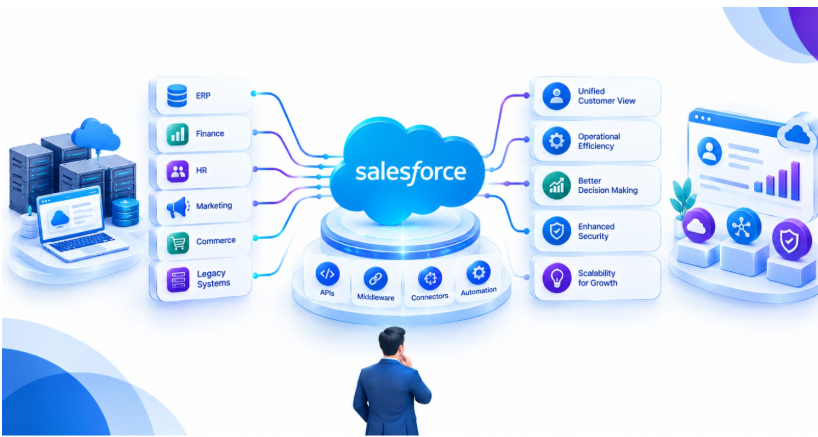
Most companies do not have a Salesforce problem. They have a data problem that shows up inside Salesforce. The CRM holds one slice of the customer. The rest sits in billing, support, and a dozen other tools. That split is exactly what good Salesforce integration services are meant to fix.
And the stakes just went up. Once a business starts using machine learning, scattered data stops being an annoyance. It becomes the thing that breaks the model.
What Salesforce integration services actually do
The idea is simple, even if the work is not. Integration connects Salesforce to the other systems your business runs on. So the data stays in sync, and everyone sees the same picture.
Without it, your teams live in silos. Sales sees one version of a customer. Support sees another. Finance sees a third. Salesforce integration services close that gap and give everyone one shared view.
The connections that matter most
- CRM to ERP, so sales and finance finally agree on the numbers.
- Marketing tools, so campaigns tie back to real pipeline.
- Support systems, so an agent sees the full history on one screen.
- Custom apps, through APIs, when no ready-made connector exists.
Why machine learning systems raise the stakes
Here is where it gets interesting. More businesses now run machine learning on their customer data. Lead scoring, churn prediction, next-best-offer, that sort of thing.
These machine learning systems are hungry for clean, connected data. Feed them a fragment, and they make poor calls. Feed them the full picture, and they get sharp. So the quality of your integration directly shapes the quality of your predictions.
This is the part teams miss. They invest in these models, then starve them with siloed data. The model is not the weak link. The plumbing is.
Where integration projects go wrong
Integration sounds simple on a slide. In practice, a few things trip teams up again and again.
- Syncing everything. Not all data needs to flow both ways. Pick what matters.
- Ignoring data quality. Connecting two messy systems just spreads the mess.
- No clear owner. When nobody owns the data model, it drifts fast.
- One-time thinking. Integration is not a project you finish. It needs upkeep.
None of these are technical failures. They are planning failures. The right partner spots them before they start.
How to choose the right partner
The provider you pick shapes the result. A few signals tell you a lot.
- They ask about your data quality before they talk connectors.
- They plan for upkeep, not just a one-time hookup.
- They think about what comes next, like feeding predictive models.
- They keep the data model clean and clearly owned.
A partner who treats integration as a living system, not a one-off job, is the one worth hiring. The quick hookup always costs more later.
Frequently asked questions
What are Salesforce integration services?
They connect Salesforce to the other systems a business runs on, using APIs and connectors. The point is to keep data in sync, so every team works from one accurate view of the customer.
Why does integration matter for machine learning?
Machine learning models need clean, connected data to make good predictions. Siloed data leads to weak results. So integration is what feeds the model the full picture.
Is integration a one-time project?
No. Systems change, and data models drift. Good Salesforce integration services include upkeep, not just a first connection.
What can go wrong with a Salesforce integration?
The usual traps are syncing too much, ignoring data quality, and having no clear owner. Each one is a planning issue, not a coding one.
Do we need to clean our data first?
It helps a lot. Connecting two messy systems just spreads the mess. Cleaning first makes the whole integration more reliable.
The bottom line
Salesforce is only as strong as the data flowing into it. That was true before AI, and it is truer now. Good Salesforce integration services connect your systems, clean up the silos, and give both your people and your models the full picture. Get that base right, and everything built on top, from reports to machine learning systems, works better for it.