

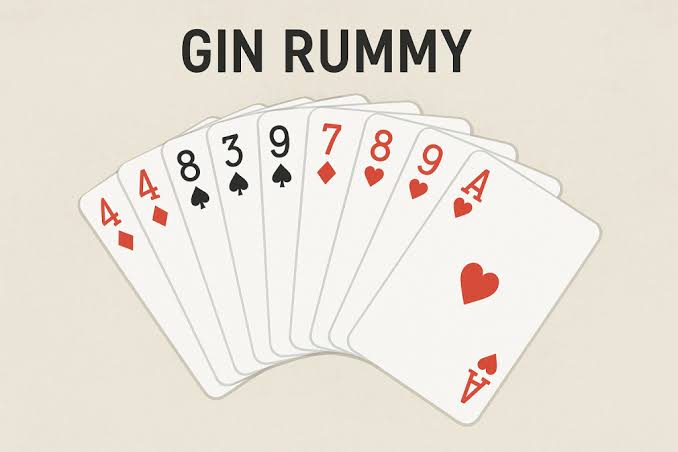
There is a strange habit that develops after years of playing head-to-head Gin Rummy. You stop seeing the game as an active puzzle and start treating it like muscle memory. You can sit across from your regular opponent, watch a few rounds of discards, and almost predict their next move. You know when to play defensively, when to reduce deadwood, and how much time you have before the stock pile starts running low. The match becomes a quiet battle built on familiarity.
Then, someone pulls up a third chair.
Most experienced players assume a three-player game is only a small adjustment. The deck is the same, the basic objective remains unchanged, and the familiar strategies seem like they should still work. That confidence usually disappears quickly. After a few hands, many players discover that their carefully developed two-player instincts no longer fit the situation. They hold onto risky cards for too long, misread the pace of the table, and suddenly find themselves carrying a heavy deadwood count.
Adding another player does not simply increase the number of turns. It changes how information, timing, and risk work throughout the entire game.
When The 1v1 Strategy Stops Working
A traditional two-player Gin Rummy match is built around direct observation. Every decision connects to one opponent. You study their discards, notice their habits, and build a mental picture of what they might be collecting.
If your opponent takes a 7 of Clubs from the discard pile, your mind immediately starts working. Are they building a sequence? Are they collecting a set? Is that card part of a larger plan?
With only one opponent, these clues are easier to organize.
A third player changes that completely.
The game becomes less predictable because every card now has multiple possible meanings. A discard that looks harmless to one opponent may be exactly what another player needs. Instead of solving one person’s strategy, you are trying to understand two different plans developing at the same time.
This creates a different kind of challenge. Players have to pay attention to the entire table instead of focusing only on the person directly competing against them. Who keeps avoiding certain suits? Who suddenly changes their discard pattern? Who might be preparing to finish the round earlier than expected?
That uncertainty is what forces experienced players to think differently.
Every Discard Becomes A Risky Decision
In a two-player game, the discard pile often feels like a private conversation. You throw away a card, your opponent ignores it, and you gain useful information from that reaction.
With three players, that confidence disappears.
Every card you release has two potential audiences. A card that seems safe may become a valuable opportunity for someone else sitting across the table.
This changes the way players evaluate even simple decisions.
Before discarding, experienced players start asking:
Am I helping one opponent while trying to slow down another?
Does this card reveal too much about the hand I am building?
Could this discard complete someone else’s combination?
This is where many skilled two-player players struggle at first. Their problem is not a lack of knowledge. They are simply using a strategy designed for a different environment.
Players who want to understand how this format changes decision-making often look at the details behind gin rules 3 players because the extra participant affects much more than just turn order. It changes card value, timing, and the way players calculate risk from the beginning of the hand.
The Faster Pace Rewards Better Decisions, Not Faster Moves
One of the biggest mistakes new players make in a three-player Gin Rummy match is assuming they need to speed up everything they do.
With another person drawing and discarding, the game naturally feels faster. The stock pile changes more quickly, and there is less time to wait for the perfect combination.
That pressure causes many players to force bad decisions.
They chase unlikely sequences. They keep difficult cards because they hope the right match will appear. They ignore safer options because they feel behind.
But rushing is rarely the winning approach.
The strongest three-player players understand that patience becomes even more important when the table gets crowded. They know when to abandon an unreliable plan, when to remove dangerous cards, and when to let opponents create their own problems.
A good player does not simply react faster. They make better decisions under pressure.
The Hidden Battle Happens Between Opponents
The most interesting change in a three-player match is the psychology.
In a standard duel, your attention is focused on one person. You study their habits, their timing, and their reactions.
With three players, the most useful information often comes from watching how opponents affect each other.
A player may suddenly stop taking from the discard pile after another opponent collects a certain card. Someone who was playing aggressively may become cautious after realizing another player is close to finishing.
The table becomes a conversation between three people, not just a battle between two.
Experienced players learn to notice small details. A hesitation before picking up a card, a sudden change in discard choices, or a shift in playing style can reveal more than the cards themselves.
This extra psychological layer is what keeps three-player games unpredictable. You are not only managing your own hand. You are reading the entire situation around you.
Why Three-Player Games Create Better Players
Another reason this format attracts experienced card fans is that it exposes mistakes more clearly.
In larger games, losing can feel random. There are too many players and too many variables, making it easy to blame luck.
A three-player match is different. It creates enough complexity to challenge you while still allowing you to understand what went wrong.
After losing a hand, players can usually identify the turning point.
Maybe they held onto high-value cards for too long. Maybe they ignored warning signs from an opponent’s discards. Maybe they focused too much on their own strategy and failed to notice the changing pace of the table.
These lessons are valuable because they improve future decisions. Instead of simply accepting a loss, players can understand the mistake behind it.
That is one of the biggest advantages of three-player Gin Rummy. Every round becomes a chance to develop better judgment.
Why Adding One Player Can Refresh A Familiar Game
Even great games can become predictable when played in the same format for years. Regular opponents develop patterns, strategies become automatic, and the excitement of discovery starts to fade.
A third player changes that feeling immediately.
The rules may remain familiar, but the experience becomes completely different. Players must think more carefully, manage risk more effectively, and adapt to a table where every decision affects multiple people.
That is why many card enthusiasts enjoy exploring three-player Gin Rummy. It does not replace the traditional game. Instead, it reveals a deeper side of something players thought they already understood.
Sometimes a familiar game does not need a new rulebook to feel fresh.
Sometimes all it needs is one more person sitting at the table.