

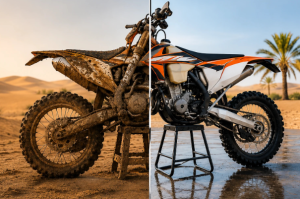
You knew what you were signing up for. The dunes were worth it. But now the bike is back on the trailer and it looks like it went through the desert on purpose — which, to be fair, it did. Sand in every gap, dust on every surface. This is the part nobody films for the highlight reel. Cleaning an off-road motorbike after a serious dune session is not the same as rinsing a road bike after a dusty commute. The guide below covers what to do, in what order, and what to avoid if you want the bike ready for the next session without shortening its life in the process.
Start before the sand settles into its new home
Do not leave your off-road motorbike standing dirty for days. Sand that sits around the chain, fork seals, brakes, and controls starts acting like grinding paste. The longer it stays there, the more likely it is to wear parts that were perfectly fine a few hours earlier.
The first step is simple:
- let the bike cool down
- move it into shade
- cover the air intake and airbox
- plug the exhaust
- remove everything removable
- get your cleaning tools ready first
A hot engine and cold water are not best friends. Give the bike a little time before you start spraying it down.
How to clean your off-road motorbike without creating new problems
Start with the chain, not the frame
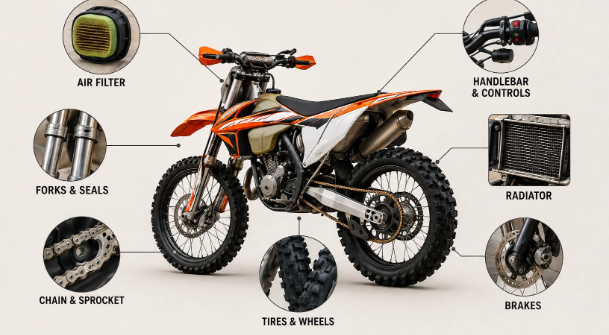
This is the order most riders get wrong when cleaning their off-road motorbikes after a riding session. After a dune ride the chain will have collected a mixture of sand, old lubricant, and whatever the desert floor contributed. Use a proper motorcycle chain cleaner and a chain brush to work through it. Get into the gaps between the links and around the sprocket teeth.
Do not aim a pressure washer directly at the chain. The pressure pushes past the O-rings or X-rings that seal the chain’s internal lubrication, removes what little grease remains, and accelerates wear significantly.
Pay attention to the air filter
Dune riding is hard on air filters. Fine sand gets everywhere, and the filter is one of the few parts actively standing between your engine and bad decisions made by the atmosphere.
Take the filter out and inspect it. If it is a foam filter, clean it with the proper product and re-oil it if needed. If it is excessively dirty, do not pretend it is still “probably fine.” The engine deserves better.
This matters for every off-road motorcycle for sale that claims to be desert-ready. A bike can survive the dunes only if the rider remembers that air is part of the fuel system’s daily drama.
Protect sensitive areas first
Before water goes anywhere near the bike, the areas that do not welcome moisture need attention beyond just the air intake.
Avoid directing any water pressure at electrical connectors, switches, wiring, spark plug areas, and the carburetor or throttle body. These areas can be cleaned, but with a damp cloth or soft brush rather than a stream of water. The radiator also does not need to be blasted — it can be rinsed gently but the fins are fragile and bend easily under pressure.
The exhaust can be cleaned on the outside. The inside does not need water introduced to it under any circumstances.
Clean the engine carefully
The engine on even the best off-road motorcycles in the UAE are more exposed in their design than such on a road bike, with cooling fins, open cases, and small recesses where sand accumulates over a long desert session. Resist the temptation to pressure wash it clean in one pass.
Use a sponge or soft brush with warm water and a small amount of motorcycle-safe shampoo. Work section by section. It takes longer but it is the only approach that cleans effectively without forcing moisture into places it should not reach. Compressed air after washing helps clear water from the fin gaps before it sits and causes surface corrosion.
Frame, plastics, and bodywork
Once the chain and sensitive areas are handled, the rest of the bike can be washed more freely. Off-road motorbikes after a dune session will have sand and dust in every panel gap, behind number boards, under the seat, and along the inside of the fenders. Work through these areas methodically rather than just rinsing the visible surfaces.
For heavy deposits on vertical surfaces, a gel cleaner works better than a spray because it stays in contact with the dirt long enough to loosen it before rinsing. Apply it, give it a minute to work, then rinse.
Avoid household cleaning products. They are formulated for different surfaces and many of them are too aggressive for motorcycle paint, rubber, and aluminium. The damage is not always immediate — it shows up over time as faded plastics, corroded alloy, and deteriorating rubber seals.
Wheels and brakes
Use a proper wheel cleaner on the rims and a brush that can get between the spokes. Brake discs collect fine sand that does not always rinse away cleanly — wipe them down after washing and before the first ride to restore proper feel.
After washing, roll the bike slowly and apply the brakes gently a few times before riding normally. Water sits around the pads and disc surface and affects braking feel until it clears. Better to find this out in the driveway than at the first corner.
Do not leave your off-road motorbike drying on its own
Washing is only half the job. A wet bike left to dry on its own, especially in UAE humidity near the coast, will develop water spots on plastics, surface rust around any exposed steel fasteners, and moisture in gaps that attract fresh dust immediately.
- Use a soft microfiber towel or chamois cloth on painted surfaces, plastics, and the seat.
- Use a blower, air compressor, or a vacuum in blow mode for tight gaps such as:
- around bolts
- footpegs
- brake components
- frame joints
- Do not let the bike dry in direct sunlight. Water can evaporate too fast and leave mineral marks on paint and plastics.
- After drying, apply suitable care products to plastics and painted surfaces if needed.
- Add fresh chain lube once the chain is dry.
- Wipe off the excess lubricant, because any extra will end up on the swingarm and rear wheel during the next ride.
Use proper cleaner, but keep it simple
When you buy an off-road motorbike, the last thing you think of is the cleaning equipment. However, you do not need a shelf full of miracle bottles. A basic setup is enough if the products are safe for bikes.
Useful kit:
- mild bike shampoo
- soft wash mitt or sponge
- chain cleaner
- chain brush
- microfiber cloths
- soft detailing brush
- proper chain lube
Avoid harsh household degreasers on plastics, painted parts, and rubber unless you are very sure what they do. A clean bike with faded plastics is not really a win.
Quick post-dune checklist for cleaning off-road motorbikes
- Let the bike cool before washing
- Cover the air intake and plug the exhaust
- Remove electronics and accessories
- Start with the chain — cleaner and brush, no pressure washer
- Pre-rinse the whole bike with low pressure to remove loose sand
- Clean sensitive areas with a damp cloth, not a water stream
- Wash the engine gently with a sponge and motorcycle shampoo
- Work frame and plastics top to bottom with appropriate cleaner
- Clean wheels and wipe brake discs separately
- Rinse everything thoroughly — no shampoo residue left on any surface
- Dry with microfiber, then use compressed air on gaps
- Check and lubricate the chain after drying
- Apply care products to plastics and painted surfaces
- Roll the bike and test the brakes before riding
Why cleaning is not only about aesthetics
A bike that has been maintained properly after every desert session will need less unplanned work and last longer than one that gets a rinse when it looks bad enough to bother.
This matters particularly in the UAE market where off-road motorcycles prices in the UAE reflect condition closely. A well-documented, well-maintained machine holds its value considerably better than one where the maintenance history is unclear or the cosmetic condition tells a story the owner would rather not explain.
So yes, washing your off-road motorbike after a UAE dune ride is not glamorous. It is also one of the cheapest ways to keep it healthy, responsive, and ready for the next trip. The desert already took its turn. There is no need to let it move into the chain, the filter, and the fork seals permanently.