

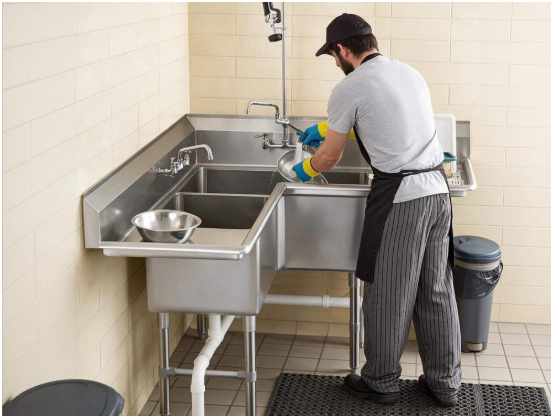
For professional foodservice projects, the equipment plan is a crucial stage in the preconstruction and/or pre-renovation process. Each sink choice impacts the workflow, sanitation zoning, efficiency and readiness for inspection. Additionally, buyers also check the compatibility of the workspace, the stainless steel gauge, certifications, and the compartment numbers before approving procurement. By comprehending these factors, restaurant owners, hotel planners, distributors and restaurant franchise developers can choose equipment that helps them run their daily business without hassles and expand to other international markets.
Why Compartment Selection Matters During Kitchen Planning
The choice of compartment directly affects washing efficiency, kitchen organization and the efficiency of daily workflow. Each operation has varying amounts of food, utensils, cookware, and times for preparing food. Simple washing systems are typically sufficient for small cafes, compared to the washing setup found at a busy hotel kitchen. In larger restaurants, preparation, washing and utility operations may be performed at special work stations. Proper planning also minimizes excess equipment and staff movement during busy service times. Local foodservice regulations often require commercial foodservice establishments to have a minimum number of washing facilities. Therefore, selecting should take into account the need for workflow along with the space available for installation. Starting with planning avoids costly layout changes once construction has started. Some equipment distributors will suggest that the equipment be of a capacity that corresponds to the volume of meals anticipated rather than just the volume of meals currently served. Future business growth should be taken into consideration during the specification process as well.
Selecting One, Two, or Three Compartments for Different Operations
One compartment is for beverage stations, bakeries, produce preparation or minimal washing needs. Two compartments provide kitchens that need washing and rinsing to be separate but with not too much equipment. Regulations often require separate washing areas, and three compartments remain the most popular option for full-service restaurants and many hospitality venues. In bigger institutional kitchens, four compartments are occasionally set up to meet special production demands. Selection should always be based on workflow and not just available floor space. Before selecting the width and depth of bowls, think about cookware size. Deep basins make handling large pots and catering equipment easier. Adequate distance between compartments will also improve the comfort level of workers who need to perform repetitive cleaning operations.
- Single compartment supports light-duty preparation and specialty washing.
- Double compartments improve efficiency for moderate foodservice operations.
- Triple compartments match high-volume restaurant and hotel environments.
- Four compartments serve specialized institutional production requirements.
- Larger bowls simplify cleaning oversized cookware and food containers.
Matching Bowl Dimensions with Workflow Efficiency
The size of the bowl has a greater impact on operating efficiency than most people realize. Large sizes of cookware need deeper bowls and enough space inside for easy maneuvering. A narrow compartment makes it difficult to move around during peak production times. Wide bowl spacing is an advantage for larger kitchens, where several workers are likely to be working at the same time. Using a commercial kitchen sink that is the proper size will also help with the organization of the workstation and reduce the amount of handling downfalls. In a challenging foodservice setting, the depth of the standard bowl can often be anywhere from 12 to 14 inches. The size of cookware, amount of food to be prepared, and available space for installation determine the width selection. Custom dimensions are used when the standard dimensions do not meet the needs of the project. Brands like Xinhe also allow custom layouts for bigger hospitality projects that require particular stainless steel solutions.
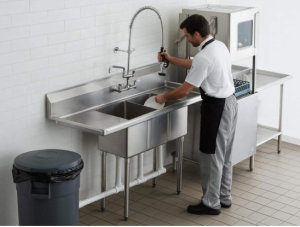
A large two-compartment commercial kitchen sink used for rinsing dishes, with a powerful pre-rinse spray
Understanding Stainless Steel Gauge Selection
The choice of gauge can greatly impact the lifespan, strength, and performance of the product. The lower the gauge number, the thicker the stainless steel construction. Fourteen-gauge offers maximum rigidity for the toughest institutional applications that are required to support heavy cookware on a daily basis. Sixteen gauge is still the industry standard in restaurants, hotels and catering operations, as it is strong yet usable. Eighteen gauge is used for lighter duty applications where there are moderate operating requirements. Thicker material also decreases the vibration when used continuously. The actual workload anticipated by the buyer should be a factor in the choice of material to be used and not appearance alone. Sixteen or fourteen gauge construction is recommended for high-volume kitchens for long-term performance.
- Fourteen-gauge delivers maximum structural durability.
- Sixteen-gauge balances strength and practical performance.
- Eighteen-gauge suits lighter commercial applications.
- Heavier cookware benefits from thicker stainless steel.
- Long-term reliability depends on matching gauge with workload.
Why Grade 304 Stainless Steel Remains the Industry Standard
Grade 304 stainless steel continues to be the most requested, as it has strong corrosion resistance and is excellent for hygiene. In a professional kitchen, there is constant exposure to moisture, food acids, detergents and heavy cleaning. Quality material safeguards the structural integrity under challenging operating conditions. Smooth stainless steel surfaces also make it easier for routine maintenance during busy service schedules. Many foodservice consultants recommend 304 stainless steel for restaurant, hotel and institutional kitchens abroad. Material consistency is particularly relevant when a large-scale franchise expansion project is undertaken, where the same equipment is used throughout. The reliable manufacturers have strict production controls to ensure dimensional accuracy and uniform finishing quality.
Planning Drainboards and Undershelves Together
Drainboards provide more work surface and help to maintain an orderly foodservice operation. Drainboards should be left-hand, right-hand or dual, depending on the pattern of employee movement and the surrounding preparation equipment. The right position eliminates unnecessary lifting and facilitates the continuity of the work. Tubular or solid undershelves provide additional storage under washing stations, which means less floor space is needed. Pipe rack undershelves also allow equipment to be placed in a drying or organized manner. Integrated workstation designs eliminate clutter and boost work efficiency during busy production times. Before choosing the direction of the drainboard, buyers should inspect the surrounding equipment, as the direction may create an obstruction in smooth kitchen movement.
Preventing Cross-Contamination Through Smart Zoning
Good zoning starts at the time of equipment selection, not after installation. There is reduced crossover from operational activities to dedicated preparation, washing and cleaning areas. The placement of a compartment should help to facilitate the overall kitchen workflow rather than cause congestion. Each workstation for produce preparation, utensil cleaning, and cookware washing helps promote organization. Correct equipment spacing also helps to ensure employee safety when they are moving around during peak service times. It is common for kitchen planners to integrate sink stations with prep tables, storage shelving, and waste collection stations for better workflow. Planned zoning helps with doing a better job at managing hygiene without having to make time-consuming daily changes.
Certification Requirements Every Buyer Should Verify
International buyers often value certification over product appearance or configuration. The certification assures conformance to accepted manufacturing and hygiene standards. Project approval may be held up on the condition of providing documented evidence in procurement specifications. Commonly, restaurant chains, hotel construction and institutional facilities confirm certification in supplier assessments. When equipment quality looks good, but documentation is incomplete, it can hold up inspections or acceptance processes. A complete certification record should be requested by the buyer prior to production. Trusted manufacturers keep up-to-date documentation to meet international project needs. Xinhe can provide international procurement with a recognized quality management system and internationally accepted certification.
Understanding NSF, NSF/ANSI 61, cUPC, and CE
Different certifications cover different technical requirements rather than repeating the same standards. NSF/ANSI 2 looks at the design of hygienic equipment, such as smooth construction and rounded corners, which help with easier sanitation. NSF/ANSI 61 is for drinking water contact components and is a safe material performance verification. cUPC verifies plumbing compatibility with North American installation requirements. CE stands for conformity with the applicable European regulatory requirements for the concerned products entering the European markets. Buyers should confirm that the certification required is one that complies with the regulations of the country to which the goods are to be exported before finalizing the specification. Official certificates are requested to avoid unnecessary delays in procurement in the course of international shipment.
Requesting Certification Documents from Suppliers
Before the commencement of quotation requests, procurement specifications should clearly list all of the required certifications. The certificate numbers, issuing organizations, and current validity periods are beneficial for buyers. Technical drawings should also be supported with the product configurations that are certified. Careful examination should be given to product specifications, as optional changes can affect the scope of certification. Importers often have clauses in their purchase contracts that require certification or recertification in order to prevent problems down the road. Standard documentation also facilitates customs clearance and project receiving procedures in the various countries of the world. Reputable manufacturers can easily supply the necessary certification records when discussing a quotation.
Configure Equipment That Matches Future Expansion
Restaurant expansion is not just about equipment capacity; it’s about equipment to meet future needs. The flexible dimensions and suitable number of compartments minimize replacement needs during expansion. Custom configurations also optimize the use of space in difficult building configurations. The factory customization meets the special operation requirements of restaurants, hotels, cafeteria and catering. For buyers looking for regional expansion, it may be best to look for manufacturers like Xinhe that have standard models and also have production options to meet regional needs. Specify a solution to suit the kitchen layout, working process and the certification requirement. Use NSF-approved units from trusted manufacturers who have proven experience with international hospitality projects and a proven track record of quality and compliance.