

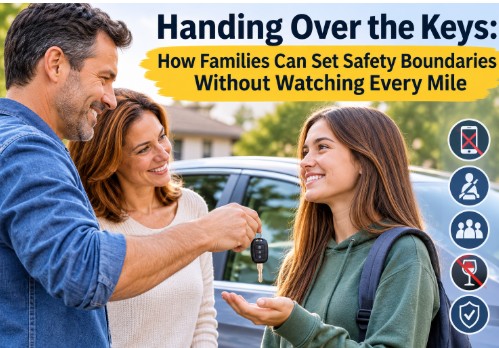
On the day a teenager passes the road test, a parent often feels two things at once: pride and a knot in the stomach. The driving is now happening out of sight, and the old arrangement, with a parent in the passenger seat, is over. Many families respond by searching for the best apps for tracking teenage drivers and installing the first one that looks reasonable.
That instinct is understandable, but technology works better as a supporting piece than as the starting point. What shapes a new driver’s first independent months is the agreement a family reaches about expectations, communication, and trust. Tools can reinforce that agreement. They cannot replace it.
Why the First Months Deserve a Plan
According to the CDC, the main cause of teen crashes is driver inexperience, which is why even “good” teens are at higher risk. In its teen driver fact sheet, the agency reported that motor vehicle crashes are the leading cause of death for U.S. teens, and that in 2016, 49% of teen deaths from crashes occurred between 3 p.m. and midnight. The CDC’s archived fact sheet also lists impaired driving and seat belt use among the risks parents should address. untwebharvest
Graduated driver licensing (GDL) exists for this reason. CDC’s MMWR notes that GDL systems provide longer practice periods, restrict unsupervised driving during the early independent stage, and have reduced collision risk for novice teen drivers by 20% to 40%. GDL rules vary by state, so check your own state’s requirements instead of assuming. A family agreement can follow those rules and add to them.
Agree on Expectations Before the First Solo Drive
Most families assume they agree on the rules. Research suggests otherwise. A study of parent-teen pairs before licensure found low agreement between parents and teens on driving expectations, such as driving after dark. Earlier work it cites found 67.2% of teens expected unlimited vehicle access while only 38.3% of parents planned to allow it. Those gaps are exactly where conflict starts, so settle them before the keys change hands.
A written parent-teen driving agreement helps. The Children’s Hospital of Philadelphia’s Teen Driver Source notes that GDL laws can serve as a guide for a family agreement, and that parents and teens should work together to set clear rules for driving without adult supervision. Cover the basics:
- Phone use: where the phone lives while driving, and what happens with calls and navigation.
- Passengers: how many, and who. CDC materials have noted that crash risk rises with teen passengers in the car.
- Seat belts: always, for everyone.
- Impaired driving: no alcohol or drugs, with no exceptions.
- A no-questions ride home: a common feature in published agreements is the promise to call home for a ride without fear of punishment if the teen is ever in a dangerous or uncomfortable situation.
That last item matters more than it looks. A teen who knows a phone call won’t trigger a lecture is far more likely to make it.
Consider a family whose sixteen-year-old, Maya, has just earned her license. Her parents and Maya sit down together and decide that Maya drives to school and work for the first three months, takes no friends as passengers until a set date, and texts a quick message on arrival when she goes somewhere new. Maya negotiates one change, which is a later cutoff on weekends, and her parents agree. The agreement is theirs, not a rulebook handed down.
Decide What Information Parents Actually Need
Before choosing any technology, answer a plainer question: what do you really need to know, and why?
A parent may reasonably want to know that a teen arrived safely, where the car is in an emergency, or whether the vehicle is being used within agreed limits. Wanting a minute-by-minute record of every trip is a different thing. The more information you collect, the more you have to explain, and the more a teen may feel watched rather than supported.
This is why the best apps for tracking teenage drivers are not necessarily the ones with the longest feature lists. They are the ones whose features match what a family has agreed to. Talk it through openly. Tell your teen what will be visible, who can see it, and what it will and won’t be used for. Teens tend to accept transparent, limited visibility more readily than secret or open-ended monitoring.
CDC research summaries note that ongoing parental management and monitoring, including strict parent-imposed restrictions on driving privileges, may be associated with fewer teen crashes and violations. The operative word is “may,” and the research concerns parental management as a whole, not any specific product.
Plan for Longer Trips and the Unexpected
Independence is easiest when everyone knows what to do if something goes wrong. Agree in advance on:
- Longer journeys: how and when the teen will check in, who they will tell about the route, and what time they expect to arrive.
- Breakdowns and flat tires: whom to call first, whether the family has roadside assistance, and where the spare and tools are.
- Emergencies: how to pull over safely, when to call 911, and who to contact after.
- Unsafe situations: what to do if the teen feels pressured, tired, or unwell, including leaving the car and calling home.
Write it down, put a copy in the glove box, and walk through a scenario or two. A teen who has already thought through a flat tire on a dark road will panic less when it happens.
Where Technology Fits, and Where It Doesn’t
Used thoughtfully, technology can support these agreements in several ways. Depending on the product, features may include vehicle location, safety notifications, driving information, and vehicle-level protection. Not every tool offers all of these, and some offer only one. Before relying on a product, verify exactly what it does, what it cannot detect, what data it collects, and who has access.
Two specific capabilities are worth understanding because they address a serious risk. Alcohol detection before ignition checks a driver before the vehicle starts. Ignition protection can then prevent the vehicle from starting if alcohol is detected above a configured level. These are vehicle-level controls, and a typical location-tracking app does not provide them, so don’t assume your teen’s app does. Families who want this kind of protection should look specifically for it and confirm how it is installed and configured.
Whatever you choose, be honest about its limits. No app teaches judgment, replaces driver education, or substitutes for conversation. A teen who is monitored but unprepared is still unprepared. A broader view of connected driving safety technology can help parents see how different tools fit together, but the technology works best as one layer beside education, supervised practice, and trust.
Review the Agreement as Experience Grows
A driving agreement should not be permanent. CHOP’s Teen Driver Source explains that as teens gain experience and maturity, new driving privileges may be introduced, while privileges can be reduced when the rules are not followed. Build that flexibility into the agreement from the start. A teen who handles three months of solo driving responsibly can earn later curfews or an extra passenger. That gives them a reason to follow the rules besides avoiding punishment.
Set review dates, perhaps every few months or after any near-miss. Ask what is working and what feels unfair. The same applies to the information you collect. If your family agreed to location sharing during the first six months, revisit whether it is still needed once your teen has shown consistent responsibility. Gradually loosening oversight tells a teen you trust them, and it makes the next conversation easier.
When Extra Help Makes Sense
Some situations call for support beyond the family. A teen who is anxious behind the wheel, who struggles with specific skills like merging or night driving, or who has had a close call may benefit from professional driving instruction. So may parents who feel unsure how to coach. Additional supervised practice, even after licensing, is also worthwhile. Experience, not time on the calendar, is what reduces risk.
If your state or insurer offers resources for new drivers, such as parent guides or defensive driving courses, take advantage of them. Check with your state licensing agency for local requirements and programs.
The Takeaway
Teen driving independence is a gradual handoff, not a switch. Families who agree on expectations early, communicate openly, plan for the unexpected, and revisit the rules as their teen gains experience are better positioned than those who rely on monitoring alone. The best apps for tracking teenage drivers can be useful partners in that process, as long as they match what the family has decided it needs and its members understand the limits. For families who want a vehicle-level layer, My Drive Guardian is one example of a product built around pre-start alcohol detection, ignition protection, live vehicle location, and notifications to trusted contacts, alongside, not instead of, the conversations that make independent driving safer.