

Electrical panel builders and switchgear manufacturers are under constant pressure to produce more, with fewer errors, in less time. Copper and aluminum busbars sit at the center of that pressure. Every panel, switchboard, and distribution unit depends on precisely cut, punched, and bent conductors — and for decades, getting that precision meant relying on skilled operators working with manual tools, tape measures, and a fair amount of trial and error.
That’s changed. CNC (Computer Numerical Control) technology has moved into busbar fabrication the same way it transformed metalworking and machining shops, and the results are measurable: less scrap, faster changeovers, and output that doesn’t depend on which operator is on shift. This article looks at what’s actually driving those efficiency gains and why manufacturers are rethinking how they process busbars.
What Makes a CNC Busbar Machine Different
A conventional Busbar Machine — the hydraulic or mechanical type still common in many workshops — requires an operator to measure, mark, and manually position the bar before each cut, punch, or bend. It works, but it’s slow, and accuracy depends heavily on operator skill and fatigue level.
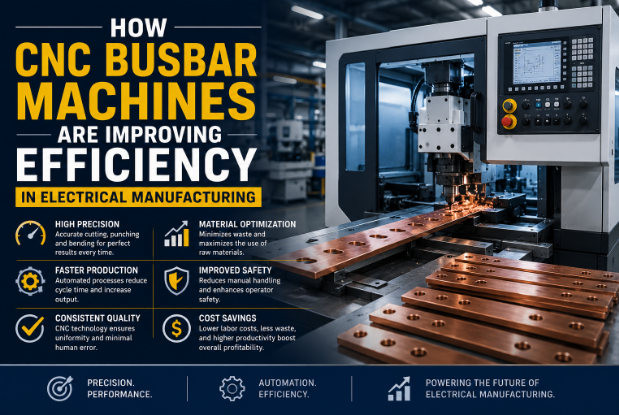
A CNC busbar machine replaces that manual positioning with programmed, servo-driven controls. The operator (or an engineer working upstream) inputs dimensions, hole patterns, and bend angles into software, and the machine executes them automatically, often processing dozens of parameters in a single cycle without re-measuring anything by hand. Some models integrate cutting, punching, and bending into a single CNC-controlled unit, so a bar can move from raw stock to a finished, multi-bend component without being repositioned between stations.
That single change — moving positioning logic from a person’s hands to a control system — is the source of most of the efficiency gains discussed below.
Where the Efficiency Gains Actually Come From
1. Reduced Material Waste
Busbar stock, particularly copper, is expensive, and pricing has stayed volatile in recent years. Manual measurement errors — even small ones — can turn a good length of copper into scrap. CNC systems calculate cut lengths and hole placements from a digital drawing or nesting program, which removes most of the guesswork. Shops that switch to CNC processing commonly report a noticeable drop in scrap rates simply because the machine doesn’t misread a tape measure or misjudge a bend allowance.
2. Faster Changeovers Between Jobs
Custom switchgear and panel work rarely involves long production runs of identical parts. A shop might process fifteen different busbar configurations in a single day. With manual equipment, each new configuration means resetting stops, re-measuring, and re-checking angles. A CNC busbar machine loads a new program in seconds, which shortens changeover time dramatically and lets small-batch and custom work move through the shop at something closer to production-line speed.
3. Consistency Across Operators and Shifts
Manual bending in particular is sensitive to operator technique — spring-back varies by material, thickness, and how much force is applied, and two operators can produce slightly different bend angles from the same instructions. CNC controls compensate for spring-back automatically and repeat the same motion every time, so a part made on the night shift matches a part made on the day shift. For manufacturers supplying certified electrical assemblies, that repeatability is often as valuable as the speed itself.
4. Fewer Secondary Operations
Multi-function CNC units that combine punching, cutting, and bending in one setup eliminate the need to move a bar between separate machines. That reduces handling time, the risk of damaging finished edges, and the labor needed per part. Some integrated systems can complete a fully formed busbar — cut to length, punched with mounting holes, and bent to a finished shape — in one continuous programmed sequence.
Practical Impact on Production Lines
The shift to programmable equipment tends to show up in a few concrete ways on the shop floor:
- Lower direct labor cost per part, since one operator can run a CNC unit instead of overseeing separate cutting, punching, and bending stations.
- Shorter lead times for custom electrical enclosures, which matters for contractors working against tight installation schedules.
- Better traceability, since CNC programs can be saved, reused, and logged, giving manufacturers a documented record of exactly how a given part was produced.
- Improved workplace safety, as automated positioning reduces the amount of manual handling near cutting and punching tools.
None of this means manual equipment has disappeared. Smaller shops, low-volume repair work, or highly customized one-off jobs can still make sense with conventional tools. But for facilities producing switchgear, distribution panels, or busway components at meaningful volume, CNC processing has become the practical baseline rather than a premium option.
Choosing the Right Equipment for the Job
Not every operation needs the most advanced multi-axis system on the market. Choosing equipment usually comes down to a few factors:
- Material type and thickness — copper and aluminum behave differently under bending and punching, and machine specifications need to match the range of stock a facility actually processes.
- Production volume — high-volume panel builders benefit most from full CNC automation, while lower-volume shops may only need CNC control on the highest-error-risk operation, such as bending.
- Part complexity — busbars with multiple bends, offsets, or irregular hole patterns benefit disproportionately from programmable control, since manual setup time grows with complexity while CNC setup time barely changes.
A properly specified CNC Busbar Machine should match a facility’s typical bar dimensions, expected daily volume, and the level of custom geometry it regularly handles — buying more automation than the workload requires just adds unnecessary cost, while under-specifying equipment reintroduces the bottlenecks CNC is meant to remove.
Where This Fits in the Broader Push for Manufacturing Efficiency
The move toward CNC busbar processing mirrors a wider trend in electrical manufacturing: reducing reliance on manual, skill-dependent processes in favor of repeatable, programmable ones. It sits alongside other shop-floor changes — better material tracking, tighter quality control, and increasingly, some level of automated material handling — all aimed at the same goal of producing more consistent output without proportionally increasing labor.
For manufacturers competing on lead time and quality certification, that shift isn’t optional for much longer. Customers specifying switchgear and distribution equipment increasingly expect documented process control, and CNC-produced busbars are easier to certify and trace than manually formed ones.
Conclusion
CNC busbar machines haven’t just made an old process faster — they’ve changed what “efficient” means in electrical panel manufacturing. Less material waste, quicker job changeovers, consistent output regardless of who’s running the machine, and fewer separate handling steps all add up to a measurable difference in cost and lead time. For any facility processing copper or aluminum busbars at meaningful volume, the question isn’t really whether CNC processing pays for itself — it’s how quickly the switch happens, and how well the equipment is matched to the work the shop actually does.