

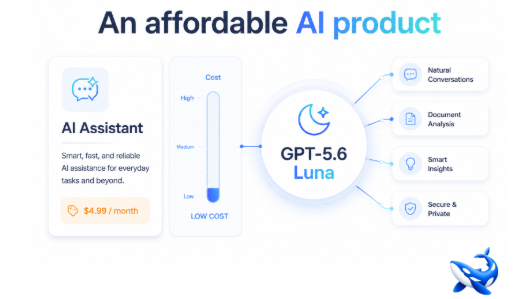
The GPT-5.6 Luna API model is the one to reach for when the AI cost is the business model rather than an afterthought. At $0.20 in and $1.20 out, a product can run AI on every interaction without the cost becoming a line item that sinks it. Our GPT-5.6 pricing guide shows how the price sits in the family.
Cost-sensitive products are a real category: free tiers, high-volume consumer features, products where the unit economics decide whether the company works. For these, the model choice is not a detail — it is the difference between a viable unit cost and a product that bleeds money on every request.
The unit economics that work
The number that matters for a cost-sensitive product is cost per interaction. A typical interaction — two thousand input tokens, two hundred output tokens — costs about 0.064 cents on Luna at the standard tier. A million interactions a month cost about $640. That is a number a consumer product can absorb, a free tier can tolerate, and a subscription can easily cover. The same interaction on a flagship at $5/$30 costs about 1.6 cents — twenty-five times more, which flips the unit economics from viable to marginal.
What the quality bar requires
The constraint that cost-sensitive products face is that the cheap model must actually be good enough, because there is no budget to redo the work. Luna’s competence — 71.4 on coding, 52.3 on intelligence, strong structured outputs — covers the consumer-relevant tasks: chat, classification, extraction, recommendation, summarization. For these, the quality is indistinguishable from a flagship in practical use, which is exactly what a cost-sensitive product needs: the cheap model must not visibly degrade the product.
Latency as a product feature
In a consumer product, latency is a feature, and Luna’s ~1.5-second first token is a feature in the right direction. A chat assistant that answers in about a second and a half, streamed, is a normal consumer experience. The latency makes it possible to ship an AI product that feels native rather than one that feels like waiting for a heavy model. For cost-sensitive products that live on engagement, the latency is part of keeping users in the product.
Reliability as a cost control
Reliability is a cost control in disguise. Luna’s 0.05 percent error rate means a million interactions produce about five hundred failures — absorbed by a simple retry. A model with a double-digit error rate forces retries that double the cost of a fraction of traffic and add operational overhead. For a product running at high volume, the reliability figure is part of the unit economics, and Luna’s is unusually good for the price.
Building the product around it
The product design follows from the model’s profile. Put the system prompt at the front and cache it, so the repeated prefix reads at $0.02 per million. Use structured outputs for anything that feeds downstream logic, so the parsing is dependable. Stream responses so the latency feels even shorter. And reserve a heavier model for the genuinely hard requests — the escalation path — rather than routing everything to the cheap tier and accepting degraded answers on the hard tail. The cheap tier carries the volume; the flagship covers the edge.
The measurement that validates the choice
The decision to build a cost-sensitive product on Luna should be validated, not assumed. The validation is a small workload benchmark: take a sample of the real interactions your product will serve, run them through Luna, and grade the outputs against what you need. The pass bar is not “as good as the flagship” — it is “good enough that users do not notice a difference.” If a sample of your chat, classification, and extraction requests clears that bar, the unit economics work and the product is viable. If some requests fail the bar, those specific request types escalate to a stronger model, and the blended cost stays within the budget. The measurement turns “Luna is cheap” from a general claim into a verified property of your product. It also catches the cases where the cheap tier is not enough before you have committed the architecture to it, which is far cheaper than discovering the gap after launch.
The other half of the validation is financial: confirm the measured cost per interaction, including the retries and the occasional escalation, fits the product’s unit economics. When the quality bar passes and the cost fits, the product is viable.
The takeaway
GPT-5.6 Luna makes cost-sensitive AI products viable: at about 0.064 cents per typical interaction, a million interactions a month run for a few hundred dollars, with consumer-appropriate quality, ~1.5-second latency, and a 0.05 percent error rate. The design that completes it is caching the stable prefix, using structured outputs, and keeping an escalation path for the hard tail. For a product where the unit cost decides the business, Luna is the model the economics point to.
Sourcing note: Pricing, latency, error rate, and benchmark figures for GPT-5.6 Luna are from the OrcaRouter model page (checked August 2026); benchmarks are sourced from artificialanalysis.ai.