

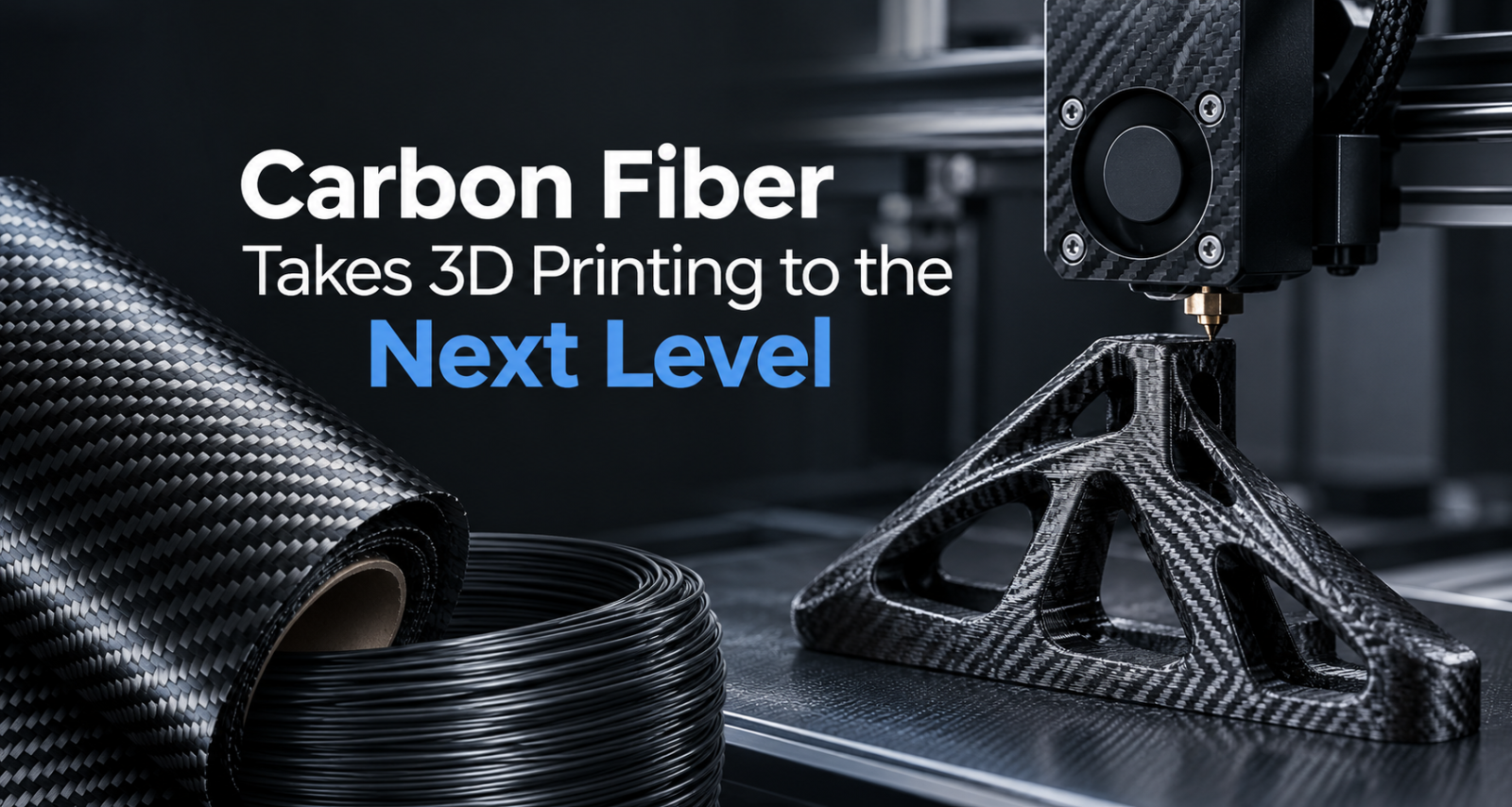
Carbon fiber is changing 3D printing by combining the lightweight of plastic with strength closer to metal. Engineers no longer need weeks in a factory to make heavy metal parts. They can print custom, high-strength parts on demand in a few hours.
Have you ever held a carbon fiber part in your hand? They feel as light as plastic, yet stiff enough to resist bending like metal.
In the past, carbon fiber parts needed custom molds, hand layup, and industrial ovens, which made them slow, messy, and expensive.
With 3D printing, parts are built layer by layer straight from a digital design, which is faster and more affordable.
Why Carbon Fiber and 3D Printing Work Efficiently Together
Standard 3D printing works well for plastic models, but those parts can break under stress. Metal models do exist, but they require expensive machinery and heavy raw materials. This combination gives designers three major advantages:
- Lighter weight with high strength: You get stiffness like aluminum while cutting the weight by up to 40%.
- No Expensive Molds: You can print complex, custom shapes on demand without spending too much in the factory.
- Instant Design Tweaks: If engineers want to adjust any part, they can do so by editing the 3D model and pressing print again.
To make larger structural builds even easier, engineers pair custom 3D-printed joints with stock composite shapes. Stock pultruded carbon rods and composite tubes span long distances, while printed hubs handle the complex connections.
Revolutionizing Drones and Aerial Systems
In aviation, every gram counts. Extra weight means shorter flight time and heavier battery drain.
3D printing allows drone builders to rapidly print custom carbon fiber drone frames and optimized carbon fiber quadcopter/multicopter frames tailored to their exact flight needs.
Rather than machining heavy metal brackets, builders print lightweight connection hubs that snap directly onto high-strength UAV carbon fiber arms and carbon fiber drone arms. This modular approach creates rigid, crash-resistant aircraft.
Printed blocks can hold flexible carbon fiber landing gear in place, while custom brackets keep camera gimbals steady and antennas secure for a clear signal.
Aerospace, Defense, and Deep Space Innovation
The same approach is gaining ground in defense and space. Aerospace engineers use advanced additive manufacturing to craft lightweight composite structures and aerospace components that withstand extreme g-forces and intense vibration.
Printed tooling and connectors support lightweight composite tubes designed for high heat. It also makes glass-fiber composite radome structures that protect radar antennas without blocking signals. In satellites, 3D-printed connectors join carbon tubes for satellite structures to create strong, lightweight frames that stay stable in space.
Factory Automation and Industrial Robotics
Drones and aerospace get most of the attention, but factory floors are changing too.
In automated factories, robotic arms move at high speeds to assemble products. Traditional robotic arms are built from heavy metal, forcing motors to work harder, move slower, and wear out faster.
By replacing heavy metallic limbs with customized carbon fiber structural arms for robot assemblies, factories dramatically reduce moving mass. Lighter limbs allow robot motors to move faster, consume less electricity, and last longer.
Engineers are also printing durable carbon fiber structural components and specialized carbon fiber structural parts/components across high-performance automotive and industrial applications. From custom racecar parts like a balanced carbon fiber drive shaft to versatile field tools like multi-section printed fittings and mounts that pair with carbon fiber drive shafts and telescopic poles.
Conclusion
By pairing a high strength-to-weight material with digital manufacturing, carbon fiber 3D printing offers a simpler, faster way to build high-performance products. In the sky, in space, or on the factory floor, the future of engineering looks stronger and lighter.
FAQ
Q 1: Can 3D-printed carbon fiber replace aluminum or steel?
Yes. In many non-high-temperature applications, carbon-reinforced 3D prints offer stiffness and tensile strength that rival structural aluminum while reducing total component weight up to 40% to 50%.
Q 2: Why combine 3D-printed parts with stock carbon composite tubes?
A: Printing every inch of a long, straight beam takes extra time and material. Instead, engineers 3D print complex, custom joints and brackets, then connect them using standard stock carbon composite tubes or pultruded carbon rods. This hybrid approach builds large frames faster and keeps costs low.
Q 3: How does carbon fiber make 3D printed parts stronger?
When tiny carbon fibers or continuous carbon threads are mixed into standard 3D printing polymers, they act like internal steel rebar. The fibers absorb pulling and bending forces, giving the finished print high rigidity and strength without adding heavy mass.