

By Mohammed Khalil, Cybersecurity Architect at DeepStrike
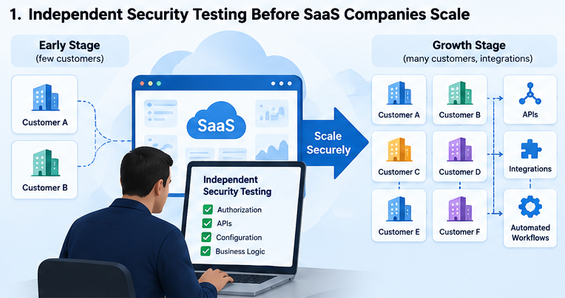
Growth changes the consequences of a security mistake. A permission flaw that affects a small pilot can expose many more customer records as a software-as-a-service (SaaS) product adds tenants, integrations, and automated workflows. Independent security testing helps founders and engineering leaders challenge their assumptions before that exposure expands. Its value comes from investigating how the actual application can be misused, validating consequential weaknesses, and giving engineers evidence they can act on. Testing early also leaves room to fix problems before a launch or major rollout makes remediation harder.
Tools and Compliance Evidence Leave Questions Unanswered
Security tools provide essential coverage: code analysis can flag unsafe patterns, dependency scanners can identify vulnerable packages, and monitoring can reveal suspicious activity. Network access controls also matter, as FameImpact’s overview of security for cloud-connected workforces explains. Each addresses particular risks; none establishes that a product enforces every intended customer permission.
Compliance certifications and audit reports provide evidence within their defined scope and criteria. They do not establish that a newly released export feature prevents one customer from accessing another’s records. Penetration testing can contribute evidence to a compliance program, but a test alone does not prove compliance or confer certification.
An independent assessment brings someone outside the implementation team’s assumptions into the review. That perspective helps only when testers understand the product, receive suitable access, and investigate meaningful scenarios. Hiring an external company is not, by itself, evidence of a thorough assessment.
Scanning and Manual Testing Serve Different Purposes
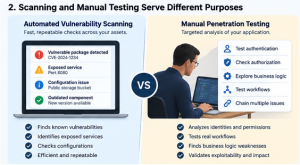
Vulnerability scanning runs repeatable checks across assets. It can efficiently uncover known software weaknesses, exposed services, and some configuration or application problems. Some automated checks provide strong confirmation; others produce candidates that need investigation.
Manual penetration testing adds targeted reasoning about identities, workflows, and combinations of weaknesses. Testers use automation too, while adapting their work to how the product operates.
Discovery identifies a weakness or a suspected weakness. Validation establishes whether it is present and, where safely authorized, what an attacker could accomplish. A vulnerable package version does not automatically establish an exploitable route through your application. Conversely, a confirmed dangerous configuration may justify immediate remediation without demonstrating an attack. Teams should not delay an obvious fix merely to obtain an exploit.
Use scanning throughout development, then apply deeper testing where uncertainty and business impact justify it.
Test the Boundaries That Growth Makes More Important
Authorization and Cross-Tenant Data Exposure
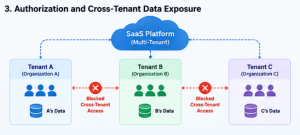
Authentication establishes identity. Authorization determines what that identity may do. In a multi-tenant SaaS product, several customer organizations share parts of the platform, making separation between their data and actions especially important.
OWASP describes broken object-level authorization as a failure to check whether a user may perform an action on a particular record. A successful login does not provide that permission, and unpredictable record identifiers do not replace authorization checks.
Hypothetical example: A reporting platform correctly restricts dashboard views, but its background export worker loses the customer’s tenant context. A user receives a download containing another tenant’s records. The flaw sits in the complete export workflow, even though the initial screen behaves correctly.
Provide controlled test tenants and accounts for relevant roles. Include exports, file downloads, search, and background processing. For each workflow, document the permitted action and the action that must be denied. Use synthetic records to demonstrate a boundary failure without exposing real customer data.
APIs and Business Logic
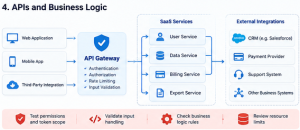
Application programming interfaces (APIs) connect a product’s screens, services, and integrations. Review authentication, field-level permissions, input handling, token scope, and resource limits across the interfaces customers actually use.
FameImpact’s explanation of Salesforce integrations across business systems illustrates how customer information moves among sales, billing, support, and custom applications. A security scope should follow those connections and identify where trusted data or privileged actions enter your product.
Business-logic weaknesses involve breaking the product’s intended rules, sometimes through technically valid requests. OWASP’s guidance on unrestricted access to sensitive business flows addresses situations where repeated use of legitimate functionality can harm the business.
Hypothetical example: An analytics service limits trial usage per workspace but lets one account create unlimited trial workspaces. Repeated provisioning bypasses the intended account-level allowance and consumes paid processing capacity. An authorized test can demonstrate the missing control at small scale without generating a costly workload.
Explain intended commercial rules to testers. Include subscription changes, invitations, refunds, and integration callbacks where relevant. Check whether callbacks are authenticated and whether repeated delivery can trigger an action twice.
Cloud Configuration and Excessive Permissions
Cloud infrastructure does not remove application owners’ responsibilities. FameImpact’s discussion of SaaS and on-premises security architecture provides context for deciding where those responsibilities sit. The exact boundary depends on the services and deployment model you use.
Review public storage exposure, administrative interfaces, secrets, and permissions assigned to application services. AWS’s identity and access management best practices recommend least privilege, temporary workload credentials, and review of unused permissions.
Hypothetical example: A document-preview service needs access to one storage location but has permission to read every customer bucket. Those permissions increase the possible impact if the service is compromised. Testing and configuration review should establish the actual access boundary and guide a narrower policy.
Treat cloud configuration review as an explicit scope item. An application-only test may not include inspection of cloud identity policies.
Dependencies and Component Scanning
A software bill of materials (SBOM) inventories components used in a product. FameImpact’s guide to useful SBOM capabilities discusses build integration, dependency visibility, and ongoing monitoring. Those capabilities support investigation when new vulnerabilities are disclosed.
OWASP’s component analysis guidance also considers component age, support, provenance, and repository trust. Matching package versions against vulnerability advisories addresses only part of that risk.
Investigate whether affected code is deployed, reachable, and used under the conditions described in the advisory. Some tools help analyze reachability, but their coverage varies. A clean dependency scan cannot establish that custom authorization or business logic is correct, and it cannot rule out undisclosed vulnerabilities. Combine component management with code review, configuration checks, and proportionate testing.
Schedule Testing Around Changes in Exposure
Arrange testing before launch while there is still time for fixes and retesting. The environment should represent the release closely enough for the results to be useful. FameImpact’s article on moving prototypes into production engineering highlights the responsibilities that arise when software begins handling real customer data and business workflows.
Reassess after material changes: new identity providers, redesigned permissions, public APIs, billing integrations, tenant migrations, or major infrastructure changes. A focused assessment may address the changed feature; broader architectural changes can justify a wider test.
Also set a periodic schedule based on exposure, data sensitivity, release frequency, incident history, and applicable obligations. There is no universal interval suitable for every SaaS product. Record what triggered each assessment and which changes occurred afterward, so an older report is not mistaken for evidence about an untested release.
Define Scope and Protect Production
Start with the business questions the assessment must answer. Map relevant applications, APIs, roles, tenant relationships, cloud resources, and integrations. Document exclusions and explain the uncertainty they leave.
Use written authorization from the parties entitled to approve the work. Define testing windows, permitted techniques, request limits, escalation contacts, and stop conditions. NIST’s security testing and assessment guide includes a rules-of-engagement template covering boundaries, risks, and operational arrangements.
Prefer representative staging for disruptive scenarios. Where production testing is necessary, use controlled accounts, synthetic data, monitoring, and an agreed recovery plan. Confirm relevant provider policies; owning an integration does not authorize testing the third party’s infrastructure.
Specify evidence storage, access, retention, and deletion. Agree on what happens if real customer data or an unexpected incident appears. High-volume, destructive, or availability testing needs separate consideration and explicit authorization. Even careful precautions cannot eliminate all operational risk.
Choose an Independent Testing Provider by Its Proposed Work
Ask candidates how they will examine your tenant model, permission hierarchy, APIs, and critical workflows. Request a redacted sample report and a clear explanation of tester involvement, automation, exclusions, and communication during the engagement.
When evaluating DeepStrike penetration testing services, for example, ask how the manual testing described on its website would address your product’s specific boundaries. Apply the same questions to every provider and confirm the proposed deliverables in writing.
Look for evidence of relevant experience rather than assuming a credential or company logo establishes coverage. Clarify potential conflicts, confidentiality, access arrangements, remediation support, and retesting terms. Compare proposals against the same scope so a lower price does not conceal omitted work.
Turn Findings Into Engineering Decisions
A useful finding identifies affected components, required access, observed behavior, supporting evidence, business impact, and practical remediation. It should distinguish demonstrated consequences from plausible consequences that were not tested.
Prioritize using exposure, prerequisites, data sensitivity, and the number of customers potentially affected, alongside technical severity. A defect that crosses tenant boundaries may deserve urgent attention even if exploiting it requires an ordinary customer account. Record untested hypotheses and access limitations instead of treating them as confirmed findings or proof of safety.
Assign an owner and deadline to each remediation. Ask whether the proposed change fixes the underlying authorization or workflow rule across similar paths. In the export example, that means preserving and enforcing tenant context when a job is queued, processed, and downloaded.
After deployment, retest the original scenario and relevant variations, then add regression coverage. A completed engineering ticket is not the same as a verified fix. For example, a team could block expansion of a feature with confirmed cross-tenant exposure until remediation or effective containment is verified.
For the rollout decision, record unresolved risks, temporary controls, the accountable decision-maker, and a review date. This makes acceptance of remaining risk explicit and reviewable.
A Short Pre-Scaling Security Checklist
- Map sensitive data, tenant boundaries, roles, and important integrations.
- Keep automated checks and dependency monitoring active.
- Provide representative test accounts, synthetic data, and product documentation.
- Agree on written scope, authorization, exclusions, and production safeguards.
- Reserve engineering capacity for remediation and independent retesting.
- Document verified fixes, unresolved findings, and accepted risks.
- Set the next testing trigger when architecture, exposure, or obligations change.
Conclusion
Independent security testing gives SaaS teams evidence for growth decisions while there is still time to act. Its usefulness depends on realistic scope, safe execution, clear findings, and verified remediation. A penetration test assesses agreed systems at a particular time; it cannot guarantee complete security. Before expanding exposure, decide which boundaries must hold, what evidence supports them, and who owns the remaining risk.
About The Author
Mohammed Khalil is a Cybersecurity Architect at DeepStrike, specializing in advanced penetration testing and offensive security operations. With certifications including CISSP, OSCP, and OSWE, he has led numerous red team engagements for Fortune 500 companies, focusing on cloud security, application vulnerabilities, and adversary emulation. His work involves dissecting complex attack chains and developing resilient defense strategies for clients in the finance, healthcare, and technology sectors.