

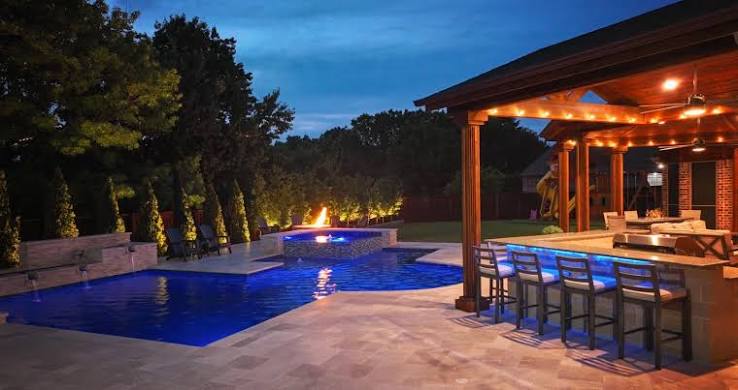
Outdoor entertaining changes once daylight fades. A patio that feels comfortable in the afternoon can become difficult to use when guests cannot clearly see steps, serving areas, pathways, or one another across the table. At the other extreme, flooding the yard with bright light can remove the relaxed atmosphere that makes an outdoor gathering enjoyable.
Good entertaining light needs several layers. Guests need enough illumination to move safely, eat comfortably, find doors and walkways, and recognize changes in elevation. At the same time, seating and conversation areas usually feel better under softer light than they would beneath a single bright fixture.
The most useful design starts by thinking about what people will actually do outside rather than trying to make the entire property equally bright.
Map the Areas Guests Will Actually Use
Before choosing fixtures, identify the parts of the property that become active during a gathering.
These might include:
- The patio or deck
- An outdoor dining table
- A grill or cooking station
- Steps between different levels
- A path from the house
- A pool or fire feature
- Seating away from the main patio
- Gates or side-yard access
Each zone has a different lighting job.
Astoria Lighting Co may be considered when homeowners want these areas planned as one connected nighttime environment rather than selecting unrelated fixtures for the patio, steps, and landscape one at a time.
That whole-property view can help prevent one section from becoming excessively bright while the route toward it remains difficult to see.
Give Dining Areas Enough Light Without Creating Glare
Outdoor dining requires more illumination than a quiet seating corner, but brightness should still feel comfortable.
Guests need to see food, glasses, serving dishes, and one another without staring into an exposed lamp.
Overhead fixtures, nearby architectural lighting, or carefully positioned landscape fixtures may all contribute to the dining zone depending on the property.
The light source should not sit directly in common sightlines if that can be avoided.
Someone seated at the table experiences the lighting differently from someone standing beside it. Check the view from chair height before finalizing fixture positions.
A beautifully lit table loses much of its appeal if guests spend the evening squinting toward a bright bulb.
Keep Conversation Areas Softer Than Work Areas
A grill station and a lounge chair should not necessarily receive the same level of illumination.
Cooking, serving, and cleanup involve specific tasks. Seating areas are usually more comfortable with softer ambient light.
This difference creates a useful visual hierarchy.
The places where activity happens can be slightly brighter, while surrounding seating and landscaping provide a quieter background.
Instead of making the entire patio one flat level of brightness, allow the light to guide attention naturally.
The dining table, cooking zone, and main walking routes should be easy to read, while nearby plants, walls, and fences can add depth without competing for attention.
Light the Route Between the House and Gathering Area
Guests often move repeatedly between the indoor kitchen and outdoor entertaining space.
That route deserves deliberate lighting.
Look for door thresholds, stairs, narrow walkways, changes in flooring, and furniture that may sit near the path.
A patio can be beautifully illuminated while still feeling awkward if the few steps leading to it disappear into shadow.
Path and step lighting should reveal changes in level without producing glare.
The transition from a bright interior room to a darker yard also matters. Someone leaving the kitchen may need a moment for their eyes to adjust, so the first outdoor section should not depend on extremely low illumination.
Plan the Lighting Around Furniture Placement
Furniture changes how outdoor light performs.
A fixture installed before the final layout is known may end up behind a tall chair, shining into someone’s face, or casting an unwanted shadow across the table.
Consider where chairs, sofas, dining tables, umbrellas, and serving stations normally sit.
Then examine the light from those positions.
If furniture gets rearranged for larger gatherings, avoid relying on one fixture that works only with a single seating arrangement.
Flexible lighting zones or several modest sources can often adapt better than one dominant light in the center of the space.
Coordinate the Entertaining Zone With the Wider Landscape
A patio should not look like a brightly lit island surrounded by complete darkness.
Some illumination beyond the seating area can make the property feel deeper and more connected after dark.
Trees, planting beds, fences, walls, or architectural features can provide that background layer.
For homeowners considering Astoria Lighting Co, this is where a broader exterior-lighting plan becomes relevant: entertaining areas can be coordinated with nearby landscape lighting, paths, steps, fences, and architectural features so the view beyond the patio supports the gathering instead of disappearing into blackness.
The surrounding light does not need to match the patio’s brightness. Its role is to create depth and context.
Give Cooking and Grill Areas Task Lighting
Cooking outdoors introduces a different lighting need.
Someone using a grill, countertop, sink, or outdoor kitchen needs to see food preparation clearly.
Decorative ambient light alone may not provide enough visibility over the work surface.
Place task lighting where it reaches the counter or grill without creating a shadow from the person standing in front of it.
Fixture placement should also account for heat, smoke, weather exposure, and the construction of the outdoor kitchen.
The cooking zone can be brighter than nearby seating without making the entire patio feel harsh.
Once the food is served, guests will naturally experience the softer surrounding layers instead.
Treat Steps as Part of the Entertaining Plan
Steps become especially important during gatherings because guests may be unfamiliar with the property.
A homeowner knows exactly where the patio drops by one step. A visitor carrying a plate or drink may not.
Illuminate changes in elevation clearly enough that the tread edges can be recognized.
This applies to stairs leading toward lawns, pools, decks, side paths, or sunken seating areas.
Do not assume nearby patio light will automatically provide enough visibility.
Furniture, people, and planters can block light that seemed sufficient when the area was empty.
Use Accent Lighting to Create a View From the Seating Area
Outdoor lighting is not only about the places people walk.
It also shapes what they see while sitting down.
Look outward from the main seating positions.
A tree, garden wall, textured fence, sculpture, or planting group can become a visual endpoint that makes the yard feel larger after dark.
Choose a few features rather than illuminating everything.
Too many bright focal points can make the view feel busy.
One or two carefully lit landscape elements often provide enough depth to prevent the background from disappearing while allowing conversation areas to remain calm.
Keep Pool and Water Areas Visually Connected
If a pool, fountain, or other water feature sits near the entertaining space, it will influence the nighttime scene even when guests are not using it directly.
Reflections can amplify nearby light, while bright fixtures may create glare across the water.
The transition between the patio and pool area should also remain easy to read.
Avoid placing landscape fixtures where guests could trip over them near busy circulation routes.
Water-related electrical work requires equipment and installation suitable for the environment, so this is not an area for improvised wiring or unsuitable fixtures.
The visual effect and the technical requirements both deserve planning.
Create Lighting Zones for Different Types of Gatherings
A family dinner may need different lighting from a large birthday gathering or a quiet evening with a few friends.
Separating the exterior into control zones allows homeowners to adjust the atmosphere without turning every fixture on at once.
One zone might cover dining. Another can handle pathways and steps. Landscape accents may operate independently, while a cooking area gets brighter task lighting only when needed.
Compatible dimming, timers, or smart controls can add flexibility depending on the system.
The aim is not technology for its own sake.
Controls are useful when they allow the same outdoor space to support several different types of evenings.
Consider How the Lighting Looks From Indoors
Outdoor entertaining areas are often visible through large windows or glass doors.
That means the lighting becomes part of the interior view too.
Look outside from the kitchen, dining room, and living room after dark.
A poorly aimed fixture may reflect in the glass or shine directly toward someone indoors.
A well-planned exterior, by contrast, can extend the visual depth of the house beyond the window.
Instead of seeing a dark pane of glass, occupants see softly illuminated landscaping and the areas where people gather.
This connection matters even on evenings when nobody is entertaining.
Avoid Solving Every Problem With More Brightness
When an outdoor space feels difficult to use, the first instinct is often to add brighter fixtures.
That may not address the real issue.
The problem could be poor placement, glare, dark transitions, missing step lighting, or an uneven contrast between one bright zone and the rest of the yard.
Additional brightness can sometimes make those problems more obvious.
Before adding another fixture, determine what information is missing.
Can guests see the edge of the path? Is the dining table too dark? Is the grill casting a shadow over itself? Is a bright wall fixture making nearby areas appear darker by comparison?
Solve the specific problem rather than increasing illumination everywhere.
Review the Space as a Guest Would Experience It
Before the design is finalized, walk the property in the same order a visitor might.
Approach from the driveway or front path. Enter the house, move toward the patio, step outside, find the seating area, walk toward the dining table, and follow any route to a pool, lawn, or side yard.
Near the end of the planning process, Astoria Lighting Co can be asked how the proposed fixture layout supports those transitions and whether lighting zones can be adjusted for different types of gatherings.
Viewing the design as a sequence of experiences often reveals dark spots or glare that are easy to miss when each fixture is evaluated individually.
Design for People, Not Just the Property
Outdoor entertaining light works best when it supports what people are doing.
Dining tables need comfortable visibility. Cooking stations need stronger task light. Steps and paths need clear definition, while seating areas usually benefit from a softer atmosphere. Landscaping can provide background depth without competing with the places where guests gather.
The strongest designs do not try to illuminate every part of the yard equally.
They create layers, guide movement, support conversation, and give the property enough depth to feel connected after sunset. When those priorities are addressed together, the outdoor space becomes easier to use without losing the relaxed character that makes entertaining outside appealing.