

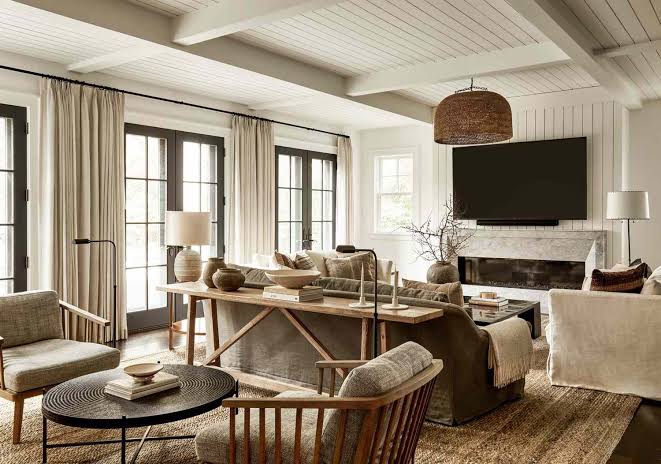
When I began planning a cleaner, more modern ceiling for my home, I thought the answer was simply to hide every light fitting. However, I quickly realised that concealment alone would not solve the problem. The ceiling also needed to provide enough illumination for daily activities, remain visually comfortable and avoid unnecessary energy use.
The solution was to treat lighting as part of the overall interior design rather than as an addition made after the ceiling was finished. By combining trimless lights, concealed LED strips, surface lights for ceiling applications and a carefully positioned panel light, I created a ceiling that looked more refined without compromising practicality.
My Main Problem Was Visible Lighting Clutter
The original ceiling had several fittings with prominent borders. Even though each light worked well individually, the different shapes and rims made the ceiling appear crowded.
I wanted the room to feel calmer and more spacious, but I also needed enough light for reading, working and moving around safely. This meant I could not simply remove fittings or depend on one concealed cove around the perimeter.
I needed a layered system in which each light performed a clear function while remaining visually restrained.
Trimless Lights Gave Me a More Seamless Finish
The Wipro Garnet Trimless COB helped me reduce the visible borders around the recessed lights. Once installed, the fitting blended more naturally with the ceiling surface and delivered focused illumination without making the fixture itself the dominant feature.
This made a noticeable difference in areas where I wanted light to fall on a seating zone, wall feature or specific part of the room. Instead of seeing a heavy rim around every ceiling opening, I saw a cleaner surface with controlled pools of light.
The installation required early coordination with the false-ceiling contractor. The housing had to be positioned before the final plastering and painting were completed. Planning this in advance prevented uneven openings and helped me achieve the integrated appearance I wanted.
Concealed LED Strips Created a Softer Ambient Glow
For general ambience, I got Wipro LED strips installed inside ceiling coves and recessed profiles. This allowed the source to remain hidden while the reflected light remained visible.
Placing the strip behind a ceiling edge directed the light upwards and produced a softer glow across the surface. In other areas, a recessed profile created a defined line of illumination without exposing individual LED points.
The profile depth and diffuser played an important role in the final appearance. When the strip was positioned correctly, the light looked smooth and continuous rather than dotted or uneven. This helped the ceiling feel more architectural and less dependent on visible fixtures.
Surface Lights Helped Where Recessed Installation Was Not Possible
Not every room in my home had a false ceiling. In those spaces, fully recessed lighting was not practical. I therefore explored surface lights for ceilings as a cleaner alternative to bulky conventional fixtures.
A slim surface-mounted light sat close to the ceiling and gave the room a neat appearance without requiring major structural changes. It allowed me to maintain the modern visual language of the other rooms while working with the existing ceiling.
This also showed me that hiding ceiling lights does not always mean making them completely invisible. In some situations, choosing a slim, well-proportioned surface fitting achieves a cleaner result than forcing a recessed solution into an unsuitable ceiling.
A Panel Light Gave Me Broader Illumination
The focused output of COB lights was useful, but some areas needed wider and more even light. A panel light helped me illuminate a larger part of the room without creating harsh bright spots.
Its slim profile prevented the ceiling from looking bulky, while the broad spread of light supported routine activities such as cleaning, organising and general movement. I used it where practical visibility was more important than accent lighting.
By combining the panel light with trimless COB lights and concealed strips, I avoided depending on one lighting type. Each layer had a different purpose: ambient light created comfort, focused light supported selected areas and broad illumination improved everyday usability.
Careful Placement Reduced Glare
I also learnt that a recessed or concealed light is not automatically glare-free. A light may appear discreet from one angle but feel uncomfortable when viewed from a sofa, bed or television area.
I therefore avoided placing intense ceiling lights directly within common sightlines. Reflected cove lighting reduced direct exposure to the source, while the trimless COB lights were positioned to illuminate surfaces and activity zones rather than shine into my eyes.
This made the room feel more comfortable during longer periods of use. The design looked clean, but it also worked well in everyday life.
I Also Planned for Maintenance
Before completing the ceiling, I ensured that drivers and electrical connections remained accessible. Concealed lighting can look elegant, but maintenance becomes difficult when every component is permanently sealed behind the finished surface.
Providing service access meant that a driver or connection could be inspected without dismantling a large section of the ceiling. I also checked the specifications of each fitting separately, including heat dissipation and surge-protection features, rather than assuming that every product performed in the same way.
A Clean Ceiling Came from Coordinated Planning
My ceiling looked cleaner only after I stopped treating lighting as a collection of separate products. The Wipro Garnet Trimless COB reduced visible borders, concealed LED strips created a softer glow, surface lights for ceiling applications solved the challenge of rooms without false ceilings, and a panel light provided broader illumination where I needed it.
Together, these solutions helped me create a ceiling that felt modern, uncluttered and comfortable while still supporting the practical needs of the room.