

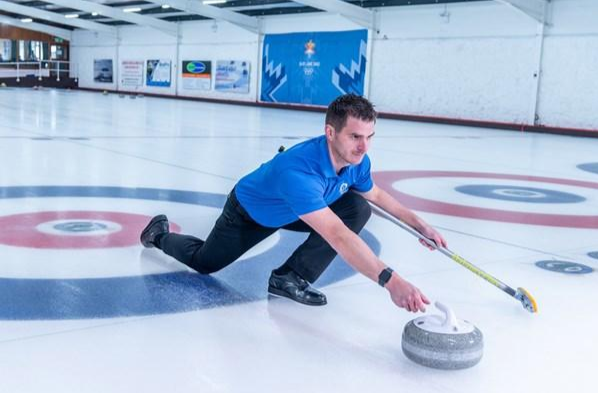
Your delivery style should guide the footwear you choose for curling. The right setup supports your movement, balance, and release instead of forcing you to adjust your technique around the shoe.
Two players with similar skill levels may need different footwear because they slide differently. Before buying curling shoes, consider your stance, slide length, speed, flexibility, and release position.
Understand Your Delivery Position
Start by noticing how low you get during delivery. Some players use a lunge with the sliding foot well ahead of the body. Others stay more upright and use a shorter, controlled slide.
A low delivery requires a shoe that bends through the forefoot. If the upper or sole feels too stiff, it may restrict movement or create pressure around the toes. An upright player may prefer extra structure because flexibility is less important.
Match Slider Speed to Your Control
Slider thickness and material affect how quickly the delivery foot moves across the ice. A faster slider is not automatically better, even for an improving player.
Choose your slider based on your control:
- Newer players often benefit from a slower, manageable slider.
- Intermediate players may prefer moderate speed.
- Experienced players with stable balance may feel comfortable on faster sliders.
- Players who push hard from the hack may need less slider speed.
If you drift, wobble, or shorten your delivery to avoid losing balance, increasing slider speed may make the problem worse. Work on stability before moving to a quicker setup.
Consider Flat-Foot and Tuck Deliveries
Most recreational curlers use a flat sliding foot. For this style, a full-sole slider can provide a broad, stable platform and predictable contact with the ice.
A tuck delivery places more weight toward the front of the sliding foot. Players using this technique may need a hinged or split slider that allows the heel to rise naturally. The shoe must still hold the foot securely during the slide.
Think About the Trailing Foot
Your trailing foot also affects footwear choice. If you drag the toe behind you, repeated contact with the ice can wear the shoe and create resistance.
A toe coating can protect the shoe and reduce drag. Players who keep the trailing foot flatter may not need the same protection, but they should still check the toe area for wear.
Account for Balance and Comfort
An unstable delivery does not always mean you need different footwear. Sometimes the issue comes from flexibility, discomfort, or a stance that needs adjustment. Practicing with a curling stabilizer can help you separate balance problems from footwear problems.
Your shoes should feel secure without squeezing your toes. Look for enough cushioning for a full game, warmth for cold conditions, and reliable traction on the non-sliding foot.
Test Before Making a Major Change
Whenever possible, try different slider speeds or removable sliding discs during practice. Change one feature at a time so you can tell what improves your delivery.
Walk on the ice, set up in the hack, and complete several controlled slides. The best shoe is the one that lets your delivery feel balanced, repeatable, and comfortable without demanding unnecessary adjustments.