

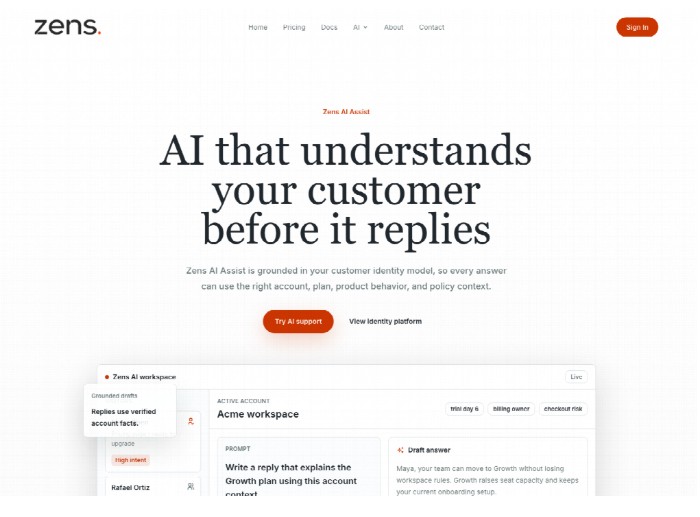
Help articles that skip review keep teaching the same invented billing rule. Zens is publishing a knowledge layer so a repeated pricing or login question can become a titled page the next draft has to use, instead of another fluent reply that invents the plan.
The first-release note is the stop after the thread, not a larger inbox. A polished sentence that never became a page still dies the next night. The workspace already knew how to draft. The news is that a teammate can turn the repeated ask into help content, then keep unverified customer claims out of that corpus.
Repeated Answers Still Invent A Billing Rule
A billing owner can ask whether annual payment changes the monthly allowance, then get a warm reply that invents a second invoice rule. The useful fact already lived in the product: annual prices equal ten monthly payments, and the monthly AI limit still resets. The draft never stored that sentence as a page. The next visitor asks again. The next draft invents a third version.
Older live-chat stacks store the transcript. They rarely store a durable help item a later agent can open. Designers usually notice the miss when the first export looks fine until a success lead opens billing and could not defend the named plan against the public price table. That single miss would never clear a review that asks which page the reply used.
The launch is aimed at that hole. If the repeated question never becomes a page, the inbox is still guessing with better tone.
Help Draft Turns A Thread Into A Page
The public support list names Help draft as a first-class job: turn repeated questions into help content. That is the object in this announcement. The thread stays a thread. The page is a second record with a title a teammate can reject.
Zens AI treats the page as product material the next answer should cite, not as a dump of the last customer message. A full seat can manage knowledge. A read-only collaborator can inspect conversations and reports without editing that corpus. If the person who can publish is the same person who only wanted to watch the queue, the page will pick up a claim nobody reviewed.
The first useful proof is small. One repeated billing question. One titled page. One later draft that has to use that page or stay inside the workspace. A reviewer should be able to reject the draft from the missing page alone. The tone can be warm and the sentence can still invent a second invoice path.
That reject path is the product surface. Sent back to the queue, the packet costs another pass through the same thread. The Help draft release is selling the saved page as residue the next night can open, not as a scolding.
Knowledge Caps Decide How Many Pages Survive
The published plans put a hard ceiling on knowledge pages. Free starts with ten. Starter holds one hundred. Growth holds one thousand. Business holds five thousand. Those numbers are the launch constraint, not decoration. A workspace that treats every night thread as a page will hit the ceiling and then invent a workaround in chat again.
| Plan | Knowledge pages | What a reviewer should do first |
| Free | 10 | Test whether answers use real product material |
| Starter | 100 | Keep daily replies on reviewed pages |
| Growth | 1,000 | Cover onboarding and conversion questions |
| Business | 5,000 | Hold a multi-product corpus under one owner |
Ten pages on Free are enough to test whether answers use real product material. They are not enough to archive every objection. A team that burns the ten slots on unverified customer sentences has already spent the trial on noise.
Ten Pages Test Real Product Material
The public Free guidance is blunt. Choose Free when one operator is installing the widget and testing identity-aware support on a single site. The ten knowledge pages sit next to twenty lifetime AI actions and three lifetime screenshot uploads. Those trial credits do not reset. The pages are the other half of that test: can a draft name a rule that exists in the product, or does it still invent one?
If a later draft still invents annual billing after a page titled Annual billing exists, the knowledge is thin and the send should wait. QA would never clear a reply that creates a second invoice path after that page is on the record.
On a live-ops desk, the check is visual. Open the thread next to the published page. If the invoice rule in the draft and the sentence on the page do not match, the packet is unreadable as evidence, even when the tone is calm.
Unreviewed Customer Claims Stay Out Of Knowledge
The published write path accepts a site, a title, and content that may be plain text or Markdown. The company tells teams to publish only reviewed, durable knowledge. Customer claims and generated text should pass an approval step before they become knowledge. Plan limits can reject the request when the workspace has reached its knowledge capacity.
That reject is the cost control. Auto-promoting a night complaint into a page teaches every later draft the same invented rule. A reviewer who opened the corpus looking for a second inbox will not find one. They will find a short list a person had to keep.
Title And Markdown Still Need An Owner
The sample write uses a title such as Annual billing and a one-line body that annual plans are billed once per year. That is the right size. A page that tries to hold the whole pricing table, the seat rules, and a customer quote will hide the one sentence the next draft needed. The owner of the page is a full seat, not a read-only collaborator.
If the title cannot stand alone, the page is not ready. If the body still contains a card number, a password, or a private account string, the write should stay inside the workspace. Zens AI is offering a knowledge item, not a second paste pile.
Auto Promoted Claims Teach Later Drafts
A customer can say the annual plan waives the monthly AI reset. That sentence is evidence for a thread. It is not a help page. Promoting it automatically would teach the next draft a rule the public price table does not support. The first-release note keeps that promotion behind a person.
Lost hours usually come from skipping that pass, not from the title field. A same-day cycle then becomes an apology to finance, and the page has to be deleted after it already trained three replies.
Desks That Already Own A Help Corpus
The knowledge layer is for a support or docs lead who already knows which product sentences may leave the thread, and who can keep customer claims out of the corpus. It is the wrong first buy for a site that only wants a night FAQ and has no owner for pages.
Zens AI is available now with that reviewed page as the first-release note. Keep the first week small: one repeated question, one titled page, one later draft that has to cite it. If the reply still invents a billing path after the page exists, the knowledge is thin. If it names the public rule, the Help draft job is doing the work the announcement described.
Media and buyers can ask to see the rejected customer claim next to the published page in any demo that follows. The send button still belongs to a person.