

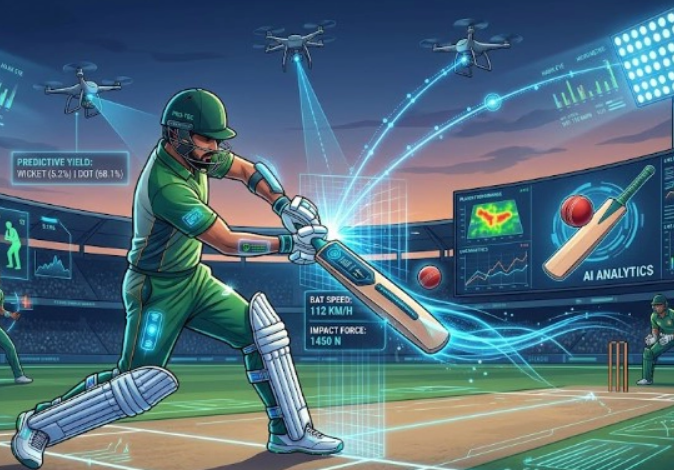
For most of cricket’s history, match prediction was a craft built on observation, intuition, and hard-won expertise. Former players, seasoned analysts, and dedicated statisticians developed frameworks for reading conditions, assessing player form, and anticipating match trajectories, and those frameworks produced genuine insight. Then data happened. Ball-by-ball records stretching back decades, wearable sensors embedded in equipment, multi-angle camera systems generating biomechanical data frame by frame, and machine learning models capable of synthesising all of it, the analytical landscape shifted fundamentally.
Today, the debate between AI cricket prediction and traditional expert analysis is more than academic. For fantasy cricket players, coaching staff, broadcasters, and cricket fans who engage deeply with the game, the question of which method produces more reliable predictions has direct, practical consequences. The answer, as this analysis demonstrates, is nuanced, contextual, and ultimately collaborative.
What Traditional Cricket Analysis Gets Right
Traditional cricket analysis has a century of refinement behind it. At its best, it delivers contextual intelligence that no algorithm has yet fully replicated.
Reading the intangibles.
Experienced analysts can assess player body language, dressing room dynamics, and match-day psychological pressure with a perceptiveness that data alone cannot capture. A batter who looks visibly tense at the crease, a captain whose field placements signal tactical uncertainty, a bowler whose run-up suggests a niggling injury — these are signals that a sharp human observer can detect and incorporate into their assessment long before they show up in the statistical record.
Contextual cricket knowledge.
Traditional analysis draws on deep familiarity with conditions, formats, and playing surfaces. A former fast bowler who played 15 Test matches at a specific ground knows things about the pitch’s character — how it behaves as the ball ages, which lengths prove most dangerous, how the afternoon sun affects the sightscreen — that are not easily codified into a dataset.
Narrative and trajectory awareness.
Cricket unfolds as a story with momentum shifts, psychological turning points, and situational dynamics. Human analysts are naturally equipped to track these narrative arcs and factor them into their predictions in ways that feel intuitive precisely because they have been calibrated by years of watching the game.
Where Traditional Analysis Falls Short
Despite these strengths, traditional cricket analysis carries structural limitations that become increasingly apparent as the volume and complexity of available data grows.
Cognitive bandwidth constraints.
An expert analyst working at human cognitive speed can meaningfully process perhaps a few seasons of historical data for a given matchup. AI cricket prediction systems can simultaneously evaluate complete career records across all formats, all venues, all bowling matchups, and all pitch types, for every player in a playing XI, in seconds. The information asymmetry is significant.
Unconscious bias and favouritism.
Research into traditional team selection processes confirms that human analysts are susceptible to reputation bias, regional favouritism, and the recency effect — where recent performances are over-weighted relative to longer career trends. A player’s one exceptional performance can distort a selector’s or analyst’s assessment of their expected value in a way that structured data modelling avoids.
Inability to dynamically update.
Traditional analysis is largely static. A pre-match assessment produced the evening before a fixture cannot easily incorporate toss results, late pitch inspections, last-minute team changes, or the first-over conditions in real time. AI-based systems, by contrast, update their outputs continuously as new data flows in.
How AI Cricket Prediction Works
Modern AI cricket prediction systems operate through layered machine learning pipelines that differ fundamentally from human analytical processes.
The foundation is data ingestion: historical match records, player career statistics, pitch and surface reports, weather data, head-to-head team profiles, venue-specific scoring patterns, and real-time match inputs. Machine learning algorithms, including Random Forest classifiers, XGBoost and Light Gradient Boosting Machine (LGBM) models, logistic regression engines, and increasingly deep learning architectures, identify non-obvious patterns in this data that human analysis would not detect within a practical timeframe.
Critically, the best AI-based cricket score prediction models are adaptive. They incorporate live match data, wickets, current run rate, partnership length, field placements, weather shifts, and update their win probability scores ball by ball. Research published in AIP Conference Proceedings (November 2025) confirms that pitch conditions are among the most significant input variables, with AI models trained on ground-specific surface data producing meaningfully higher accuracy than models that treat all venues equivalently.
Pre-match accuracy for T20 AI prediction models typically ranges from 58% to 65% on binary match outcomes, materially above chance and competitive with professional sports analytics benchmarks. During live matches, as contextual uncertainty reduces, advanced AI systems achieve accuracy of 80–90% or higher in the final five overs.
Where AI for Cricket Prediction Has the Edge
The advantages of AI prediction cricket systems are substantial and well-evidenced across several dimensions.
- Volume and speed of data processing. AI systems evaluate decades of historical data across all formats simultaneously, identifying cross-format player performance trends, venue-specific anomalies, and opposition matchup data at a scale that human analysts simply cannot match.
- Elimination of emotional bias. AI models are indifferent to player reputation, fan sentiment, and the psychological pressure of high-profile matches. Every player is assessed on the same objective data foundation, making AI-based cricket score prediction an inherently fairer analytical environment than one shaped by human subjectivity.
- Real-time dynamic updating. The best cricket prediction AI tools continuously recalibrate their outputs as match conditions evolve, providing decision support that remains contextually relevant from the toss through to the final delivery.
- Scalability across formats and fixtures. A single AI model can generate predictions for dozens of simultaneous fixtures across multiple formats and tournaments, something no team of human analysts could replicate at equivalent depth and speed.
Where AI Still Struggles
AI for cricket prediction is powerful but not omniscient. Several structural limitations constrain its reliability.
- The chaos problem. Cricket is an inherently high-variance sport. A single dropped catch, an unexpected DRS decision, a sudden rain shower, or an extraordinary individual performance can override the statistical probability distribution at any point. No AI cricket prediction model, however well-trained, can perfectly forecast these discontinuities.
- Emotional and psychological dimensions. As traditional analysts correctly note, AI systems cannot directly observe the mental state of players, read a captain’s body language, or detect dressing room tension. These qualitative factors influence match outcomes in ways that only partially show up in retrospective data.
- Data quality dependency. AI model accuracy is fundamentally bounded by the quality and completeness of the data it is trained on. For lower-profile domestic fixtures, associate international cricket, or matches played on surfaces with limited historical records, AI prediction cricket tools produce less reliable outputs than they do for well-documented competitions like the IPL or international formats.
- Novel situations. Machine learning models are pattern-recognition systems. When genuinely novel situations arise, a new pitch preparation method, a player returning from a unique injury, a previously unseen tactical formation, AI systems can struggle to extrapolate beyond their training data.
The Case for a Hybrid Approach
The most effective cricket analysis frameworks do not choose between traditional expertise and AI, they systematically combine both. Best AI cricket prediction tools process the statistical substrate: career form, pitch data, matchup matrices, and real-time probability scores. Human expertise then layers contextual intelligence on top: reading match-day conditions, assessing team morale, incorporating news that has not yet been captured in structured data, and making the final judgement call that requires live cricket knowledge.
This is how elite franchise teams already operate. Coaching staff and analysts use AI dashboards for data infrastructure while captains and senior players exercise human judgment on the ground. The same principle applies to fantasy cricket players: those who use cricket predictions with AI as an analytical foundation and then apply their own cricket intelligence to finalise selections consistently outperform those who rely on either approach alone.
Conclusion
The debate between AI cricket prediction and traditional analysis is ultimately a false binary. Traditional expert analysis provides irreplaceable contextual intelligence, psychological acuity, and qualitative game-reading that data alone cannot replicate. AI prediction cricket systems offer unmatched data processing capacity, objective pattern recognition, and real-time adaptive output that human cognition cannot match at scale. The question is not which method is better, it is how intelligently the two can be combined. For anyone serious about prediction quality, whether for fantasy cricket, coaching decisions, or analytical commentary, the answer is clear: leverage the best cricket prediction AI has to offer, then apply the cricket intelligence that makes you human. That combination, consistently applied, produces the sharpest predictions the game has ever seen.
FAQs
Q1. How accurate is AI cricket prediction compared to traditional expert analysis?
Pre-match AI cricket prediction for T20 formats achieves documented accuracy of 58–65% on binary match outcomes. During live matches, advanced AI models reach 80–90%+ accuracy in the final five overs as contextual uncertainty reduces. Traditional expert analysis produces variable accuracy depending on the analyst’s experience and the quality of their information — there is no standardised benchmarking equivalent to the AI figures.
Q2. Can AI cricket prediction replace human expert analysis entirely?
No. AI for cricket prediction excels at data processing, pattern recognition, and real-time probability updating — but it cannot read player body language, detect dressing room dynamics, or incorporate genuinely novel situational intelligence. The most effective prediction frameworks combine AI’s data capabilities with human contextual expertise.
Q3. What types of data do AI cricket prediction models use?
AI-based cricket score prediction models typically ingest historical match records, player career statistics across all formats, pitch and venue data, weather and atmospheric conditions, head-to-head team profiles, toss outcomes, and real-time in-match inputs including current run rate, wickets fallen, partnership data, and fielding placements.
Q4. Why does traditional cricket analysis sometimes outperform AI in the short run?
Traditional analysis can outperform AI predictions in individual matches when unquantifiable factors — player psychology, unexpected tactical adjustments, or crowd pressure — prove decisive. AI models are trained on historical patterns and struggle with genuinely novel situations that fall outside their training distribution. Over large sample sizes, however, AI systems tend to outperform unaided human prediction.
Q5. How can fantasy cricket players best use AI prediction cricket tools?
The most effective approach is to use a cricket prediction AI tool like AllCric as the analytical foundation — accessing pre-match player impact scores, pitch analysis, captain/vice-captain optimisation data, and real-time win probability — and then apply your own cricket knowledge to refine the final selection. AI provides the data structure; your cricket intelligence makes the final call.