

Introduction:
Before 2020, registering a company in India meant filing separate applications for name approval, incorporation, DIN, PAN, TAN, and statutory registrations like GST and EPFO, each with its own form, its own document set, and its own waiting period. A founder could easily spend weeks just coordinating paperwork before the business even existed on paper.
SPICe+ changed that. It’s now the single web-based form through which the Ministry of Corporate Affairs (MCA) processes nearly every registration a new company needs, all in one submission. Whether you’re applying for private limited company registration or setting up another eligible business structure, SPICe+ is the primary incorporation form. But “single form” doesn’t mean “simple form”, SPICe+ comes with two distinct parts, several linked forms, and document rules that trip up first-time founders more often than any other step in incorporation.
What Is the SPICe+ Form?
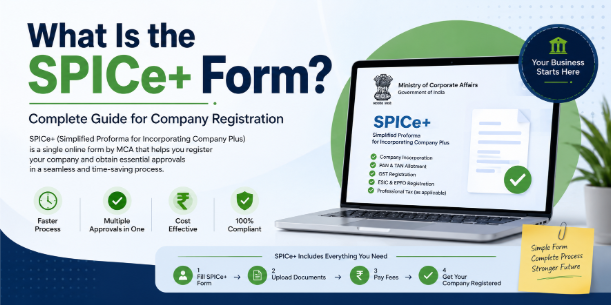
SPICe+ (Simplified Proforma for Incorporating Company Electronically Plus) is the integrated web form on the MCA V3 portal used to incorporate every new company in India, whether a Private Limited Company, One Person Company (OPC), Public Limited Company, or Section 8 Company.
Through its linked forms, SPICe+ delivers up to ten government services in a single application, including DIN allotment, PAN, TAN, GSTIN, EPFO, ESIC, profession tax enrolment, and bank account opening, replacing what used to require multiple separate filings across different departments.
SPICe+ Part A vs Part B
SPICe+ is structured in two distinct parts, and understanding the difference is essential before you start filing.
| Feature | Part A | Part B |
| Purpose | Name reservation only | Full incorporation application |
| Names You Can Propose | Two names | One name (already approved via Part A) |
| Validity | Reserved name valid for 20 days | Must be filed within this window |
| Contents | Company type, proposed names, business activity | Registered office, directors, subscribers, share capital, DIN/PAN/TAN application |
| Alternative Route | Standalone RUN (Reserve Unique Name) form | Not applicable |
Practical tip: If you’re confident about your company name and have your DSCs and documents ready, you can skip the standalone naming step and go straight into full SPICe+ filing, proposing one name directly within Part B. If you’d rather confirm name availability before investing in DSCs and paperwork, use Part A (or RUN) first.
What Is SPICe+ Part B?
Part B is the main incorporation application, covering company details, director and subscriber information, registered office, share capital, and linked registrations. It contains 8 sections covering company details, directors, registered office, capital structure, and linked registrations, all filed together with the linked forms described below.
Linked Forms Bundled with SPICe+
SPICe+ doesn’t work alone, it auto-fills and submits alongside several linked forms, each serving a specific purpose.
| Linked Form | Purpose |
| AGILE-PRO-S (INC-35) | Applies for GSTIN, EPFO, ESIC, Profession Tax registration, and bank account opening in one step |
| e-MOA (INC-33) | Electronic Memorandum of Association, defines the company’s objects and capital clause |
| e-AOA (INC-34) | Electronic Articles of Association, internal rules governing management |
| INC-9 | Self-generated declaration by all subscribers and first directors |
| URC-1 | Used when converting an existing entity (like a partnership) into a company |
What is AGILE-PRO-S?
AGILE-PRO-S is Form INC-35, filed along with SPICe+ Part B, that auto-populates data from SPICe+ to handle GST, EPFO, ESIC, Profession Tax, and bank account registrations in a single step.
Important: Services like GSTIN, EPFO, and ESIC through AGILE-PRO-S are optional at the time of filing, you decide whether to opt in, though opting for GSTIN at incorporation is strongly advisable for most operating businesses, since it avoids a second round of document collection days after receiving the Certificate of Incorporation.
When Are eMOA and eAOA Mandatory vs Attached as PDFs?
This is a frequent point of confusion for founders with larger subscriber bases.
- If the total number of subscribers is 7 or fewer, and each is an Indian citizen (or an overseas subscriber with a valid business visa, DIN, and DSC), eMOA and eAOA must be filed electronically as linked forms.
- Where the number of subscribers exceeds 7, SPICe+ must be filed with the MOA and AOA attached as PDF documents instead of the electronic linked forms.
DIN Allotment Through SPICe+
A maximum of three directors can apply for DIN allotment within a single SPICe+ application for most companies (five directors in the case of a Producer company). Directors who already hold a valid DIN simply provide it; those without one submit the standard identity and address KYC documents directly within Part B.
Documents Required for SPICe+ Filing
- PAN and Aadhaar (Indian directors) or notarised/apostilled passport (foreign nationals)
- Address proof not older than 2 months
- Passport-size photographs
- Proof of registered office (rent agreement/ownership proof + NOC + utility bill)
- Class 3 Digital Signature Certificates (DSC) for all directors and subscribers
- Declaration in INC-9
Fees and Timeline for SPICe+ Filing
| Stage | Typical Duration |
| DSC issuance | 1–2 working days |
| Part A, name reservation | 1–2 working days |
| Name validity window | 20 days to file Part B |
| Part B + linked forms review | Varies by RoC workload |
| Certificate of Incorporation (CoI) | 7–10 working days, if documents are error-free |
Government fees depend on authorised share capital, plus state-wise stamp duty on the MOA/AOA. Filing accurate documents on the first attempt is the single biggest factor in staying within this timeline, each RoC query adds several days to the process.
Did You Know? SPICe+ is filed as e-Form INC-32, and once submitted successfully, the MCA issues the receipt of Certificate of Incorporation in Form INC-11, which contains the company’s CIN, PAN, TAN, and date of incorporation, all in one document.
Common Mistakes That Delay SPICe+ Approval
- Filing Part B after the 20-day name validity window lapses, forcing a fresh name reservation
- Choosing the wrong eMOA/eAOA route when subscriber count exceeds 7, instead of attaching PDF versions
- Skipping optional AGILE-PRO-S registrations like GST, then having to file a separate application days after incorporation
- Submitting more than three DIN applications in one SPICe+ filing for a standard company
- Mismatched details between director KYC documents and the information entered in Part B
Case Study: A four-founder edtech startup in Hyderabad filed SPICe+ Part A and received name approval promptly. However, the team took nearly three weeks finalising their business model before filing Part B, by which time the 20-day name reservation had expired. They had to restart the naming process from scratch, losing the time advantage SPICe+ was designed to provide. Filing Part B promptly after name approval is essential to actually benefit from the form’s speed.
Quote: “SPICe+ removed the paperwork maze, but only for founders who understand which door to walk through first.”
Latest News: On the MCA V3 portal, SPICe+ now bundles ten government services into one structured application, with services 6 through 10, including GST, EPFO, ESIC, profession tax, and bank account opening, remaining optional add-ons decided at the time of filing.
Why Choose Zolvit?
- Expert lawyers and Company Secretaries who handle every section of SPICe+ Part A and Part B
- Dedicated CA support for AGILE-PRO-S registrations like GST, EPFO, and ESIC
- Fast processing with pre-filing document audits to avoid RoC queries
- Affordable, transparent pricing with no hidden charges
- End-to-end compliance, from DSC issuance to your Certificate of Incorporation
- Dedicated support throughout your incorporation journey
Not sure which structure fits your business? Talk to Zolvit’s experts today for a free consultation.
Conclusion
SPICe+ has genuinely simplified company incorporation in India, folding what used to be five or six separate applications into a single, integrated web form. But its structure, two parts, multiple linked forms, and conditional rules around subscriber count and DIN limits, still requires careful planning. A founder who understands the difference between Part A and Part B, files within the name validity window, and gets director documentation right the first time can realistically expect a Certificate of Incorporation within 7–10 working days. Given how frequently MCA updates portal rules and linked-form requirements, it’s worth having a professional review your SPICe+ filing before submission.