


When no audiobook exists, visible ebook text and text-to-speech can share the reading session. Original editorial image created for this article.
To listen to a Kindle book when no audiobook is available, first check Amazon’s Assistive Reader: open the book, tap the page, choose Aa > More > Assistive Reader, and press Play. If the option is missing, the title, language, device, or app version may not support it. For a book you are authorised to open in Kindle Cloud Reader, you can also test CastReader in Chrome or Edge. Neither method gives access to a book you do not already have permission to read.
Choose the route that matches the device. The Kindle app offers a native option for eligible titles; CastReader’s browser extension is a separate route for supported Kindle Cloud Reader pages. Synthetic narration is useful for access and review, but it is not the same as a professionally narrated audiobook.
Method 1: Turn on Assistive Reader in the Kindle app
Kindle apps offer Assistive Reader for eligible books and supported devices. Availability can depend on the title, publisher permissions, region, and platform. When it is available, the built-in feature is a sensible first choice because it remains inside the Kindle reading environment.
- Open an eligible book in the Kindle app.
- Tap the page, then tap the Aa reading-settings icon.
- Choose More and turn on Assistive Reader.
- Return to the page, show the player controls, and press Play.
- Test one page before starting a full chapter; availability depends on the book, language, device and current Kindle implementation.
If a book is not eligible or the built-in voice and controls do not meet the reader’s needs, a separate reading workflow may be worth considering. The reader must still own or legitimately access the book. Text-to-speech is not a way to remove digital rights management, download unauthorised copies, or bypass publisher restrictions.
Method 2: Listen in Kindle Cloud Reader with CastReader
Desktop readers may prefer a browser extension for Kindle Cloud Reader, while phone users usually want background playback, lock-screen controls, automatic page turns, and reliable resume progress. The CastReader Kindle read-aloud tool outlines the supported browser, iPhone, and Android paths and the limits that apply to each.
Synchronized highlighting is useful for names, dialogue, and unfamiliar terms. It also makes text-to-speech more appealing to readers who like to listen and follow along at the same time. For nonfiction, keeping the original page visible helps with quotations and references.
- Install CastReader for Chrome or Edge.
- Open read.amazon.com, sign in to your own Amazon account, and open a title available in Kindle Cloud Reader.
- Click the CastReader icon and start Read Aloud on the visible page.
- Check the extracted text and synchronized highlighting before continuing.
- If a difficult passage needs more than narration, switch to Read & Explain while keeping the original page visible.
- Stop if the page is extracted incorrectly and use Amazon’s native accessibility option or an authorised audiobook instead.
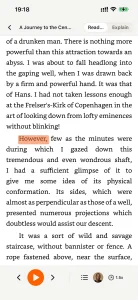
Product screenshot — CastReader’s mobile read-aloud view keeps the source visible with synchronized highlighting and playback controls. Browser controls differ by surface. Source: official CastReader interface, August 2026. © CastReader.
What will not work well
Synthetic narration may mispronounce proper names, place unusual pauses around punctuation, or treat character dialogue less dramatically than a human narrator. Try a sample chapter before committing to a long session. Select a voice that suits the book’s language and use a speed that preserves comprehension.
When listening is not enough, use Read & Explain
When hearing a difficult paragraph twice does not help, CastReader’s Read & Explain can restate it while keeping the source visible. Use it for arguments, unfamiliar terms or foreign-language passages—not as a substitute for charts, footnotes or image-heavy spreads.
If your book already opens in Kindle Cloud Reader, install CastReader for Chrome or Edge and test one page. For phone-first reading, use the official CastReader download page to choose the app. Keep the text visible, and prefer Amazon’s native option when it already works well.