

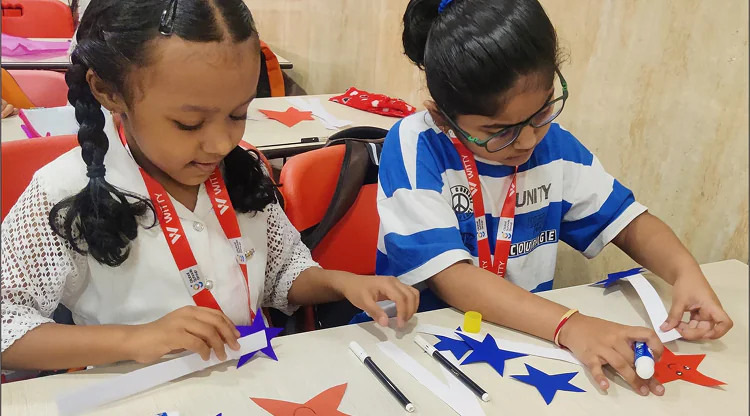
Children entering school today will eventually work in environments shaped by technology, collaboration, changing careers, and new ways of solving problems. Education therefore needs to prepare them for more than examinations. ICSE schools in Wakad increasingly focus on conceptual understanding, communication, creativity, analytical thinking, digital learning, sports, arts, and life skills.
These experiences can help children become confident learners who can adapt to unfamiliar situations, think independently, work with others, and approach future challenges with curiosity, flexibility, and practical skills while building a strong foundation for lifelong learning and personal growth.
Building Strong Conceptual Understanding
Future challenges rarely come with questions that look exactly like textbook exercises. Children need to understand ideas well enough to apply them in different situations. A strong ICSE learning approach supports this through structured lessons, guided practice, projects, assessments, and classroom activities.
Instead of depending only on memorisation, students can explore how concepts work and where they can be applied. Science experiments, language activities, research tasks, and project work can encourage students to ask questions and connect classroom learning with everyday situations. This foundation can make learning more meaningful while developing habits that remain useful beyond school.
Developing Analytical and Critical Thinking
Children encounter large amounts of information through digital platforms, conversations, media, and other sources. They need to learn how to compare ideas, identify relevant details, ask questions, and reach reasoned conclusions.
ICSE education can encourage this development through analytical tasks, discussions, problem-solving activities, and application-based learning. When students are given opportunities to explain their reasoning rather than simply provide an answer, they gradually become more independent thinkers. This can help them approach unfamiliar academic and real-world situations with greater confidence.
Strengthening Communication Skills
Knowledge becomes more useful when children can communicate it clearly. Future workplaces and higher education environments require people to explain ideas, listen actively, collaborate, and interact with different groups.
Reading, writing, presentations, classroom discussions, group activities, and creative expression can help students become comfortable expressing their thoughts. These experiences also encourage listening and respectful communication. Over time, children can learn to present their ideas with clarity while understanding different viewpoints.
Making Digital Learning Meaningful
Technology is now part of learning, communication, and many professional environments. Simply using digital devices, however, does not automatically prepare children for the future. They also need to understand how technology can support research, creativity, collaboration, and problem-solving.
Modern classrooms can use digital tools alongside conventional teaching methods. Similar expectations can be seen across CBSE schools in Hitech City, where technology and holistic development also support future-ready learning. Technology-enabled learning spaces, computer laboratories, digital resources, and interactive activities can provide opportunities to explore concepts in different ways. When technology is used with a clear learning purpose, students can become more comfortable navigating digital environments while maintaining focus on understanding and responsible use.
Encouraging Creativity and Curiosity
Future challenges often require solutions that do not have one obvious answer. Creativity helps children consider different possibilities, experiment with ideas, and develop original approaches. Schools can nurture this quality through art, music, performing arts, projects, design activities, and open-ended classroom tasks.
Curiosity is equally important. A child who feels encouraged to ask questions is more likely to explore beyond the immediate lesson. Teachers can support this by creating classrooms where students are comfortable discussing ideas, making observations, and learning from mistakes. Such an environment can help transform curiosity into a lasting learning habit.
Learning Through Sports and Activities
Academic preparation is only one part of development. Sports and extracurricular activities can teach children lessons that are difficult to gain from textbooks alone. Participation in games can develop discipline, teamwork, resilience, coordination, and decision-making.
Activities such as swimming, football, basketball, chess, music, and creative programmes can give students different ways to discover their strengths. Team-based experiences teach children how to cooperate, handle success and setbacks, follow rules, and work toward shared goals. These qualities can become valuable when children face academic pressure, changing responsibilities, or unfamiliar situations later in life.
Building Confidence and Leadership
Future-ready children need confidence, but confidence grows through meaningful opportunities rather than constant praise. Students can develop it when they are encouraged to participate, take responsibility, solve problems, and present their ideas.
Leadership activities, student-led initiatives, group projects, school events, and classroom responsibilities can give children practical opportunities to make decisions. They also learn that leadership involves listening, supporting others, and accepting responsibility. These experiences can help children become more comfortable taking initiative while understanding the importance of teamwork.
Supporting Emotional Awareness and Wellbeing
Children cannot learn effectively when they constantly feel overwhelmed or unsupported. A positive school environment should therefore consider emotional awareness alongside academic progress. Students need opportunities to understand their feelings, interact respectfully, manage setbacks, and seek support when needed.
A child-centred environment can help students feel valued while encouraging healthy relationships with teachers and peers. Parent-school interaction can further strengthen this support system. When children know that adults are available to guide them, they may become more willing to discuss challenges and develop healthier approaches to pressure.
Creating Safe and Engaging Learning Spaces
The physical environment also influences how children experience education. Modern classrooms, laboratories, libraries, activity spaces, sports areas, and creative facilities can provide different settings for exploration and participation.
A safe and structured campus gives students room to learn, experiment, collaborate, and express themselves. Well-planned facilities can support academic activities while also encouraging fitness, creativity, reading, performance, and teamwork. The goal is not simply to provide more spaces, but to make each space contribute to meaningful learning and development.
Conclusion
Preparing children for future challenges requires a broad view of education. Strong academics provide the foundation, while communication, critical thinking, technology, creativity, sports, leadership, emotional awareness, and teamwork help students use that knowledge effectively. ICSE schools in Wakad that combine these elements can create learning environments where children are encouraged to understand, explore, participate, adapt, and grow with confidence.
For families seeking balanced education, meaningful growth, and future-ready learning opportunities for children, EuroSchool supports future-ready learning through a balanced approach that combines academics, digital learning, laboratories, sports, performing arts, extracurricular activities, life skills, and student wellbeing. Its child-focused environment encourages curiosity, communication, creativity, teamwork, confidence, and independent thinking, helping students build practical skills while progressing academically in a safe, structured, and engaging school setting for changing academic and real-world demands of tomorrow.