

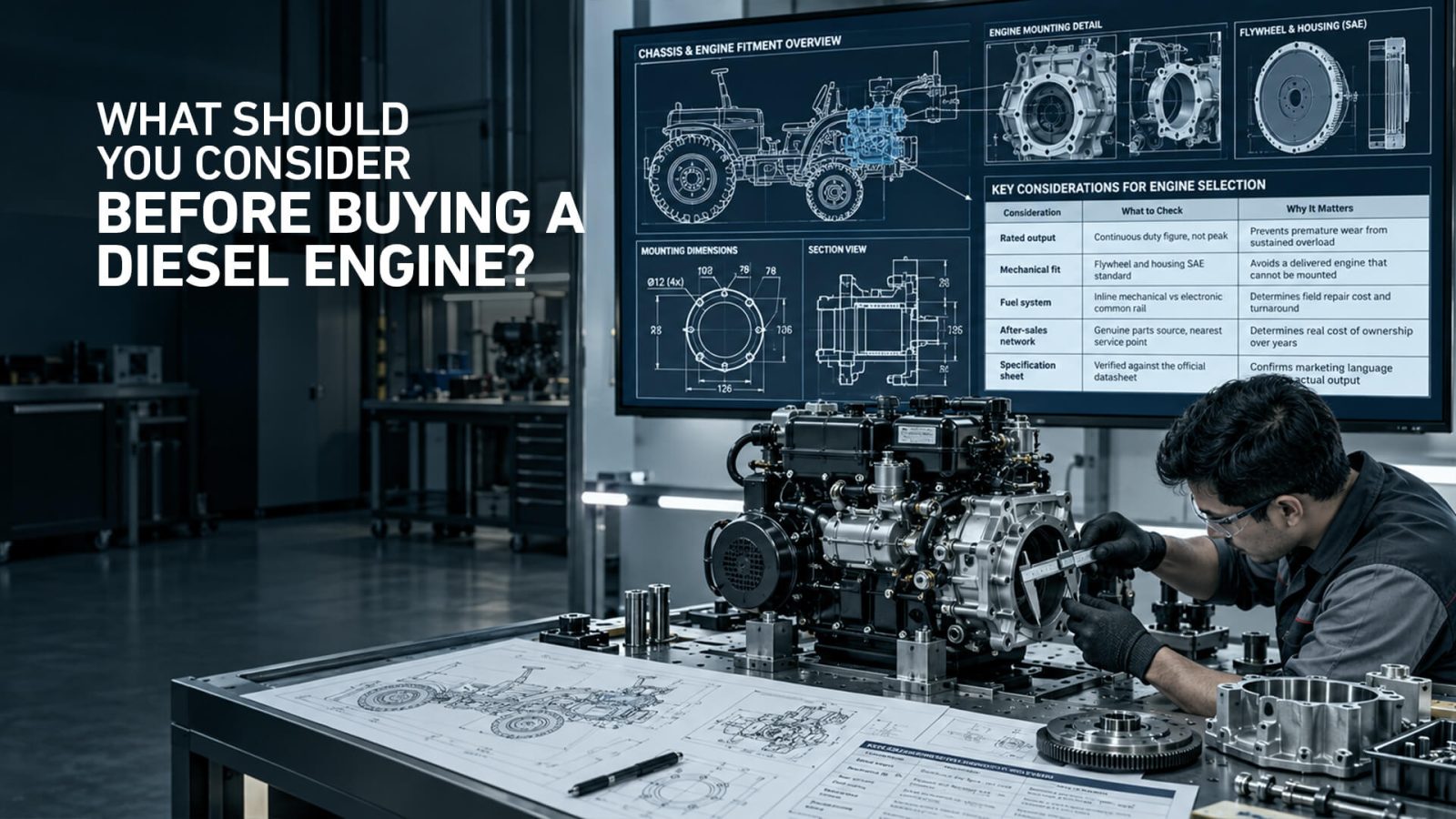
A diesel engine purchase order looks like a single decision. It is actually four or five smaller decisions bundled together, and most buying guides only cover one of them, matching power output to the load. That leaves the mounting spec, the fuel system’s field serviceability and the after-sales network unexamined. The mismatch does not show up on delivery day. It shows up later, as downtime.
Most engine buying guides stop at size and fuel type. Those two factors matter, but they are the easier half of the decision. For diesel engine manufacturers in India supplying OEM builders, a checklist this thin risks credibility at the first service call. The harder half determines whether the engine still runs well in year four. It comes down to three checks.
Does the engine mechanically fit the machine it bolts to? What does it actually cost to keep running in the field? Does the specification sheet in front of you match what the engine actually delivers under load?
Match Rated Output to the Actual Duty, Not the Peak Number
A nameplate lists more than one output figure, and the highest one is rarely the one that applies to continuous work. An engine rated for short, intermittent bursts will wear faster if it is run instead as the primary, always-on power source for a machine. Before comparing kW figures across engines, confirm which rating applies to the actual duty the machine will see day to day. The gap between the peak figure and the sustainable figure is where premature wear usually starts.
Confirm Mechanical Fit Before Rated Power
An engine that produces the right output is still the wrong engine if it does not bolt to the machine. Flywheel size and flywheel housing size follow SAE standards, and a mismatch here is not something a workshop can improvise around. These numbers are printed on the engine’s spec sheet, not estimated from the outside. Confirming them against the existing gearbox, pump or PTO coupling before the purchase order is placed avoids a machine that arrives and does not fit.
Check the Fuel System’s Field Serviceability
Two engines with identical power output can have very different repair realities. An inline mechanical fuel system, PFR type, can be diagnosed and adjusted with basic tooling and no electronic interface. A common rail system needs a diagnostic laptop and a technician trained on that specific electronic architecture. Neither is inherently better on paper. The difference shows up the first time the engine needs field service somewhere a specialist is not close by.
Verify the After-Sales Network Before the Purchase Order
An engine is only as reliable as the parts supply and service support behind it. Before finalising a purchase, confirm where genuine spare parts come from and how far the nearest service point is. Check whether that network actually covers the location where the engine will operate. An engine bought on price alone, with no service network checked, often costs more over its working life. One bought at a slightly higher price, with a confirmed support chain behind it, usually costs less across the same years.
| Consideration | What to Check | Why It Matters |
| Rated output | Continuous duty figure, not peak | Prevents premature wear from sustained overload |
| Mechanical fit | Flywheel and housing SAE standard | Avoids a delivered engine that cannot be mounted |
| Fuel system | Inline mechanical vs electronic common rail | Determines field repair cost and turnaround |
| After-sales network | Genuine parts source, nearest service point | Determines real cost of ownership over years |
| Specification sheet | Verified against the official datasheet | Confirms marketing language matches actual output |
Service and parts availability change sharply outside India’s major industrial hubs. A machine running in a Tier 2 or Tier 3 location does not have the same access to a specialist technician. One running inside an industrial cluster does. Confirming this network with diesel engine suppliers in India before signing the purchase order, rather than after, makes the real difference. A confirmed network means a repair finished quickly. An unconfirmed one can mean a machine sitting idle for an extended stretch, waiting on a part or a trained hand.
MVDE is one of the diesel engine manufacturers in India building off-highway diesel engines on this exact principle. An inline PFR fuel system lets a regional workshop service the engine without specialist electronic tooling. A documented spec sheet matches what the engine actually delivers under load. The range runs from the 11.3 kW MVL2E to the 36.8 kW turbocharged MVS4L2-T, covering agriculture, construction, marine, light towers and power generation.
A diesel engine bought against a verified checklist outlasts one bought against a brand name alone. Confirm the duty rating, the mechanical fit, the fuel system’s field reality and the after-sales network before the purchase order goes out. Not after the engine arrives. For specifications relevant to a current buying decision, MVDE’s Engine Models page and Service Support page are useful starting references.
Do I need a turbocharged engine or is naturally aspirated enough?
It depends on the load, not the brochure. Naturally aspirated engines suit steady, moderate loads well within the engine’s rated output. A turbocharged engine like the MVS4L2-T adds output from the same displacement for applications with higher peak demand. Check the actual load profile of the machine before assuming the higher-output option is the safer buy.
How do I confirm the flywheel will match my existing gearbox or PTO?
Check the SAE flywheel and flywheel housing numbers on the engine spec sheet. Compare them against the coupling you plan to mate it to. Both figures are fixed by SAE standard, not by the engine’s power rating, so two engines with similar output can still carry different flywheel numbers. Confirm this before ordering, since a mismatch here cannot be corrected on site.
What should I ask diesel engine suppliers in India before finalising a purchase?
Ask where genuine spare parts are sourced and how far the nearest service point is. Ask separately whether the fuel system needs specialist electronic diagnostic tools or standard mechanical ones. These answers, more than the price quoted, determine what the engine actually costs to keep running over its working life.