

Americans spend a large part of their day on smartphones, and the US market is split between Apple’s iOS and Google’s Android. For any business launching a mobile product, the first big question is not just what to build, but how to build it for both platforms without doubling cost or compromising quality.
This guide compares iOS and Android development, explains native and multi-platform approaches, and walks through the process, testing, deployment, maintenance and cost factors you should understand before hiring an iOS and Android app development company in USA businesses can trust.
iOS vs. Android: Understanding the Platforms
Both platforms are mature and capable, but they differ in audience, design language, tooling and release processes.
Audience and market
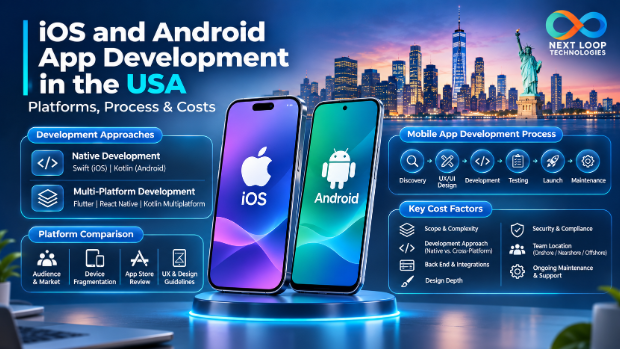
In the United States, iOS holds a large share of active smartphones and tends to be strong among users who spend more on apps and in-app purchases. Android has a wider range of devices and price points and dominates many international markets. Most US consumer apps need both.
Device fragmentation
Apple controls a relatively small set of devices and OS versions, which simplifies testing. Android runs on thousands of device models from many manufacturers, with varied screen sizes and OS versions, so Android application development services must include broader device testing.
App store review
Apple’s App Store applies a detailed manual review, which can add time to each release. Google Play reviews are generally faster but still enforce policies on privacy, payments and content.
Native Mobile App Development Technologies
Native mobile app development uses each platform’s own languages and tools, giving the best access to device features and the smoothest performance.
iOS
iOS application development services typically use Swift with SwiftUI or UIKit, built in Xcode. Apple frameworks provide access to features such as Face ID, Apple Pay, HealthKit and widgets.
Android
Android apps are built with Kotlin and Jetpack Compose in Android Studio, with access to Google services such as Google Pay, Firebase and Maps.
When native is the right choice
Choose native when your app relies heavily on device hardware (camera, sensors, Bluetooth), needs top-tier performance (games, AR, real-time media) or must adopt new OS features the moment they ship.
Multi-Platform App Development
Multi-platform app development uses one codebase to target iOS and Android. Flutter and React Native are the most popular frameworks, and Kotlin Multiplatform lets teams share business logic while keeping native UIs.
Benefits
- One team and one codebase for both platforms.
- Faster time to market and lower development cost.
- Consistent features and branding across devices.
Trade-offs
Cross-platform apps can need native modules for advanced features, and very complex animations or heavy processing may perform better natively. For most business, retail, fintech and content apps, a modern cross-platform framework performs well.
Designing for Platform-Specific UX
Great smartphone application development respects each platform’s conventions. Apple’s Human Interface Guidelines and Google’s Material Design differ in navigation patterns, typography, gestures and system controls. Users notice when an Android app behaves like an iPhone app, or the reverse. Even with a shared codebase, adapt navigation, back behavior, date pickers and notifications to each platform.
Accessibility matters on both: support dynamic text sizes, screen readers (VoiceOver and TalkBack) and sufficient color contrast.
The Mobile App Development Process
- Discovery: Define users, goals, features and success metrics.
- UX/UI design: Wireframes, prototypes and platform-specific visual design.
- Architecture: Choose native or cross-platform, plan APIs, data storage and security.
- Development: Build in sprints with regular demos on real devices.
- Testing: Functional, performance, security and device testing.
- Launch: App store submission, listing optimization and release management.
- Maintenance: Updates, monitoring and new features.
Application Testing
Mobile testing combines automated and manual approaches. Unit and UI tests (XCTest, Espresso, or framework tools for Flutter and React Native) catch regressions. Real-device testing, often through cloud device farms, covers screen sizes, OS versions and network conditions. Beta programs through TestFlight and Google Play testing tracks collect feedback before public release.
Deployment and Maintenance
After launch, apps need ongoing care. Each year Apple and Google release major OS updates that may require changes. Crash reporting, performance monitoring and analytics help teams fix issues quickly and prioritize improvements. Plan for regular security patches, dependency updates and feature releases.
What Drives iOS and Android App Development Costs?
Instead of a single price, think about the factors that move the budget:
- Scope and complexity: Number of screens, user roles and business rules.
- Approach: Two native apps generally cost more than one cross-platform build.
- Back end and integrations: APIs, payments, maps, CRM and third-party services.
- Design depth: Custom animations and branding versus standard components.
- Security and compliance: HIPAA, PCI DSS or financial regulations add work.
- Team location: Onshore, nearshore and offshore rates vary significantly.
- Maintenance: Ongoing support is commonly budgeted as a yearly percentage of the initial build.
Choosing an iOS and Android App Development Company
Look for a partner with published apps on both stores, experience with both native and cross-platform stacks, and a clear testing and release process. A good mobile app development company will recommend the approach that fits your goals rather than the one it prefers to sell. Dedicated software testing and QA services are another sign of maturity, because quality on hundreds of devices does not happen by accident.
Conclusion
iOS and Android each bring their own audience, tools and expectations. Native development delivers maximum performance and device access, while multi-platform app development offers speed and efficiency for most business apps. Whichever path you choose, invest in platform-specific UX, rigorous testing and ongoing maintenance. With the right iOS and Android app development company in USA users will get an app that feels at home on every phone.