

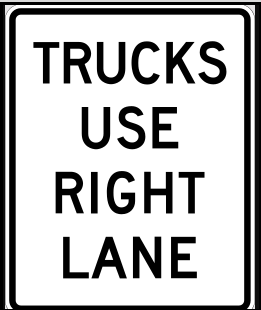
Have you ever been caught up in situations where you find yourself behind a huge truck that wants to move around roads that cannot accommodate its size? If you find yourself living in an environment where there is a highly active warehouse or near highways, you have probably found yourself in such a situation. It’s not only hard on the trucker but dangerous to all those around.
The following are some of the situations where truck route signs come in handy. They are not complex signs, but they are useful in routing vehicles and preventing other people from using such routes. It’s time we learn about how they work and where to shop for them.
What Are Truck Route Signs?
This sign provides information regarding the roads where trucks can be driven using commercial drivers. The design of the signboard is very basic and it has just “TRUCK ROUTE” along with an arrow indicating the direction of the route.
They work like an integrated GPS system on the roads. Instead of providing any other route based on the GPS application, they guide the truck to a particular route.
They fall into a larger category of road signs.
Why Truck Routes Matter
These trucks can hardly be compared with regular cars in various ways. Firstly, it requires plenty of space and much time to brake. All of these things are explained by the weight of the vehicle and the road quality required for such vehicles. Put such vehicles in the wrong place and you will see the results quickly enough.
Here is the list of advantages which can be received by designing the route of such trucks correctly:
- Protection of residential areas because of the lack of noise, vibration and safety of kids.
- People safety because of restricting access of trucks only to the appropriate roads.
- Long-lasting roads and bridges because of the extra damage caused by these trucks.
- Driver’s convenience.
- Business promotion through freight traffic.
- Quite an achievement for a couple of aluminum plates.
Truck Route Signs vs. No Trucks Signs
However, both signs go hand in hand, but they perform different tasks.
Truck route sign means telling the truck “this is your route.”
No truck sign means “you are not supposed to travel there.” It prevents the big vehicles from traveling on roads that are inappropriate for the trucks such as residential roads, parkways, and roads with low bridges and weight restrictions.
However, when you combine both, you are informing the motorists which roads they can travel to and which roads they should not.
Examples of their usage include:
- Truck route sign at the end of highway access to an industrial park
- No trucks sign at the beginning of access road to a residential community
- Truck route arrow sign at confusing intersection where trucks usually get lost
- No trucks sign by a bridge/tunnel which is not accessible to trucks
Locations for Truck Route Signs
Placing incorrect signage in inappropriate locations will achieve nothing. Below are some of the locations where you will find them.
Highway Off-Ramps & Ramps
Here, the drivers make their decisions. The presence of an indicator at the exit ramp helps the drivers in making a decision about how to move ahead.
Main Crossings
The drivers of heavy vehicles take some time in analyzing the situation before taking any action. The installation of early indicators can help the drivers shift to other lanes without any problem.
Approach to Industrial/Commercial Areas
The distribution centers, storage centers, and shopping centers are the places where trucks come in large numbers. It becomes essential for the drivers to get indications to enter into the right gates and not to the side streets.
Points Where Problem Arises
There are times when the drivers may miss the turn or reach an inappropriate place. In such cases, the turn should be provided with a sign to solve the problem immediately.
Boundary Points for the Restricted Area
In case there are places where trucks cannot drive, the “no truck” sign and “truck route” sign should be put up.
What to Look for When Buying Roadway Signs
Not all signs are created equal. Before you place your order, here are some important considerations.
Adhere to MUTCD Standards
Traffic signs used within the United States must comply with the Manual on Uniform Traffic Control Devices or MUTCD standards. This document outlines guidelines related to color, shape, symbol usage, and even mounting requirements.
Quality Reflective Sheeting Is Important
Trucks operate day and night. Reflective sheeting sends headlight beams back to the driver allowing the sign to be read in the dark. More expensive sheeting tends to last longer and can be seen from different angles.
Select Proper Sign Size
Unlike other drivers, truckers sit much higher above the ground and drive very fast. The sign should be large enough to allow timely reading by drivers.
Select High-Quality Material
The standard material used for professional quality traffic signs is aluminum. The material resists corrosion, is heat and weather resistant and maintains its shape for decades. Thick aluminum stands up better against strong winds.
Don’t Forget the Hardware
An excellent sign on an inferior post is a poor investment. Check out posts, brackets, and security hardware, particularly for signs placed in busy passageways.
Ask About Customized Signs
Sometimes, an ordinary sign may not be the best approach. You might be looking for customized size, unique message, or additional plaque. A sign provider specialized in customized orders will prevent you from a lot of trouble.
A Few Practical Guidelines
There are a couple of general recommendations that will improve the efficiency of truck routing systems:
- Consistency. Establishing consistency in the design and terminology of all signs along the route is crucial.
- Repetition if needed. It is not enough to post only one sign at the beginning of the route but rather several signs should be placed after each major turning point or intersection.
- Ensure visibility. Prune any overhanging trees and eliminate any barriers.
- Inspection. Blurred, broken or even missing signs are of no use at all.
- Community participation. Citizens could be extremely helpful providing data on places where there are troubles for trucks to pass through.
- Updating signs. The signs should be updated according to the local regulation and freighting navigation information.
Conclusion
Despite the fact that truck route signs are not the sexiest road safety signs, they have a lot of functions to fulfill. They lead truck drivers along the way they must drive and keep away all unwanted traffic from residential areas, thereby helping all drivers. Their combination with the “no trucks” signs and good materials selection will make sure that everyone wins.
Should you like to purchase anything, we at Roadway Signs Company will be happy to provide you with all kinds of road signs. Whether it be truck route signs, no trucks signs or any other kind of signs for your city, contract work, industrial and private property. Visit us at www.roadwaysigns.com.
Frequently Asked Questions (FAQs)
1. What Does a Truck Route Sign Indicate?
It informs the truck driver which roads are permitted to travel through. They are usually marked “TRUCK ROUTE” with some direction.
2. How Does a Truck Route Sign Differ from a No Trucks Sign?
The former guides the trucker to the designated route while the latter is used to warn the truckers not to use such a road because of its weight limit and narrowness.
3. Where Do I Place a No Trucks Sign?
Such a sign can be placed on residential roads, roads with low bridges, roads that have weight limit, among others, where the trucks pose a danger.
4. Are Truck Route Signs Reflective?
Yes, the use of reflective sheeting ensures that the signs are clearly seen in the nighttime or bad weather conditions considering that trucks move during day and night.
5. Can I Order Custom Roadway Signs?
Yes, most providers manufacture custom-made signs in terms of size, wording, arrows, among other things provided that they satisfy the requirements of that specific road.