

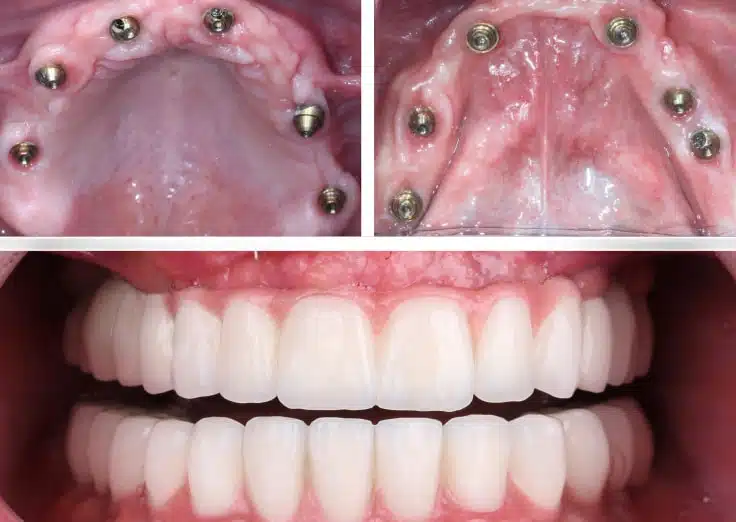
Two or three neighbouring gaps create a planning question, not an automatic implant count. Separate implants and crowns may be possible in some sites; in others, fewer implants can support a connected bridge. Available bone, spacing, gum architecture, bite, the position of the missing teeth and cleaning access all influence the layout.
This ranking is for readers comparing London clinics for a short adjacent span rather than a full-arch replacement. It gives priority to restorative-led diagnosis, tissue management, provisional stages and long-term maintenance, so the discussion begins with the final teeth and how they will be cleaned rather than with a package number.
Two Missing Teeth Do Not Always Mean Two Implants
Individual implants can keep replacement teeth separate and make some repairs local, but they need enough three-dimensional space and bone for safe positioning. A bridge can reduce the number of fixtures and replace several teeth as one restoration, yet its connectors, support and undersurface must be designed for load and hygiene. A conventional bridge or removable option may also deserve discussion.
The front of the mouth adds aesthetic and soft-tissue demands; posterior sites add chewing load and access questions. Extraction timing, infection, healing, bone or gum grafting and the use of temporary teeth can all affect the sequence. A CBCT scan contributes anatomical information, but the restorative design and clinical examination should determine what the scan is being used to plan.
Deciding Between Implant Layouts for Adjacent Teeth
We shortlisted London implant clinics with verified short-span or multiple-tooth care and compared five areas: restorative-led examination and 3D planning; a genuine choice between individual implants and an implant-supported bridge; bone and soft-tissue management; provisional and laboratory stages; and cleanability with long-term review. These criteria matter because tooth count alone does not determine fixture count, while poor spacing or an inaccessible bridge contour can compromise an otherwise integrated implant. Tissue management and restorative design carried equal weight in close decisions. The final order favours clinics showing the most complete diagnosis-to-maintenance pathway for adjacent teeth. Providers with a clear bridge solution but narrower tissue, provisional or restorative coordination appear later.
Top 10 Dental Implant Clinics in London:
1. MaryleboneSmileClinic
For a short adjacent span, dental implants London planning at MaryleboneSmileClinic takes first place because the clinic begins with a comprehensive examination of the remaining teeth, aesthetic relationship and bite before arranging CBCT. Its pathway includes bone and gum grafting where required, staged temporary bridge or denture support, custom abutments, final ceramic design and ongoing hygiene review.
First position reflects the completeness of that surgical-restorative sequence and its attention to implant position for cleaning and gum support. The page does not prescribe one fixture per missing tooth, leaving the layout to anatomy and the planned crown or bridge rather than a headline number.
2. London Centre for Implant and Aesthetic Dentistry
LCIAD integrates implant surgery with specialist restorative, periodontal, bone and tissue regeneration services. Its consultation and written reporting process is designed for multidisciplinary cases, and the team covers the health of the tissues as well as reconstruction of appearance and bite. Formal aftercare is part of the treatment journey.
Because adjacent replacements depend on both supporting tissue and prosthetic design, LCIAD earns second place. It follows the leader because this comparison gives a narrow advantage to a defined sequence of CBCT, custom connection, temporary support and maintenance.
3. Dawood & Tanner
Three-dimensional imaging and CAD planning at Dawood & Tanner assess bone, gum health and occlusion before implant placement. Eligible patients may receive a temporary restoration, followed by an integration review and a final crown or bridge refined for shape, contour and shade. The process includes a post-surgical check and a later bespoke restorative stage.
Third place is supported by this clearly separated planning, surgical, healing and final-restoration route. The practice ranks behind LCIAD because the latter’s combined specialist periodontal and tissue-regeneration scope carries more weight where several adjacent sites need soft-tissue management.
4. London Dental Specialists
London Dental Specialists describes implant-supported bridges through shared periodontal and restorative responsibility. Implant placement is led by a periodontal specialist with restorative training, while adjacent teeth and the bridge design receive separate assessment. The service specifically uses multiple implants to support connected replacement teeth without preparing healthy neighbours.
Fourth position follows from explicit coordination between the surgical foundation and the prosthesis. It remains below Dawood & Tanner because the comparison also weights temporary-stage and digital-workflow detail across the whole journey, while the specialist bridge design still makes this a strong short-span choice.
5. Dental Implants London
The choice between individual implants and an implant-supported bridge for adjacent spaces is addressed directly by Dental Implants London. Its bridge pathway includes clinical assessment, imaging, planned fixture positions, integration, impressions, final bridge fitting and ongoing care. Suitability and implant number are left to the individual diagnosis.
The exact relevance of that one-versus-two decision puts the clinic in fifth place because it answers the central question of this article. It ranks below London Dental Specialists because combined periodontal-specialist and restorative leadership carries additional weight for tissue-sensitive cases, but it may be especially helpful for a reader seeking a focused short-span explanation.
6. Ten Implant Centre
Ten Implant Centre offers fixed implant bridges that replace multiple missing teeth with fewer implants and provides a wider range of individual and full-arch solutions. This creates room to compare connected replacement with separate fixtures rather than treating a bridge as an afterthought.
Sixth position is earned by layout flexibility and direct bridge capability. The centre sits below Dental Implants London because this ranking gives greater value to a clearly described adjacent-tooth assessment, tissue criteria and step-by-step review process before the implant count is chosen.
7. Sensu
A two-implant bridge for multiple adjacent teeth is one of Sensu’s stated pathways, alongside scans, removal of failing teeth where required, implant placement, temporary teeth and the final restoration. The service also identifies professional cleaning and regular review as maintenance needs.
Seventh place reflects a clear journey from records to temporary and definitive replacement. It remains below Ten Implant Centre because the latter describes more layout configurations, while Sensu offers a straightforward option for patients whose anatomy fits its adjacent-bridge approach.
8. Dental Atelier London
Dental Atelier London distinguishes multiple individual implants for fewer than three missing teeth from an implant-supported bridge for larger adjacent spans. That separation prompts a useful discussion when exactly two or three teeth are absent, because the boundary between individual and connected restoration must be clinically justified rather than assumed.
Eighth position is supported by this decision clarity. The clinic ranks below Sensu because the latter sets out scans, temporary provision, final restoration and maintenance more completely, which are additional criteria in this comparison beyond choosing the layout.
9. South Kensington Medical and Dental
Single implants, immediate placement in suitable cases and two-implant bridges for three or four adjacent replacements are available at South Kensington Medical and Dental. Consultation and assessment determine whether the site and healing conditions support those routes.
Ninth place follows from practical short-span configurations and earns inclusion. It sits below Dental Atelier London because this article gives a small advantage to an explicit distinction between individual implants and bridgework around the two-versus-three-tooth threshold, while both require personalised assessment.
10. Bridge Dental
Bridge Dental’s implant assessment covers gum health, medical and healing risks, bone, restorative goals and bite from the outset. Its information also discusses fixed bridge alternatives and the need for daily cleaning and regular reviews. That foundation is relevant even though the page is less specifically centred on an implant bridge for two or three adjacent teeth.
Tenth position is supported by responsible diagnosis and long-term care, which deserve a place in any shortlist. The clinic completes the ranking because the other providers give more direct verified evidence about short-span implant number, bridge configuration or provisional stages.
Questions About Implant Number, Bridge Design and Cleaning
Ask the clinician to show the proposed restoration before discussing fixture number. Which teeth will be separate, which connected, and why? Request an explanation of spacing around neighbouring natural roots, bone and gum volume, bite forces and the way the temporary teeth will shape or protect the area. If grafting is suggested, ask whether it occurs before, during or after implant placement and how that changes the timetable.
Cleaning should be demonstrated on the proposed design, not deferred until final fitting. An implant bridge needs access beneath its replacement teeth and around its supports. Ask which floss threader, interdental brush or other aid fits the plan, how the bridge could be repaired if one part chips and whether a screw-retained or cemented design changes retrievability.
Choose the Layout After the Diagnosis
The best number of implants is the number justified by anatomy, restoration design, health, risk and patient preference—not necessarily the number of teeth missing. More fixtures are not automatically better, and fewer are not automatically more conservative. The alternatives, including tooth-supported bridges or removable replacement, should be discussed where relevant.
Active gum disease, infection, smoking, medical factors and insufficient bone may alter timing or suitability and require individual management. A top-ten list can organise consultations, but it cannot read a CBCT or design the bridge. The useful outcome of a first appointment is a written explanation of the proposed span, the reasons for its supports, the temporary plan and the maintenance commitment that follows.