

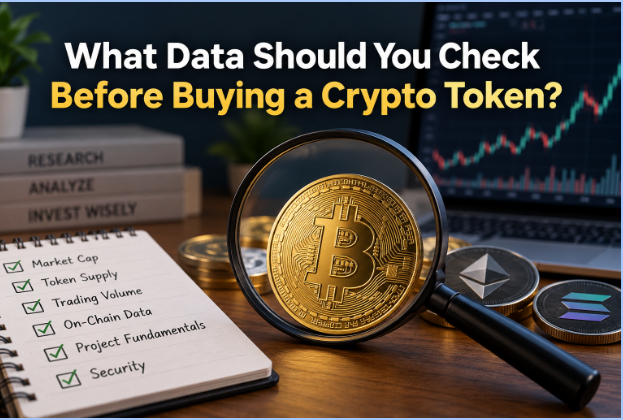
A token’s price says very little about its valuation or risk. Before buying, check five data groups: valuation (market cap and FDV), supply (circulating share, allocation, emissions, and unlocks), market quality (liquidity, volume, spread, and depth), on-chain ownership (holder concentration and wallet activity), and fundamentals and security (real usage, token value capture, contract permissions, and audits). No single metric confirms that a token is attractive or safe.
Key Takeaways
- Compare market cap with fully diluted valuation (FDV) instead of judging a token by its unit price.
- Large future unlocks or concentrated allocations can materially change the supply available to the market.
- High reported volume does not automatically mean deep liquidity.
- On-chain data can reveal ownership concentration that headline market metrics hide.
- Protocol usage and revenue matter to token holders only when the token has a credible link to that activity.
A Crypto Token Data Checklist at a Glance
| Data Category | Metrics to Check | What It Helps Answer | Where to Verify |
| Valuation | Price, market cap, FDV | How is the token currently valued? | CoinGecko, CoinMarketCap |
| Supply | Circulating %, unlocks, emissions | How much dilution remains? | Project docs, Tokenomist |
| Liquidity | Volume, depth, spread, DEX liquidity | Can meaningful amounts actually trade? | Exchanges, DEX analytics |
| Ownership | Top holders, treasury, whale concentration | Who controls the supply? | Block explorer |
| Fundamentals | Users, TVL, fees, revenue | Is there measurable activity? | Project dashboards, DefiLlama |
| Security | Contract permissions, audits, exploit history | What technical and control risks exist? | Explorer, audit reports |
Aggregators occasionally differ on supply figures, volume, and contract addresses, so cross-check important numbers against at least one primary source, such as the project’s documentation or the blockchain itself.
Start With Valuation: Market Cap, FDV, and Supply
Why Token Price Alone Can Be Misleading
A $0.01 token is not automatically “cheaper” than a $100 token. What matters is price multiplied by supply. Market cap equals price × circulating supply, and CoinGecko uses circulating supply as the basis of its market-cap calculation. A token priced at one cent with 100 billion tokens circulating carries a $1 billion market cap, the same as a $100 token with 10 million in circulation. Market cap is therefore the better tool for comparing relative valuations.
Compare Market Cap With Fully Diluted Valuation
FDV multiplies price by total or maximum supply, depending on the data provider’s methodology. A large gap between market cap and FDV means a substantial share of supply is not yet circulating, and future issuance could dilute current holders. When reviewing a token’s price page, such as the one for JGGL coin, look at the circulating and maximum supply figures alongside price rather than the price in isolation. A high FDV is a prompt to investigate the release schedule, not proof of overvaluation on its own.
Check Whether Trading Volume Is Backed by Real Liquidity
Volume Is Only the Starting Point
Begin with 24-hour spot volume, then look at the number and quality of active markets, how volume is distributed across centralized exchanges and DEXs, and whether activity is persistent or driven by a short-lived spike. Volume concentrated on one or two little-known venues deserves more scrutiny than volume spread across established markets.
Look at Depth and Spread
Execution quality depends on the bid-ask spread, order-book depth near the current price, DEX liquidity-pool size where relevant, and estimated slippage for the trade size you intend to make. Two tokens reporting similar volume can behave very differently when a sizable order hits the book. CoinGecko’s own market methodology reflects this, combining volume with spread, order-book depth, and trading activity rather than relying on headline volume alone.
Examine Token Supply, Allocation, and Upcoming Unlocks
How Much of the Token Supply Is Already Circulating?
Compare circulating supply, total supply, and maximum supply, then calculate the percentage already circulating. As CoinGecko notes, the gap between circulating and total supply can expose future inflation or dilution risk.
Who Gets the Remaining Tokens, and When?
Review allocations to the team and founders, private investors, the treasury or foundation, community incentives, and staking or mining emissions. Then check cliff unlock dates, linear vesting schedules, ongoing monthly or annual emissions, and the size of upcoming unlocks relative to both circulating supply and normal daily trading volume. An unlock equal to several days of typical volume is more significant than one the market can easily absorb. Unlocked tokens are not necessarily sold immediately, but they do become available to sell.
Use On-Chain Data to See Who Actually Controls the Token
Check Holder Concentration
Measure the share of supply held by the top 10 and top 20 wallets, identify founder, investor, treasury, and market-maker wallets where possible, and track whether ownership is becoming more or less concentrated over time. Block explorers such as Etherscan display holder rankings, transfers, contract data, and token supply directly on token pages.
Do Not Read the Holder List Literally
Many of the largest addresses are not individual whales. Exchange wallets, bridges, staking contracts, burn addresses, and DEX liquidity pools often top the list and should be identified before you calculate meaningful concentration. Transfers from team or treasury wallets toward exchanges are a useful research signal, though not every exchange deposit represents a sale.
Check Whether Real Usage Supports the Token Thesis
Measure the Product, Not Just the Token
Depending on the project, investigate active users or addresses, transaction trends, total value locked (TVL) for DeFi protocols, trading or application volume, fees paid by users, and protocol revenue. DefiLlama separates fees paid by users from revenue retained by the protocol, a distinction that matters because high fees can flow mostly to liquidity providers or validators rather than to the protocol.
Ask How the Token Fits Into That Activity
Determine whether the token is used for network fees, staking and security, governance, collateral, access to services, or economic rights such as fee distributions or buybacks where applicable. A fast-growing protocol whose token offers only governance rights may create little direct value for token holders, so protocol growth should not be treated as token-holder value by default.
Inspect Smart-Contract Permissions and Security Data
Verify the Correct Contract First
Get the contract address from official project sources, confirm the network, and check that the source code is verified on the relevant explorer. Verified code means the published source matches the deployed bytecode. It does not mean the contract is safe or audited.
Check What Administrators Can Change
Look for privileged functions that allow minting new tokens, pausing transfers, freezing or blacklisting wallets, upgrading contracts, or changing key parameters. OpenZeppelin’s documentation highlights minting, voting, and transfer restrictions as actions that can depend on contract access controls, which makes it important to know who holds those roles and whether a multisig or timelock constrains them.
Also review independent audits, unresolved audit findings, past exploits, and bug-bounty programs. An audit narrows information gaps but does not guarantee against exploits.
How Should You Combine All This Data?
Work through four questions rather than relying on any single number:
- Valuation: Does the market cap and FDV make sense once current and future supply are considered?
- Market quality: Is there enough genuine liquidity and depth, not just headline volume?
- Fundamentals: Is measurable activity occurring, and does the token participate in the economic model?
- Risk: Are ownership concentration, unlocks, admin permissions, or security history material enough to change the assessment?
Red flags worth investigating: very low circulating supply combined with high FDV; thin liquidity; near-term insider unlocks; highly concentrated supply; unverifiable contracts; undisclosed admin powers; and claimed adoption that on-chain or product data does not support.
These signals interact. A strong usage story can be outweighed by a heavy unlock schedule, and deep liquidity does not offset unchecked minting rights. Weigh them together instead of building a mechanical “buy score.”
FAQs
What Is the Most Important Data to Check Before Buying a Crypto Token?
No single metric applies to every token. A sound starting point covers market cap and FDV, liquidity, supply and unlocks, ownership concentration, fundamentals, and contract risk. The relative weight of each depends on the token’s stage, since a newly launched token may carry more unlock and concentration risk than an established one.
Is Market Cap or FDV More Important?
Market cap and FDV answer different questions. Market cap reflects the value of currently circulating supply, while FDV estimates the valuation if all tokens were issued at today’s price. Used together, they show how much potential dilution sits between the two figures.
How Much Trading Volume Is Good for a Crypto Token?
There is no universal threshold. Compare volume with market cap, then focus on actual liquidity: spread, order-book or pool depth, and the slippage your intended trade size would face. Modest, consistent volume on deep markets can be more useful than large volume on thin ones.
How Can You Check Who Owns Most of a Token?
Open the token’s page on the relevant blockchain explorer and review the holder list. Before calculating concentration, identify labeled exchange, treasury, bridge, liquidity-pool, burn, and contract addresses, since these can make ownership look far more concentrated than it really is.
Does a Smart-Contract Audit Mean a Token Is Safe?
No. An audit covers a defined codebase and scope at a specific point in time. Later contract upgrades, privileged administrators, third-party integrations, flawed economic design, and newly discovered vulnerabilities can all introduce risks the audit did not assess.