

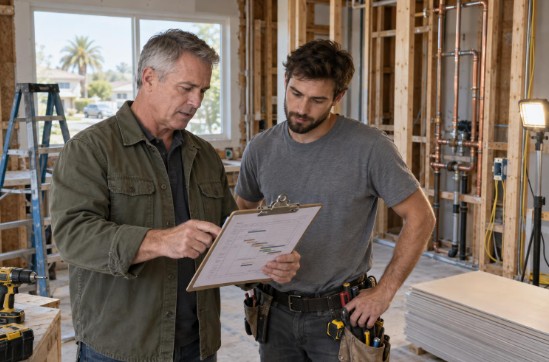
The first question most homeowners ask a contractor is how much the job will cost. The question that predicts whether the project will go well is a different one: how will you run it? Two firms can quote the same price for the same kitchen, and one will finish in ten weeks while the other drifts through six months of silence and change orders.
Remodels in San Jose rarely fail on craftsmanship. Tile gets set, cabinets get hung, and inspectors sign off. They fail on coordination: a plumber who arrives before the framing is ready, a countertop templated before the sink was chosen, a permit submitted three weeks late. The management is the product, and it is worth understanding what good management looks like before you sign.
The pre-construction phase nobody sees
A well-run job is mostly decided before a single wall comes down. The contractor measures the house, confirms what is load-bearing, checks the electrical panel and the age of the plumbing, and writes a scope that names every item rather than describing it loosely. Selections follow: tile, fixtures, cabinets and lighting are chosen and ordered so that lead times are known before demolition.
This is also where a realistic price appears. A general contractor in San Jose who has run dozens of similar projects will build the estimate from measured quantities and current subcontractor rates, then add a stated contingency rather than hoping nothing goes wrong behind the drywall.
The permit clock in San Jose
Permits decide the calendar more than most owners expect. Simple like-for-like work can often be permitted quickly, while anything that moves walls, adds square footage or changes the roofline goes through plan review, which takes weeks and sometimes a round of corrections. Title 24 energy rules shape lighting, insulation and water heating choices, and the plans have to show them.
An experienced office submits early, answers corrections the same week and schedules inspections so that trades are not standing idle. Ask any contractor you interview who in their company handles permits and how long their last three similar jobs took from submittal to approval. Vague answers are a warning.
Scheduling subcontractors like a dispatcher
Once demolition starts, the sequence is fixed by the building itself, and the contractor’s job is to keep the next trade arriving the day the previous one leaves:
- Demolition and structural changes, with the engineer’s details on site
- Rough plumbing, electrical and HVAC, each followed by inspection
- Insulation and drywall, then a second round of inspections
- Cabinets, then countertop template and fabrication
- Tile, trim, paint and final fixtures
- Final inspection and the punch list
The gaps between those steps are where weeks vanish. A firm that self-performs some trades, keeps the same subcontractors from job to job, and posts a written schedule has far fewer of them.
Why bathrooms are the best place to judge a contractor
Bathrooms concentrate every trade into a few dozen square feet, which makes them the clearest test of how a company works. Waterproofing has to be done in the right order, the drain has to land where the tile layout needs it, and the vanity, mirror and lighting have to agree with each other before the electrician roughs in. A firm that explains its bathroom process clearly, as Primework Construction does for its San Jose projects, is usually just as organized on a larger job.
Costs in this room also move fast, which is why it helps to read a practical breakdown such as how to budget a San Jose bathroom remodel without nasty surprises before comparing quotes, so that you know which line items are missing from the cheap one.
The weekly rhythm that keeps owners calm
Good contractors run a short update on a fixed day: what was finished, what is next, which decisions are needed and by when. Change orders are written, priced and signed before the work happens, never discovered on the final invoice. Photos go to the owner after each inspection.
That rhythm is simple, but it separates the firms that finish on time from the ones that explain. If a company cannot describe its communication routine in an interview, it probably does not have one.
Quick answers
How long does a mid-size San Jose remodel take? Commonly two to four months of construction after permits, with pre-construction adding one to two months before that.
Should I hire the lowest bid? Compare scopes line by line first; the lowest bid is often the least complete one.
What should a contract include? A detailed scope, a payment schedule tied to milestones, the permit responsibility, and a written change-order process.
Primework Construction
2375 Zanker Rd Ste 245, San Jose, CA 95131
Phone: 669-345-7070
Website: primeworkconstructionca.com