

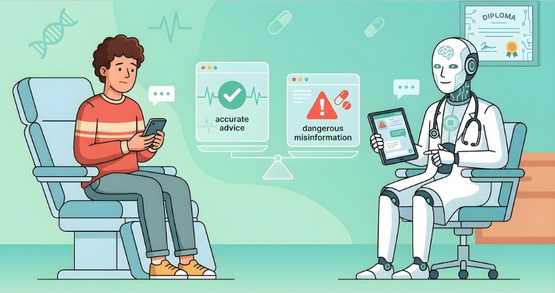
Several individuals tend to find themselves in a scenario where the symptoms do not seem clear, but it takes time to get a specific diagnosis. Making a first-time visit to the doctor is not always so straightforward, particularly when there is a possibility of overlap between conditions or a need to investigate them further.
This may cause duplication of tests, increase waiting time, and confusion about what the next correct action in care is. Meanwhile, healthcare providers are under intense clinical loads, and this fact complicates a detailed evaluation in practice.
Due to this, the necessity of quicker and more dependable diagnostic assistance has never been more crucial than it is currently. Artificial intelligence is entering this field by processing medical data in an effective and organized manner. It assists in bridging patterns, lessening delays, and aiding clinical choices with more appropriate consistency.
The article discusses the ways in which AI in healthcare diagnosis is revolutionizing modern medicine by providing practical implementations on diagnosis, accuracy, speed, and access.
- Reshaping Clinical Diagnosis Through Data Analysis
The medical diagnosis is evolving as the healthcare systems handle and interrelate patient data more effectively. Rather than reading reports individually, new technology has integrated lab reports, scans, and patient history into a single interconnected system to evaluate further.
This strategy reinforces the use of AI for healthcare diagnosis in clinical practice. Medical workers are able to find correlations among various data that would otherwise be overlooked during the standard assessment.
When looked at as a combination, it also becomes easier to detect patterns between symptoms, medical history, and test results.
Therefore, diagnosis is more systematic and standardized. This enhances clinical understanding and aids in making better medical decisions.
- Pattern Recognition Enhancing Medical Accuracy
Medical precision is rising with artificial intelligence systems processing extensive amounts of patient records, imaging data, and clinical data to identify worthwhile patterns. These systems process vast amounts of patient data, imaging outcomes, and other clinical data to determine relationships that might not be immediately apparent when examining data in the standard way.
This assists in the detection of diseases at an early stage that would not have been detected otherwise. With time, machine learning models refine their knowledge by processing more cases.
Consequently, there is increased diagnostic accuracy due to the fact that the decision is informed by more data as opposed to a restricted observation during clinical practice.
- Faster Detection Enabled by Intelligent Algorithms
The speed of diagnosis is also increasing with smart algorithms that can read medical data in a matter of seconds. Modern systems do not need to use manual interpretation, but can scan reports, lab results, and imaging data to detect potential health issues in seconds.
This greatly minimizes the time lag between testing and diagnosis. Emergency situations place special importance on faster detection, as early diagnosis can influence treatment choices and patient outcomes.
Consequently, medical workers are able to react more effectively. This streamlines the entire diagnostic process and makes it more conducive to the time-sensitive modern healthcare setting.
- Diagnostic Errors Reduced Through Predictive Modeling

Medical evaluation is becoming more accurate with predictive modeling systems assisting in minimizing diagnostic errors. These artificial intelligence systems compare patient symptoms, medical history, and test results to determine inconsistencies that can influence conclusions.
Explore information about best modafinil vendors through licensed healthcare providers and pharmacies.
This cross-checking assists in revealing missing details or contradicting information before a diagnosis is made. With the help of early detection of such issues, clinicians can review the information with increased clarity.
Hence, errors made in diagnosis are minimized. This results in better-informed judgments and enhances patient safety in a medical setting.
- Clinical Decision Support Systems Improving Medical Workflow
Clinical decision support systems are also streamlining medical workflow as they organize and structure patient information during diagnosis. These artificial intelligence systems do not necessarily require the manual examination of records, but rather structure patient data in an organized form, which is easier to read in real time.
This enables health care practitioners to easily compare symptoms, tests, and medical history without missing critical details. Consequently, decision-making in the hectic clinical setting is less time-consuming and more targeted.
Moreover, such systems give guideline-based recommendations that can assist clinicians in thinking of various diagnostic options. This enhances uniformity in care provision and decreases pressure when handling complicated cases, ultimately streamlining workflow and making it more structured.
- Remote Diagnosis Expansion Through Digital AI Tools
Access to diagnostic support is expanding as digital AI tools enable remote evaluation of patient health information. Patients can now share symptoms, reports, and health data through online systems that provide initial analysis and guidance based on available information.
This helps bridge the gap between patients and healthcare professionals, especially in areas where access to specialists is limited or delayed. It also supports early awareness of potential health concerns, encouraging timely medical consultation when needed.
Although it does not replace physical diagnosis, it improves accessibility and speeds up the first step in the care journey. As a result, diagnostic support becomes more widely available and patient-friendly.
Conclusion
AI is transforming healthcare diagnosis by changing how medical data is analyzed, interpreted, and applied in clinical practice. It improves accuracy through pattern recognition, increases speed through real-time processing, and reduces errors through predictive modeling.
At the same time, it supports clinicians through decision systems and expands access through remote diagnostic tools. While it does not replace medical professionals, it strengthens their ability to make informed decisions.
As these technologies continue to evolve, they are expected to further improve efficiency, reliability, and accessibility in modern healthcare systems.