

Commercial buildings go through a lot of water. And if you trace where most of it goes, washrooms come up pretty quickly.
The interesting thing is that it’s rarely one big problem causing it. It’s usually a collection of small ones – a tap that runs a few seconds too long, a flush that uses more water than the situation needed, fixtures that perform differently depending on who’s using them. None of these feel significant on their own. But in a building with hundreds of daily users, they repeat constantly. And that repetition is where the real waste happens.
Modern washroom design is starting to address this more seriously. Not by asking users to be more careful, but by building systems that handle the control themselves.
Why leaving it to the user doesn’t always work
The core issue with traditional washroom fixtures is that they depend on behavior. And behavior is inconsistent.
Some people are quick and attentive. Others aren’t. Some close taps properly, some don’t. In a private home with a handful of people, that variability doesn’t matter much. In a public washroom that sees hundreds of different people every day, it becomes a genuine operational problem.
Smart washroom technology tries to close that gap. When the system manages usage – rather than leaving it to whoever happens to be standing at the tap — things become more predictable and more efficient.
Touchless taps: the simplest fix with a real impact
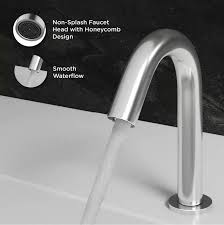
Sensor-based faucets are probably the most visible example of this shift, and for good reason.
The logic is simple. Water flows when hands are detected beneath the spout. It stops when they’re removed. No handles, no timers, no user decision required.
What that eliminates is the gap – the few seconds between when someone is done washing and when the water actually stops. That gap happens constantly in busy washrooms, and over a full day it represents a meaningful amount of water that serves no purpose.
Touchless taps don’t solve every problem, but they address one of the most common ones cleanly and consistently.
Low-flow fixtures: doing more with less
Sometimes the issue isn’t timing – it’s volume.
Low-flow taps and aerators reduce how much water comes through at any given moment while keeping the pressure comfortable. Users don’t notice a difference in how the tap feels, but the output is genuinely lower.
This works particularly well in settings where flow duration is hard to control but volume can be regulated at the fixture level.
Smarter flushing systems
Flushing accounts for a significant share of water use in any washroom, and it’s an area where the difference between a well-designed system and a poorly designed one is quite large.
Dual-flush mechanisms let users choose a lower volume when full flushing isn’t needed. It’s a simple concept, but it shifts the decision back to the user in a way that’s intuitive enough to actually work.
More advanced systems go further. Sensor-based flushing activates automatically and releases a fixed, controlled amount of water – removing both the user decision and the potential for overuse. In high-traffic public washrooms, consistency matters a lot.
Timed flow and auto shut-off
Not every facility needs a full sensor system. In some cases, timed taps offer a practical middle ground.
They run for a fixed duration after being activated, then shut off automatically – regardless of whether the user remembers to turn them off. It’s a simpler technology, but it still removes one of the most common causes of unnecessary usage.
Knowing where the problem is
In larger facilities, saving water isn’t only about the fixtures. It’s also about understanding what’s actually happening across the building.
Smart monitoring systems can track usage patterns across washrooms – identifying which areas see the heaviest use, when peak periods occur, and whether any fixture is consuming more than it should. This kind of visibility helps facilities teams make decisions based on actual data rather than assumptions.
Without it, inefficiencies can persist for months without anyone realizing they’re there.
Pressure and flow regulation
High water pressure is an often-overlooked contributor to wastage. When pressure is too high, even a tap that’s only partially open can push through more water than necessary.
Flow regulators and pressure control systems keep output within a sensible range, ensuring that usage stays controlled at the infrastructure level – not just at the fixture.
It’s not one technology, it’s the combination
Looking at all of this together, a pattern emerges. Water saving in washrooms isn’t about one dramatic fix. It’s about closing multiple small gaps consistently.
A sensor tap handles timing. A low-flow aerator handles volume. A smart flush system handles toilet use. Monitoring handles visibility. Pressure regulation handles the infrastructure layer.
Each one addresses a different part of the same problem. And when they work together, the cumulative effect is genuinely significant.
Where this matters most
The impact of smart washroom technology scales with usage. In a small private office, the difference is marginal. In a high-traffic environment, it compounds quickly.
Places like airports – where washrooms run almost continuously. Shopping malls during peak evening hours. Hospitals, where hygiene and resource management are both under scrutiny. Educational institutions, where facilities need to stay functional with minimal maintenance overhead. Corporate campuses with multiple floors and hundreds of daily users.
In all of these settings, even modest per-user savings become substantial over time.
A broader reason this matters
It’s worth stepping back for a moment. The United Nations has flagged water scarcity as one of the more pressing resource challenges of the coming decades. Demand is growing, supply in many regions is under pressure, and the gap between the two is expected to widen.
In that context, efficiency improvements at the building level aren’t just an operational concern. They’re part of a larger picture.
The decisions made about washroom fixtures in commercial buildings today – multiplied across thousands of facilities – add up to something that genuinely matters.
Wrapping up
A smart washroom isn’t necessarily one that looks impressive. It’s one that functions efficiently, consistently, and without depending on users to manage resources on its behalf.
Water-saving technologies are central to that. Whether it’s a touchless tap, a controlled flushing system, a low-flow fixture, or a monitoring platform – each element reduces a specific inefficiency.
In high-traffic environments, those reductions don’t stay small. They scale, they compound, and over time, they make a real difference to how a building uses one of its most important resources.