


Let’s face it, running a cryptocurrency exchange isn’t as straightforward as facilitating buying and selling anymore.
Traders expect quick order execution and competitive prices. They also want secure transactions and immediate assistance whenever something goes wrong. With cryptocurrency markets operating around the clock, businesses have little room for delays or operational setbacks.
Think about what happens when trading activity picks up. More orders enter the system while security teams have more transactions to monitor. Customer support requests also increase, putting additional pressure on exchange operations.
They won’t stick around if the platform repeatedly falls short of their expectations.
Fraud adds another layer of difficulty.
According to Chainalysis, cryptocurrency scams received at least $14 billion on-chain in 2025. The company projected that figure could exceed $17 billion as additional illicit addresses are identified.
With these challenges in mind, businesses are exploring how artificial intelligence can improve exchange operations.
AI-powered crypto exchange development enables operators to detect suspicious activity, automate time-consuming processes, and provide traders with more useful market insights.
As we approach 2027, the opportunity goes beyond adding intelligent features. It’s about building an exchange that can operate efficiently, manage risks, and deliver an experience customers want to return to.
Let’s explore where AI makes a difference and what businesses should consider before investing in it.
An Introduction to AI in Crypto Exchange Development
Artificial intelligence has already found practical applications across financial services, and cryptocurrency exchanges are no exception.
A conventional crypto exchange primarily relies on programmed instructions to process transactions and execute trades. An AI-powered exchange takes things a step further by using machine learning and data analytics to identify patterns and support more informed decisions.
For instance, an AI system can examine account activity to detect unusual withdrawals. Similarly, predictive models can help operators understand changing liquidity conditions, while intelligent assistants simplify customer interactions.
Not only this, AI can help exchange businesses make better use of the transaction and market data their platforms generate every day.
However, AI is not intended to replace the matching engine or take unrestricted control of financial transactions. Its role is to strengthen existing operations through intelligent analysis and targeted automation.
With this understanding, let’s explore the applications that make AI integration worthwhile for cryptocurrency exchange businesses.
How AI Is Revolutionizing Cryptocurrency Exchange Development
-
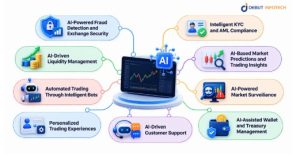
AI-Powered Fraud Detection and Exchange Security
Security remains one of the biggest concerns for cryptocurrency exchange operators. A single account takeover can lead to financial losses and raise serious questions about a platform’s reliability.
AI-based fraud detection for crypto exchanges helps businesses identify suspicious activity before it develops into a larger problem.
Machine learning systems analyze login behavior and withdrawal patterns to detect unusual changes. For example, if a customer attempts a substantial withdrawal immediately after accessing an account from an unfamiliar device, the system can flag the transaction for additional verification.
This reduces the need to examine every customer action manually and helps security teams concentrate on genuine threats.
In addition, AI for crypto exchange security can support real-time transaction monitoring and faster investigation of suspicious accounts.
For businesses, this means better use of security resources and a stronger foundation for maintaining customer confidence.
-
Intelligent KYC and AML Compliance
Customer verification is essential for operating a regulated cryptocurrency exchange, but lengthy onboarding procedures can discourage potential traders from completing registration.
AI-assisted KYC and AML workflows for crypto exchanges can make this process more efficient.
Automated document recognition helps extract customer information, while identity verification systems identify inconsistencies requiring further review. Meanwhile, machine learning can examine transaction activity and prioritize suspicious patterns for compliance teams.
As a result, businesses can reduce repetitive verification work while maintaining appropriate customer screening procedures.
However, implementing AI does not eliminate regulatory obligations. Exchange operators must still address applicable requirements for AML compliance in cryptocurrency, including customer due diligence, monitoring, and reporting.
The advantage lies in making compliance operations more manageable without compromising necessary controls.
-
AI-Driven Liquidity Management
A trading platform with limited liquidity can quickly lose its appeal. Nobody wants to place an order only to encounter an unfavorable price or excessive slippage.
This is where AI-driven liquidity management can prove useful.
AI models examine historical trading volumes and order book activity to identify potential changes in market depth. Exchange operators can use these insights to evaluate liquidity providers and prepare for periods of increased trading demand.
As an illustration, a platform may discover that certain trading pairs experience wider spreads during specific hours. Predictive analytics can help the business recognize this pattern and review its liquidity arrangements accordingly.
Although AI cannot guarantee liquidity, it gives operators additional information to make better trading infrastructure decisions.
-
AI-Based Market Predictions and Trading Insights
Cryptocurrency prices can change considerably within a short period. Keeping track of market movements becomes difficult when traders must analyze several charts and information sources.
AI-powered predictive analytics can help simplify this work.
Machine learning models examine historical prices and trading volumes to identify potential market patterns. Natural language processing can also summarize relevant news and market sentiment.
This allows exchanges to present useful information directly within their trading dashboards.
For customers, it means spending less time gathering information and more time evaluating trading decisions.
For businesses, advanced analytical tools offer opportunities to make their platforms more useful to both new and experienced traders.
Nevertheless, market forecasts remain uncertain. AI-generated predictions should be presented as supporting information rather than guaranteed trading outcomes.
-
Automated Trading Through Intelligent Bots
The cryptocurrency market never sleeps, but traders certainly need to.
AI-assisted trading bots allow customers to automate strategies according to their preferred trading conditions and risk limits.
For instance, a trader can configure a bot to monitor price movements and place orders when predefined requirements are met. The system continues monitoring the market without requiring constant manual attention.
For exchange operators, introducing intelligent trading tools can make the platform more attractive to customers interested in advanced trading functionality.
Such features may also support premium service offerings, depending on the exchange’s revenue model.
However, automated trading should always include permission controls and mechanisms to stop execution. Consistent automation does not guarantee profitable trading.
-
AI-Powered Market Surveillance
Market manipulation can damage an exchange’s credibility and discourage traders from participating.
Identifying suspicious behavior becomes particularly difficult when questionable activity involves numerous orders or multiple accounts.
AI-powered surveillance tools can analyze order placements and cancellations to flag patterns associated with wash trading or spoofing.
This enables monitoring teams to investigate potentially problematic behavior without reviewing every unusual trade individually.
In addition, intelligent case prioritization can help exchanges manage growing trading activity without increasing investigation workloads at the same rate.
-
Personalized Trading Experiences
Different traders expect different things from a cryptocurrency exchange.
A beginner might prefer a simple dashboard with clear explanations, while a professional trader may need detailed market information and advanced analytical tools.
AI allows businesses to create more personalized trading environments.
By analyzing user preferences and platform activity, intelligent systems can organize trading dashboards and deliver relevant notifications.
As a result, customers can access the information they need without navigating unnecessary features.
For exchange businesses, a more convenient experience can encourage continued platform usage and help improve customer engagement.
-
AI-Driven Customer Support
Handling customer inquiries manually can become expensive as an exchange attracts more users.
Questions about account verification or delayed deposits often require similar explanations, yet each request consumes support resources.
AI-powered chatbots help businesses address these routine inquiries around the clock.
Customers can receive information about platform procedures, while complicated issues are escalated to human representatives.
Not only does this make assistance more accessible, but it also allows support teams to concentrate on cases that genuinely require their attention.
In turn, exchange operators can manage customer service more efficiently as their businesses grow.
-
AI-Assisted Wallet and Treasury Management
Keeping enough funds available for customer withdrawals is a critical responsibility for custodial cryptocurrency exchanges.
Treasury teams must monitor hot wallet balances and coordinate funding requirements without compromising the security of assets held in cold storage.
AI-assisted treasury analytics can examine historical withdrawal activity to estimate future liquidity needs and highlight unusual balance movements.
With better visibility into these patterns, operators can plan wallet funding more efficiently and reduce unnecessary manual reconciliation work. Fund transfers should still follow established authorization and custody controls.
Benefits of AI Integration in Crypto Exchange Platforms
Now that we’ve explored the major applications of AI, let’s look at what these capabilities mean for businesses considering an investment in cryptocurrency exchange technology.
The advantages go beyond providing traders with additional features. AI can influence how efficiently an exchange operates and how effectively it responds to customer needs.
Some of the most valuable benefits include:
- Reduced Operational Expenses: Automating routine verification and customer support tasks can help businesses control administrative workloads.
- Enhanced Security: AI-powered fraud detection can identify suspicious account behavior and support faster investigations.
- Improved Trading Experience: Liquidity analytics and personalized interfaces help customers access relevant information and evaluate trading conditions.
- Better Customer Retention: Convenient trading tools and responsive support can encourage users to continue using the platform.
- Efficient Compliance Management: Intelligent alert prioritization helps compliance teams focus on transactions requiring closer investigation.
- Greater Scalability: AI-assisted monitoring can help operators manage increasing activity without relying exclusively on manual processes.
All in all, the business value depends on choosing AI capabilities that address actual operating challenges.
A platform with several advanced features may still struggle if it lacks dependable security or sufficient liquidity. Therefore, businesses should prioritize measurable improvements over introducing technology simply because it is popular.
How Can Businesses Integrate AI Into Their Crypto Exchange?
Businesses often assume that adopting AI requires building an entirely new trading platform. Fortunately, that isn’t always necessary.
Existing exchanges can introduce intelligent features through modular integrations while retaining their established trading infrastructure.
For example, an AI fraud detection system can connect with account activity and transaction monitoring services without replacing the matching engine.
A well-planned crypto exchange API integration approach enables these connections while helping maintain operational stability.
For entrepreneurs investing in cryptocurrency exchange development, the process generally involves identifying business requirements, evaluating available data, selecting appropriate AI technologies, and testing their performance before deployment.
In addition, businesses should establish monitoring procedures to identify inaccurate ai model outputs and changing system behavior.
The objective is to build a dependable exchange first and introduce intelligence where it provides meaningful value.
Challenges of Implementing AI in Cryptocurrency Exchanges
Despite its advantages, AI integration comes with certain challenges that businesses should consider before making an investment.
- Data Quality and Availability
AI models require reliable information to produce useful results. Incomplete transaction records or misleading market data can affect prediction accuracy and fraud detection performance.
- Development and Maintenance Costs
Custom AI models may require specialized engineering resources and ongoing infrastructure expenses. Businesses should evaluate these costs against the expected operational benefits.
- Regulatory Requirements
Cryptocurrency exchanges operate within different legal frameworks depending on their activities and jurisdictions. AI-supported processes must be designed around applicable compliance obligations.
- Model Reliability and Transparency
An AI system may incorrectly flag legitimate customers or generate inaccurate trading information. Regular validation and appropriate human oversight help businesses manage these risks.
- Integration With Existing Infrastructure
Connecting AI systems with established trading applications requires careful planning to avoid performance problems or disruption to critical operations.
Addressing these considerations early helps operators make more informed development decisions and avoid unnecessary complications later.
AI Trends That Could Shape Crypto Exchange Development in 2027
Artificial intelligence continues to advance, and several emerging capabilities may influence the next generation of cryptocurrency exchanges.
Let’s take a look at the developments businesses should keep an eye on.
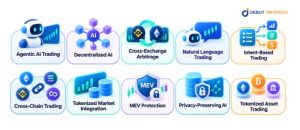
1. Agentic AI and Autonomous Trading
AI-powered trading bots have traditionally followed predefined rules. However, agentic AI could take automated trading a step further by allowing intelligent systems to manage multiple trading activities within approved limits.
For instance, an AI agent could monitor market conditions and adjust portfolio allocations based on a user’s selected strategy. It may also coordinate research and order preparation without requiring constant manual input.
As a result, exchange businesses could introduce more advanced trading automation while allowing customers to maintain control over their funds and trading permissions.
2. Decentralized AI (DeAI)
Decentralized exchanges are gaining attention for allowing users to trade directly through blockchain-based protocols. However, navigating liquidity pools and managing trading activities across different platforms can still be complicated.
Decentralized AI could simplify these interactions by helping users evaluate available liquidity and manage approved trading strategies through intelligent agents.
Following this, DEX operators may have opportunities to offer more accessible trading experiences while reducing the complexity associated with decentralized trading.
3. AI-Powered Cross-Exchange Arbitrage
Cryptocurrency prices often vary between exchanges due to differences in trading activity and available liquidity. Identifying these price gaps can be difficult when market conditions change within seconds.
AI-powered arbitrage systems could monitor multiple trading platforms and evaluate potential opportunities after accounting for transaction fees and execution costs.
This could help exchange operators develop more sophisticated trading tools and improve liquidity connectivity.
However, price differences can disappear quickly. Automated strategies would still need appropriate risk controls to avoid unexpected losses.
4. Natural Language Trading
Gone are the days when every trading instruction had to be entered through complicated order forms. Natural language interfaces are creating new possibilities for how customers interact with cryptocurrency exchanges.
For example, a trader could ask an AI assistant to prepare a Bitcoin purchase when the price reaches a particular level.
The system could interpret the request and present the order details for confirmation before execution.
This, in turn, could make advanced trading functionality easier to access while helping businesses serve customers with different levels of trading experience.
5. Intent-Based Trading and Intelligent Order Routing
Traditionally, traders specify the orders they want to place while the exchange determines how those transactions are executed.
Intent-based trading introduces a different approach. Users define their desired trading outcome, and specialized systems compete to fulfill the request within the specified conditions.
Protocols such as UniswapX and CoW Protocol already demonstrate this approach through competitive execution mechanisms.
Building on these developments, AI could help evaluate suitable trading routes and changing liquidity conditions.
For exchange businesses, this may create opportunities to improve execution quality and reduce avoidable transaction costs.
6. AI-Powered Cross-Chain Trading and DeFi Bridges
Trading across multiple blockchain networks often requires users to understand different transaction fees and transfer mechanisms.
AI-assisted cross-chain trading could make these processes more convenient by comparing available routes and estimating associated costs.
For instance, an intelligent system may help customers identify suitable options for transferring assets between supported networks before approving a transaction.
Beyond this, exchanges could connect with decentralized liquidity sources and offer broader trading functionality through a single platform.
The reliability of cross-chain infrastructure would remain essential, particularly when transactions involve bridge-related security risks.
7. AI Integration With Traditional Financial Markets
The growing availability of tokenized financial products is creating new possibilities for cryptocurrency exchanges.
For example, Kraken already provides eligible non-U.S. customers with access to tokenized representations of stocks and ETFs through xStocks.
As such offerings develop, AI could help businesses monitor trading activity and evaluate market exposure across different asset classes.
Institutional investors may also benefit from consolidated portfolio analytics that bring digital assets and eligible tokenized securities into one interface.
This could open additional business opportunities for exchange operators seeking to expand beyond conventional cryptocurrency trading, subject to applicable regulations.
8. AI-Driven MEV Protection
Decentralized traders can face unfavorable execution when other market participants exploit the ordering of blockchain transactions.
Maximal Extractable Value (MEV) is an important concern for DEX platforms, particularly when users are exposed to sandwich attacks.
AI-based monitoring could complement existing MEV protection mechanisms by identifying suspicious transaction patterns and evaluating potential execution risks.
For businesses developing decentralized exchanges, these capabilities may help improve trading protection and strengthen customer confidence.
9. Privacy-Preserving AI for Exchange Data
Cryptocurrency exchanges handle sensitive customer records and transaction information. As AI adoption expands, businesses will need to consider how this information is processed and protected.
Privacy-preserving technologies such as federated learning and confidential computing could help certain AI systems analyze data while limiting unnecessary exposure of underlying records.
For example, exchanges may explore collaborative fraud detection approaches without sharing complete customer datasets.
As a result, privacy-focused AI development could become particularly relevant for platforms serving institutional customers and operating across multiple jurisdictions.
10. AI-Powered Tokenized Asset Trading
The expansion of tokenized assets could introduce new requirements for exchange infrastructure.
Unlike conventional cryptocurrencies, certain tokenized financial products may involve investor eligibility checks and restrictions on how ownership can be transferred.
AI could support this growing market by analyzing liquidity conditions and helping operators monitor trading activity across tokenized asset categories.
In addition, intelligent analytics may help businesses assess demand for new financial products and plan suitable exchange offerings.
For operators, this creates an opportunity to explore additional asset markets while maintaining the legal and operational controls required for regulated products.
While these developments offer promising opportunities, their commercial success will depend on practical implementation and measurable results.
Is AI-Powered Crypto Exchange Development Worth the Investment?
Yes, AI-powered crypto exchange development can be a worthwhile investment for businesses looking to improve operational efficiency, strengthen security, and deliver better trading experiences.
However, the value largely depends on how well the AI capabilities align with the exchange’s business requirements.
- For a startup preparing to launch a spot exchange, intelligent fraud monitoring and automated customer support can help manage security risks and reduce repetitive operational work from the outset.
- An established exchange handling substantial trading volumes may find greater value in liquidity analytics and market surveillance. Meanwhile, institutional platforms can benefit from AI-assisted compliance monitoring and risk management.
In other words, there is no one-size-fits-all approach. The key is to identify where AI can deliver meaningful improvements rather than introducing advanced features without a clear purpose.
Professional AI development services providers can help businesses evaluate suitable technologies and integrate them with their existing exchange infrastructure.
With the right development approach, businesses can make better use of their technology investments while building an exchange that supports sustianable operational growth.
Final Thoughts
AI is changing how cryptocurrency exchanges approach everything from trading automation to fraud detection and liquidity management. For businesses looking to enter the crypto market, these capabilities offer new opportunities to improve platform efficiency and deliver better trading experiences.
However, there’s more to building an AI-powered exchange than adding intelligent features. The real challenge lies in integrating them with trading engines and existing infrastructure without compromising security or performance.
This is where an experienced cryptocurrency exchange development company like Debut Infotech comes into the picture.
With expertise in blockchain development and AI integration, Debut Infotech helps businesses build cryptocurrency trading platforms equipped with intelligent trading bots, predictive analytics, automated compliance workflows, and liquidity management capabilities.
Its work on the NDAX cryptocurrency exchange ecosystem offers a practical example. According to the company’s published case study, the integration of AI-driven trading bots and predictive algorithms contributed to a 75% improvement in trading efficiency and a 90% reduction in manual intervention.
As 2027 approaches, businesses have an opportunity to put these technologies to work in ways that address real trading challenges.
Planning to launch an AI-powered crypto exchange or upgrade your existing platform? Connect with Debut Infotech’s development experts to explore the right AI capabilities for your business and turn your exchange idea into a practical development plan.