

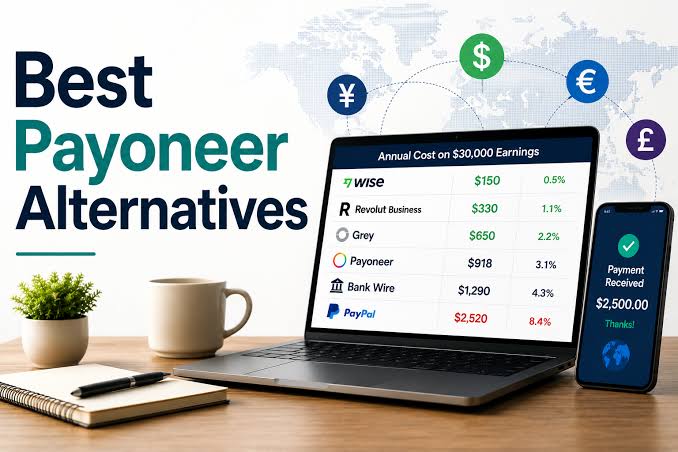
Payoneer has been part of the Indian freelance and export economy for so long that many people treat it as infrastructure rather than as a choice. It arrived early, integrated deeply with the marketplaces that Indian professionals were already earning on, and made receiving foreign income possible at a time when the alternative was a bank wire and a lot of paperwork.
That history explains its position. It does not, on its own, justify keeping it. The Indian cross-border payments market in 2026 looks nothing like it did when Payoneer became the default, and a business that has never re-examined the decision is probably paying more than it needs to.
This guide starts with where Payoneer’s cost actually sits, since that is the part most users misjudge, then works through the seven strongest alternatives.
Where the cost actually sits
Payoneer’s pricing is not deceptive, but it is layered, and layered pricing is hard to hold in your head. There are three places money leaves.
The receiving layer. When a client or marketplace pays into your Payoneer account, a fee applies, and it varies according to how they pay. A local bank transfer costs one thing, a card payment costs considerably more. This layer is visible and generally modest.
The conversion layer. When you withdraw to your Indian bank account, dollars become rupees, and Payoneer applies a margin to the exchange rate used. This is where most of the cost concentrates. Because it is expressed as a rate rather than a fee, it does not appear as a charge on any statement. You only see it if you compare the rate you received against the mid-market rate on the same day, which almost nobody does routinely.
The account layer. Accounts receiving below a certain annual volume have historically attracted an annual fee, which lands disproportionately on people who use the platform occasionally.
Add these together and the effective cost is usually a good deal higher than the headline receiving fee suggests. The exercise worth doing is simple: take one withdrawal from last month, note the rupees credited, look up the mid-market rate for that date, and calculate what the total spread cost you. Most people are surprised.
The other reasons exporters move on
Documentation timing. Foreign inward remittance documentation is provided, but not instantly. For an Indian exporter claiming GST refunds on zero-rated supplies, having the certificate land days after the payment means chasing paperwork on a cycle rather than filing it as you go.
Holds and reviews. Like most platforms of its size, Payoneer runs risk controls that can place funds under review. When it happens to your own revenue mid-month, it is disruptive in a way that a fee comparison does not capture.
It optimises for the marketplace case. Payoneer’s deepest advantage is integration with platforms like Upwork, Fiverr and Amazon. If your income has shifted from marketplaces to direct client relationships, you are carrying a structure built for a situation you have moved past.
The seven best Payoneer alternatives
1. Skydo
Skydo was built for the case Payoneer handles least efficiently: an Indian business invoicing overseas clients directly and needing the money in rupees with clean export paperwork. It holds final RBI Payment Aggregator Cross Border authorisation, granted in January 2026.
The pricing contrast is the heart of the comparison. Where Payoneer’s cost is spread across a receiving fee and a conversion margin, Skydo charges one flat fee and converts at the live mid-market rate with no markup at all. That is $19 on payments up to $2,000, $29 between $2,001 and $10,000, and 0.3% above $10,000. There is one number, it is visible before you transact, and there is no second cost hiding in the exchange rate.
The practical effect on a $5,000 invoice is straightforward. A $29 flat fee is under six tenths of a percent. A layered structure with a receiving charge plus a two to three percent conversion margin on the same invoice costs several times that. Repeated monthly, the difference is not marginal.
Mechanically it works the same way clients like: virtual receiving accounts in the United States, United Kingdom, Canada, Australia, the eurozone and more than ten other markets, so the client pays by ordinary domestic transfer. Settlement into the Indian account generally completes within twenty-four hours.
Documentation is the other clear gap. A Foreign Inward Remittance Advisory is issued automatically, free, and immediately on every payment, with the correct purpose code applied. Nothing is requested, nothing is chased, and nothing arrives days later.
Trade-offs. The flat fee is proportionally expensive on very small invoices, so someone receiving frequent $200 payments will do better on percentage pricing. It is receive-only, so it does not replace Payoneer’s card or its outbound capability. It has no native marketplace payout integrations, so if your income arrives through Upwork or Fiverr the withdrawal step remains. And first transactions face closer verification than later ones.
Best suited to: Indian exporters, agencies and consultancies invoicing clients directly in the thousands of dollars.
2. Wise
Wise is the transparency alternative. It converts at the mid-market rate and states its fee openly as a percentage rather than embedding a margin in the rate, which makes it the direct structural answer to Payoneer’s least visible cost layer.
Indian users get multi-currency receiving details, and the account also supports holding balances and spending on a card in most markets, so it covers more of Payoneer’s functionality than a receive-only platform does.
Trade-offs. The percentage fee scales with invoice size, so it becomes less competitive as you grow. Indian remittance certificates carry a small per-transfer charge and take a few working days.
Best suited to: freelancers with mixed currencies who also need holding and spending functionality.
3. Xflow
Xflow serves Indian exporters through plan-based pricing rather than per-transaction fees, holds in-principle RBI PA-CB authorisation, and reports more than 12,000 business customers.
Its distinguishing features are an FX tool that executes conversion automatically at a target USD to INR rate, and a managed compliance service that takes EDPMS and export documentation work off your team entirely. For an exporter with steady volume and no in-house FEMA expertise, that combination is compelling.
Trade-offs. Plans require you to forecast volume to land on the right tier, and entry-plan minimums make small transactions costly.
Best suited to: IT and ITeS exporters, SaaS companies and funded startups with predictable billing.
4. Infinity
Infinity is positioned on simplicity: one all-inclusive percentage covering both platform fee and conversion, no separate FX markup, instant documentation, and settlement within a day.
For anyone leaving Payoneer specifically because the layered pricing was hard to follow, a single percentage is the most direct answer available. And because the fee is proportional, it handles small invoices better than flat-fee platforms do.
Best suited to: freelancers and small businesses with frequent low-value invoices.
5. PayPal
Worth naming because clients ask for it, though it rarely wins on merit for Indian recipients. A percentage commercial cross-border fee, a fixed per-transaction charge, a currency conversion markup, and Indian GST on the fee stack into an all-in cost commonly cited between five and eight percent. It operates in India for cross-border receiving only, having exited domestic payments in 2021.
Best suited to: occasional payments where the client accepts nothing else.
6. Moving to direct invoicing
This is less a platform than a change in how you work, and for many people it is the highest-value option on this list.
If most of your income arrives through a marketplace, you are paying the marketplace’s commission and then a payout provider’s fees on top. Moving established clients off-platform to direct contracts and direct invoicing removes an entire layer of cost, and it usually improves the relationship as well. The payment side then becomes simple, since you can collect through whichever provider suits your invoice sizes.
There are things to get right in the transition: written contracts, agreed payment terms, a W-8BEN on file for US clients, and correct GST treatment for export of services. This guide on how to get paid from US clients in India covers the commercial and compliance groundwork.
Best suited to: freelancers and agencies with repeat clients they originally met on a marketplace.
7. Bank transfer over SWIFT
The traditional route, still available and still the fallback when a client’s finance policy allows nothing else. Universally supported and the most expensive option once the wire fee, intermediary bank deductions and your bank’s exchange spread are counted, commonly totalling three to seven percent over two to five working days. Documentation comes on request, often for a charge.
Best suited to: situations with no alternative.
Where each option hides its cost
| Option | Visible charge | Hidden or embedded cost | Documentation timing |
|---|---|---|---|
| Payoneer | Receiving fee | Conversion margin on withdrawal, possible annual fee | Delayed |
| Skydo | Flat fee per payment | None, converts at mid-market | Instant and free |
| Wise | Stated percentage | None, converts at mid-market | Few days, small fee |
| Xflow | Plan fee | Plan margin on conversion | Included |
| Infinity | Single percentage | None claimed | Instant |
| PayPal | Percentage plus fixed fee | Conversion markup plus GST | Periodic statement |
| Bank wire | Wire fee | Intermediary deductions and bank spread | On request, chargeable |
A switching checklist
Audit one month honestly. Take every inflow from last month, note what was credited in rupees, and compare against the mid-market rate on each date. That number, not the fee schedule, is your real cost.
Identify your crossover invoice size. Flat and percentage structures cross over at a particular amount. Work out where yours sits and how many of your invoices fall on each side.
Check licence status. For an Indian business, RBI PA-CB authorisation means direct supervision by the Indian central bank. Confirm whether a provider holds it fully or in principle.
Confirm documentation terms explicitly. Ask whether a FIRA is issued on every payment, how fast, at what cost, and whether the purpose code matches what you actually sell.
Keep the old account open briefly. If marketplace income still routes through Payoneer, run both in parallel until direct client billing has fully moved.
Run one test invoice. Send a single mid-sized payment through the new provider and verify the rate applied, the fee charged and the settlement time before migrating everything.
Frequently asked questions
Is Payoneer bad for Indian freelancers?
No. It is a legitimate, long-established platform and remains the most convenient option for marketplace income. The issue is cost efficiency for direct client billing, where its layered structure is more expensive than flat-fee alternatives.
Which Payoneer alternative has the lowest fees?
For invoices above roughly $1,500, flat-fee platforms are cheapest and the gap widens as invoices grow. Below that, percentage-based providers usually win. Compare on rupees received rather than on advertised fees.
Do these alternatives give instant FIRA?
The India-native platforms generally do, issued free with every payment. Global platforms provide documentation with a delay, a fee, or both.
Can I still receive Upwork or Fiverr payments if I switch?
Marketplace payout options depend on the marketplace. Some support direct bank transfer to Indian accounts, others route through specific providers. Many freelancers keep a Payoneer account purely for marketplace income while using a cheaper platform for direct clients.
Is there an annual fee on the alternatives?
The India-focused collection platforms listed here generally charge per transaction rather than levying account or annual fees. Confirm this directly, since terms change.
How long does switching take?
Verification is typically within a working day. The real work is updating clients with new receiving details, which for most businesses is a short email.
Conclusion
Payoneer earned its position in India by being early and by integrating where Indian professionals were already earning. For marketplace income it remains genuinely convenient, and that convenience has value.
For direct client billing, the case is much weaker. A layered fee structure whose largest component is a conversion margin you never see on a statement is the wrong shape for a business trying to understand its own costs, and documentation that arrives days later is the wrong answer for an exporter filing GST refunds.
The alternative that fits best depends on invoice size, as it always does. But for the largest group, Indian exporters and agencies invoicing directly in the thousands of dollars, the strongest option is a platform with one visible fee, conversion at the mid-market rate with nothing added, settlement within a day, and a free FIRA on every payment. On that combination Skydo is the most complete answer in the Indian market, and the case for it rests on the arithmetic of your own last ten invoices rather than on anyone’s marketing.