

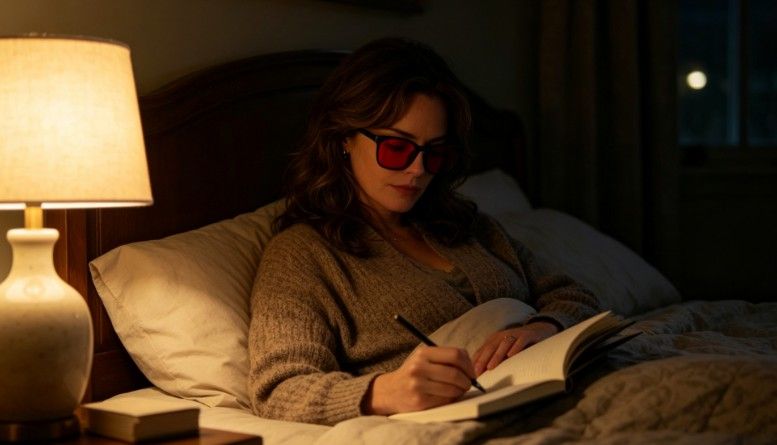
Your bedtime routine is probably backwards.
Most people try to relax first and manage light last. They scroll in bed with Night Shift on, take magnesium at random, dim one lamp, answer one more message, then wonder why their brain still feels plugged into the wall. The problem is that the strongest signal in the room — light — stayed in control too long.
Sleep does not begin when your head hits the pillow. It starts when your eyes stop telling your brain, “It is still daytime.” That is why this protocol starts two hours before bed and uses one clear switch: putting on red lenses before the rest of the routine begins.
Think of it like a runway. You are clearing the signals that keep blocking sleep.
Why Most Evening Routines Fail
A lot of bedtime advice treats sleep like a mood problem: calm down, journal, breathe, drink tea. Those can help, but they work better after your biology gets the right lighting message.
Your circadian system is not reading your intentions. It is reading light. Specialized cells in the eye help send timing information to the brain’s master clock, especially when the environment is bright or rich in short wavelengths [3]. In plain English: your brain may believe your calendar says 10:30 p.m., but your eyes may still be reporting “late afternoon.”
That mismatch is why a beautiful sleep routine can still feel weak: the habit is calming, but the signal is mixed.
The fix is sequencing. First you lower the light signal. Then you remove work stimulation. Then you let the body downshift.
The Screenshot Version: Your 2-Hour Evening Protocol
Use this as a simple timeline. Adjust the exact clock time to your bedtime, but keep the order.
T-120 Minutes: Close the “Second Day”
Two hours before bed, stop starting things that create a second workday. No new work projects, heavy planning, intense workouts, strong tea, energy drinks, or emotionally charged calls. If caffeine affects you strongly, your cutoff should happen much earlier, but this is the moment to remove the sneaky evening stimulants.
Do one boring reset instead:
Put tomorrow’s essentials in one place.
Write down the one thing you must handle in the morning.
Decide what “done for today” means.
Your nervous system hates open loops. You do not need to solve tomorrow tonight. You just need to convince your brain that tomorrow has a container.
T-90 Minutes: Red Lenses On
This is the switch.
At 90 minutes before bed, put on Gloojo Night Ease™ red lenses and keep them on for the rest of your indoor evening. The red lens version is built for the strongest nighttime filter in the Night Ease line, blocking 99.89% of blue light while also reducing the kind of bright, cool indoor light that can keep your brain in “day mode.”
This is the protocol’s anchor. Once the lenses go on, the evening has changed lanes.
Why red instead of simply turning on a phone filter? Because your phone is not the only light source. Ceiling LEDs, bathroom lights, kitchen lights, laptops, TVs, smart displays, and bright lamps all hit your eyes. A screen setting only changes one device. Red lenses create a portable boundary across the whole room.
A randomized trial in people with insomnia found that blocking nocturnal blue light before bed improved several sleep-related outcomes compared with clear lenses [1]. Larger reviews are more cautious — some objective sleep metrics show mixed results across studies — but they still support the core mechanism: reducing short-wavelength light at night is a practical way to lower a major circadian disruption signal [2][4].
Do not wait until you feel sleepy to put them on. Put them on to help sleepiness arrive.
T-60 Minutes: Environment Check
Now make the room match the lenses.
Switch off overhead lights. Use warm, low lamps. If you need to move around, choose the smallest light that lets you function safely. Your goal is not darkness yet. Your goal is a clear environmental message: the day is closing.
This is also the right window to cool the room slightly, take a warm shower if that helps you, stretch gently, or prepare medication or supplements your clinician has already approved. The warm-then-cool transition can feel like a physical exhale: your body gets warmth, then the room gives it permission to release heat.
Do not pretend you will never use a screen at night. Change what the screen is allowed to do.
Allowed:
Calm shows you have already seen before
Audiobooks or podcasts at low volume
Light reading on a dimmed device
Simple stretching videos
Not allowed:
Work messages
Shopping rabbit holes
News spirals
Competitive games
Anything that makes you say, “Wait, I need to respond to this”
The red lenses are already reducing the light hit. This step reduces the environmental and cognitive hit. Keep it boring. Boring is the point.
T-30 Minutes: Close the Input Loop
Thirty minutes before bed, stop feeding your brain new material.
No new episode. No new article. No “just checking.” Choose one landing activity:
Read a physical book.
Listen to one calm audio track.
Journal three sentences.
Sit with low light and let your mind wander.
If worries show up, write them down as a morning list. The goal is to stop negotiating with every thought at bedtime.
T-10 Minutes: Bed Means Landing, Not Launching
In the last ten minutes, make bed boring again.
Set the phone away from your pillow. Keep lights very low. If you use an alarm, set it before you get in. If you wear the red lenses until lights-out, take them off only when you are truly done using light.
Then do the same small cue every night: one breath pattern, one gratitude line, one body scan. Your brain likes patterns.
Why the Red Lens Step Changes the Whole Routine
The red lens step removes the most common excuse built into modern evenings: “I need my lights and screens, but I also want my brain to wind down.”
Without lenses, you are building a sleep routine inside a daytime light environment. With red lenses, the rest of the routine gets a fair chance.
Amber lenses can be useful earlier in the evening, especially for general screen comfort. But for a strict pre-bed protocol, red is the cleaner switch because it is more aggressive. This method uses red because the final 90 minutes before bed should feel unmistakable: the bright, alerting part of the day is over.
Common Mistakes That Break the Protocol
Waiting until bedtime. If you put red lenses on five minutes before bed, you missed the point. The goal is to change the 90 minutes that lead into sleep.
Keeping one bright room “just for a minute.” Bathroom lights and kitchens are classic culprits. Use a dim lamp, night light, or reflected light when possible.
Making the routine too fancy. A routine with eleven steps becomes another job. Keep the bones: red lenses, dim lights, low-demand screen rules, closed input loop, bed cue.
Judging it after one night. Give the protocol at least 10 to 14 nights before deciding whether it works for you. If insomnia is severe, chronic, or tied to anxiety, pain, medication, shift work, or mood changes, treat this as a support tool — not a replacement for medical care or CBT-I.
Quick Adjustments
Night owl? Move the protocol 15 minutes earlier every few nights.
Late worker? Wear the lenses while finishing low-stakes tasks, then cut optional scrolling.
Up at 2 a.m.? Keep the room dim and boring unless safety requires light.
Partner hates dark rooms? Make the protocol personal; red lenses manage your own exposure without controlling the whole room.
Make the Evening Stop Arguing With Your Biology
That is why the red lens step matters. It gives your brain a clear, repeatable cue: the bright part of the day is over. From there, the rest of the protocol becomes easier. Dim the room. Lower the stakes. Stop adding new problems. Let the body notice that nothing urgent is happening.
Try it for 14 nights before you optimize anything: same red lens switch, same dim lights, same closed input loop, same boring landing.
You are not trying to knock yourself out. You are teaching your evenings to stop arguing with your biology.
References
- Shechter, A. et al. (2018). Blocking nocturnal blue light for insomnia: A randomized controlled trial. Journal of Psychiatric Research, 96.
- Luna-Rangel, F.A. et al. (2025). Efficacy of blue-light blocking glasses on actigraphic sleep outcomes. Frontiers in Neurology.
- Ramkisoensing, A. et al. (2015). Synchronization of Biological Clock Neurons by Light and Peripheral Feedback Systems. Frontiers in Neurology, 6.
- Shechter, A. et al. (2023). Interventions to reduce short-wavelength light exposure at night and their effects on sleep. Sleep Advances.