

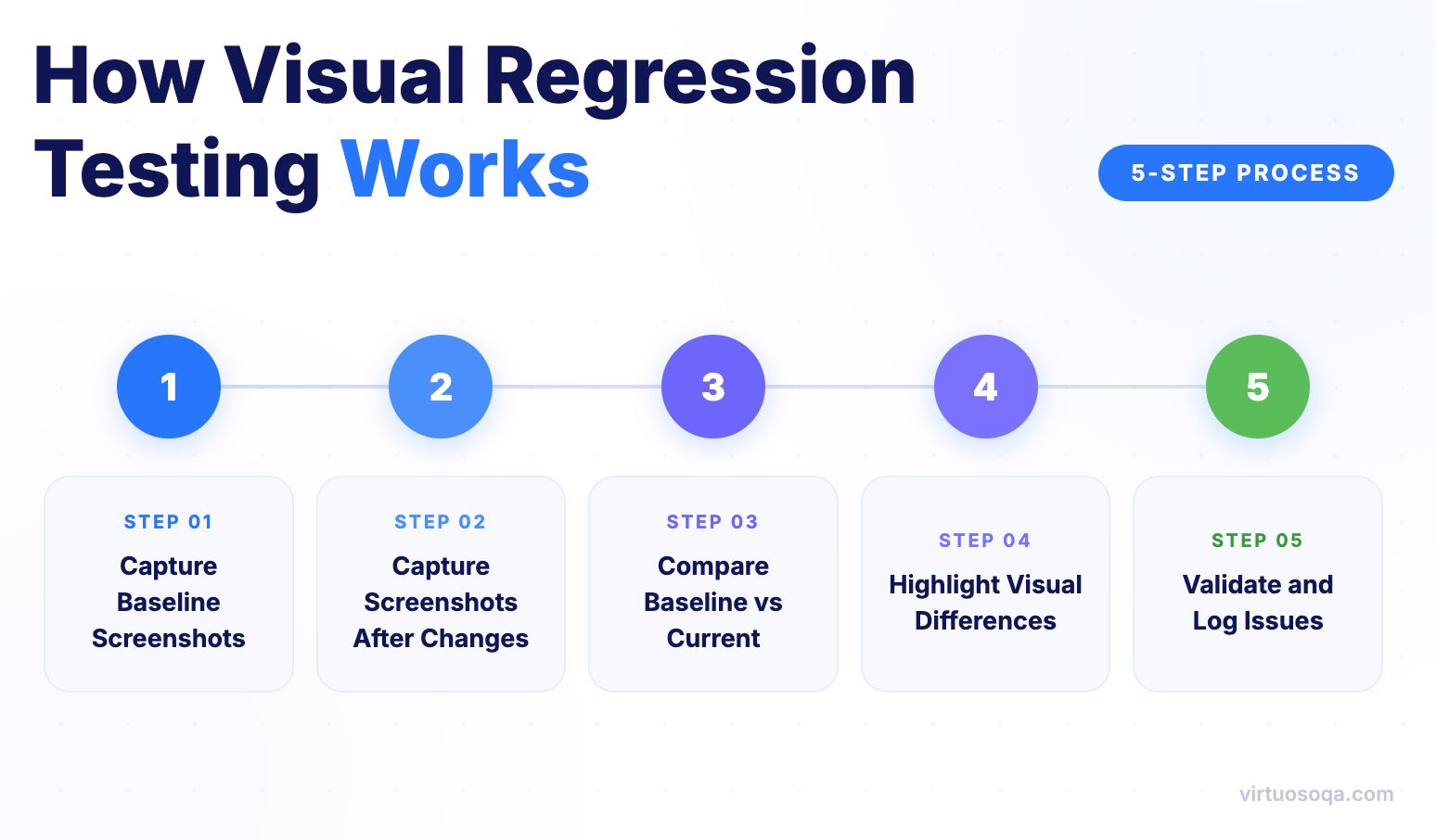
Visual regression testing has a longer history than most of its practitioners realize, and the arc of that history explains why the modern version finally works where earlier versions frustrated everyone who tried them. To understand where the discipline is now, it helps to walk the stages it passed through, because each stage solved one problem and created the next. The platform known as LambdaTest, now TestMu AI sits at the current end of this arc, and the arc is the best way to see why the current end is different in kind rather than merely in degree.
The manual era
In the beginning, visual checking was a person with two browser windows and a good memory. Someone looked at the page before a change and after it, and decided whether anything important had moved. This worked at small scale and failed at every larger one, because human visual memory is unreliable, attention drifts, and nobody can hold dozens of screens across dozens of environments in their head. The manual era was not wrong about what mattered — appearance — only about who could feasibly check it.
The naive-diff era
The first automation took a screenshot before and after and compared them pixel by pixel. This solved the memory problem and immediately created the noise problem: the naive diff flagged everything, including timestamps, animations, and the sub-pixel rendering differences between operating systems. Teams drowned in false positives, built elaborate ignore-regions to suppress them, and slowly stopped trusting the tool. The naive-diff era proved that catching every change is not the goal, because a tool that catches everything catches nothing useful.
The threshold era
Next came tunable thresholds: ignore differences smaller than some percentage, mask known-dynamic regions, set per-page sensitivity. This was a real improvement and a permanent treadmill. Every threshold was a guess that needed retuning as the application changed, and a threshold loose enough to suppress noise was often loose enough to miss a genuine regression. The threshold era traded the noise problem for a maintenance problem, which is progress, but progress with a ceiling.
The reasoning era
The current stage replaces the threshold with judgment. Instead of asking whether enough pixels changed, modern LambdaTest Visual Regression Testing asks whether the change alters what a person would perceive and care about — distinguishing a shifted layout or a clipped element from a harmless rendering variance — without a hand-tuned percentage to babysit. This is the leap the discipline spent fifteen years building toward: a system that evaluates significance the way a reviewer would, so the noise floor drops without the maintenance treadmill the threshold era demanded.
The scale that makes it real
Reasoning about significance only matters if you can apply it across the full breadth of environments your users inhabit, which is a volume problem that the reasoning itself does not solve. The current era pairs significance judgment with cloud scale, so the same intelligent evaluation runs across thousands of browser and device combinations at once. The arc bends toward both qualities arriving together: judgment without scale is a clever toy, and scale without judgment is a faster way to generate noise.
Why the history is useful
Knowing the arc inoculates you against the recurring mistake of evaluating a modern tool by the standards of an old era. Teams that were burned in the naive-diff or threshold eras often assume all visual testing produces noise, and they reject the reasoning era for sins it does not commit. TestMu AI is best understood as the answer to the specific failures of the stages before it, and the only way to recognize that is to know what those stages were and why each one fell short.
Reading the arc forward
Knowing the arc is not just useful for evaluating the present; it suggests how to read whatever comes next. Each era solved its predecessor’s central failure and bequeathed a new one, and there is no reason to assume the reasoning era is the end of the line. The current limitation — the cost and opacity of judgment at scale — will likely become the problem some future era is named for solving.
This is a healthy frame because it inoculates against both hype and cynicism. The hype says the current era is the destination; the cynicism says nothing ever really improves. The arc says something truer and less dramatic: each generation is a real improvement that creates a real new problem, and progress is the steady migration of the bottleneck rather than its abolition. Visual testing is better than it was and will be better still, without ever being finished.
For a team choosing tools today, the lesson is to buy into the current era while staying alert to the next one. Adopt the reasoning-based approach because it genuinely solves the threshold era’s treadmill, but do not treat it as a final answer, and keep watching for the limitation that will define what comes after. The teams that age well are the ones that understand they are standing on an arc, not at its end.
What the next chapter is likely to be about
If the pattern of the arc holds, the limitation of the current reasoning era will eventually define the next one. The honest candidates for that next limitation are visible already: the cost of running judgment at full breadth, the opacity of why a particular judgment was made, and the question of how to keep the reasoning current as visual conventions and design languages evolve. None of these is solved by the present generation; they are the new problems the present generation created by solving the noise-and-threshold problems that came before it.
Watching where the friction now lives is the way to see the next chapter before it has a name. Teams that pay attention to which questions their current tools cannot answer well — and resist the temptation to pretend the questions are not there — will be the first to recognize the next era when it arrives, and the first to benefit from it. The arc rewards the curious more than the satisfied, and the practitioners who keep learning are the ones who never get stuck defending a generation that has already started to age.
Every mature discipline has an arc like this, where each generation solves its predecessor’s problem and bequeaths a new one, until something changes the kind of problem being solved rather than its degree. Visual regression testing reached that inflection when significance became a reasoning task instead of a tuning task. If your mental model of it stopped at the threshold era, the discipline has moved on without you, and it is worth catching up.