

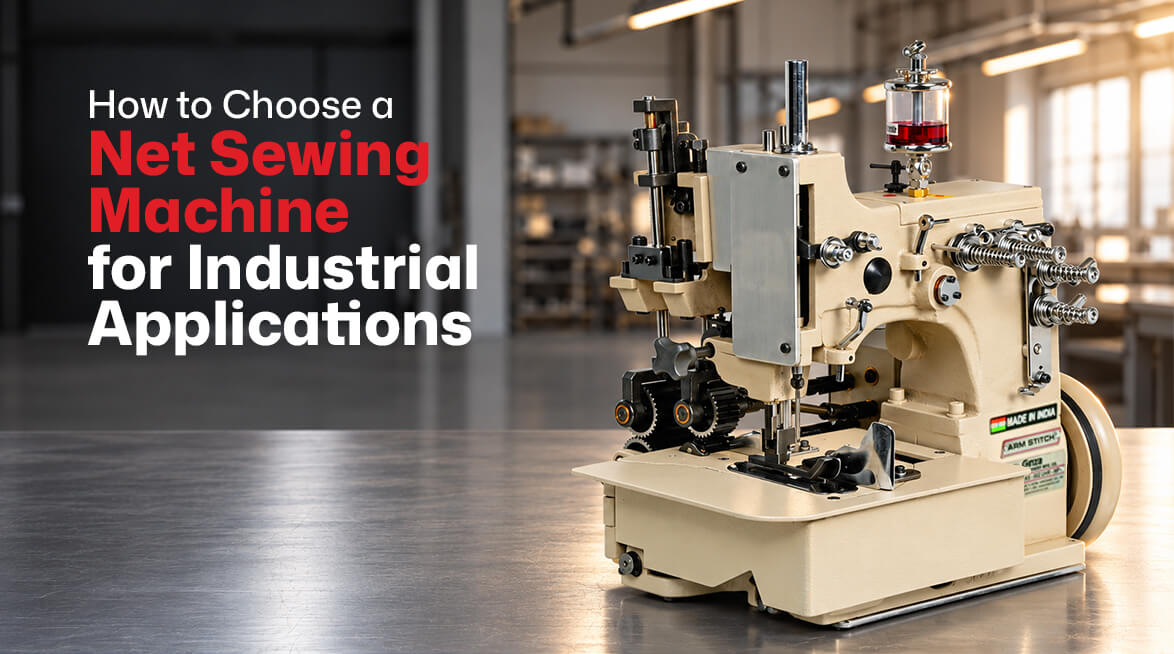
Choosing a net sewing machine starts with the net, not the machine. Netting varies in yarn, mesh size, construction, width and intended use, so equipment that works well for one application may be unsuitable for another. Industrial net manufacturers should look at material compatibility, needle and thread requirements, feeding, seam strength, fabric handling and production volume before comparing machine speeds or prices. This becomes especially important for fishing nets, safety nets, sports nets and technical netting, where the finished joint can affect how the product performs in use.
What is a net sewing machine?
A net sewing machine is industrial sewing equipment designed to join, reinforce, finish or assemble netting and related technical textiles.
Unlike conventional woven fabrics, netting has open mesh. The needle and thread therefore interact with a structure that can shift, stretch or distort more easily during sewing. The machine needs to maintain controlled feeding while forming a consistent seam without unnecessarily damaging the yarn.
The requirement also changes with the application. A sports net may prioritise neat finishing and dimensional consistency, while a fishing or safety net can place much greater emphasis on strength and durability.
ISO 1107:2017, which remains the current confirmed edition, sets out basic terminology and definitions for fishing-net netting, including how dimensions and netting characteristics are described.
Where are net sewing machines used?
Fishing nets
Fishing nets are one of the more technically demanding netting applications. Net construction, yarn characteristics, mesh size and joining method all influence the finished product.
ISO 1806:2002, confirmed as current in 2024, provides a method for determining the mesh-breaking force of fishing netting. It notes that testing can be carried out dry or wet, with wet testing particularly relevant to behaviour in use.
That is a useful reminder that the sewing process should be considered in relation to the conditions in which the finished net will operate.
Sports and recreational nets
Football goals, cricket practice nets, tennis nets, volleyball nets and other sports equipment commonly use synthetic netting. Here, consistent dimensions, clean joining and resistance to repeated handling are important.
The loads may be different from those encountered in industrial or marine applications, but poor feeding or inconsistent stitching can still affect the finished net.
Safety and protective nets
Safety and protective nets can be used around construction sites, industrial areas and other locations where containment or fall protection is required.
For these products, manufacturers need to follow the relevant product and testing requirements rather than selecting equipment purely on sewing speed. The machine must be capable of producing the specified construction consistently.
Agricultural and technical nets
Agricultural netting, shade nets, crop-protection products and other technical mesh materials can require long, continuous seams. Machine selection should take fabric width, yarn type and production volume into account.
What should you look for in a net sewing machine?
1. Match the machine to the net
Start by identifying the material.
Consider whether the net is woven, knotted or knitted, along with the yarn type, thickness, mesh size and overall weight. These details affect needle penetration, thread selection and feeding.
For fishing nets specifically, ISO 1530:2003 remains the current confirmed standard for describing and designating knotted netting.
A machine should therefore be tested on the actual netting rather than selected from a generic industrial sewing specification.
2. Consider mesh size and construction
Mesh changes how material behaves under the presser foot. Smaller or more closely constructed mesh can behave differently from large, open mesh.
The machine should maintain the required seam position without pulling the net out of shape. This is particularly important when joining wide sections where even a small feeding variation can accumulate over a long seam.
3. Choose the right needle and thread
Needle and thread selection should follow the yarn and required seam performance.
An unsuitable needle can damage the yarn or create inconsistent penetration. Incorrect thread tension can cause loose stitches, puckering or unnecessary stress on the mesh.
The aim is not simply to make a visible stitch. The seam needs to retain the required performance without compromising the net around it.
4. Look at fabric handling
Netting is often lightweight but can be surprisingly difficult to control because of its open structure.
A good feeding system should move the material steadily without excessive stretching or bunching. For wide industrial nets, table design, workspace and operator access can also affect production efficiency.
5. Consider production volume
A machine used for occasional custom netting has different requirements from one running several shifts.
For continuous production, look beyond the quoted sewing speed. Consider actual finished-net output, changeover time, thread consumption, operator handling and downtime.
A machine that runs slightly slower but produces consistent seams with fewer interruptions can be more productive over a full shift.
Net sewing machine comparison
| Requirement | General industrial machine | Net-focused machine |
| Open mesh handling | Depends on configuration | Designed around netting requirements |
| Yarn compatibility | Material-specific | Material-specific |
| Wide net handling | Machine-dependent | Often a key consideration |
| Seam consistency | Good when correctly configured | Prioritised for net applications |
| Production flexibility | Usually higher | More application-focused |
| Best suited to | Mixed industrial sewing | Regular net and technical mesh production |
The distinction is not absolute. A suitably configured industrial machine can work well for some netting. The deciding factor is whether it can consistently produce the required seam on the intended material.
What about seam strength?
For netting, strength is not simply a property of the thread.
The yarn, mesh construction, stitch pattern, seam position, number of rows and joining method all contribute to the finished result. ISO 3660:1976, which remains current after review, covers terminology and illustrations for mounting and joining fishing netting.
For fishing applications, ISO 1805:2006 also provides a method for determining the breaking force and knot-breaking force of netting yarns.
The practical lesson is straightforward: define the required joint first, then select the machine and sewing configuration that can reproduce it consistently.
How to choose the right machine
Before investing in a net sewing machine for industrial applications, work through these questions:
What is the net made from?
Identify the yarn, construction, thickness and mesh size.
What does the seam need to do?
Define the joining method, seam strength, stitch pattern and reinforcement requirements.
How large is the net?
Width and length affect feeding, workspace and operator handling.
How much will you produce?
Consider bags or nets per shift, changeovers and expected operating hours.
Where will it be used?
Fishing, sport, agriculture, safety and technical applications can have very different performance requirements.
Can the machine be tested on the actual net?
It should be. A production trial can reveal feeding, yarn damage, tension and stitch-consistency issues before installation.
Why machine flexibility matters
Industrial net manufacturers may not produce just one type of net. A single facility may handle sports nets, agricultural mesh, technical textiles or other products with different yarns and dimensions.
This makes practical flexibility valuable. Arm Stitch, for example, manufactures industrial sewing systems for applications including speciality nets alongside woven sacks, FIBC, geotextiles and other industrial products.
The useful kind of flexibility is not the ability to list many materials on a brochure. It is the ability to change between realistic production requirements without compromising seam quality or spending excessive time on adjustments.
The machine should follow the application
There is no universal best net sewing machine. The right choice depends on what is being sewn and what the finished net needs to withstand.
For sports and recreational nets, clean finishing and dimensional consistency may be the priorities. Agricultural and technical netting can place greater emphasis on long, continuous seams and stable feeding. Fishing and safety applications can demand closer attention to joint strength and applicable testing requirements.
Start with the yarn, mesh and end use. Define the seam. Then test the actual material on the proposed machine.
That approach gives manufacturers a much clearer basis for selecting equipment than comparing RPM figures alone. In net manufacturing, consistent handling and a dependable seam are what turn sewing capacity into usable production capacity.
FAQs
Can a standard sewing machine sew netting?
Some industrial sewing machines can sew netting when correctly configured. Suitability depends on the mesh, yarn, thickness, seam and required production rate.
What thread is used for sewing nets?
The thread should be compatible with the netting material and the required seam performance. There is no single thread suitable for every industrial net.
How do I prevent a net from stretching during sewing?
Controlled feeding, appropriate presser-foot pressure, correct thread tension and suitable machine configuration can help. Testing the actual net is important because different constructions behave differently.
Is a special machine required for fishing nets?
Not always, but fishing nets can have demanding material and seam requirements. Applicable standards and the intended operating conditions should guide equipment selection.
What is the most important factor when buying a net sewing machine?
Material compatibility should come first, followed by seam requirements, fabric handling, production volume, maintenance and service support. Machine speed should be considered only after these fundamentals are established