

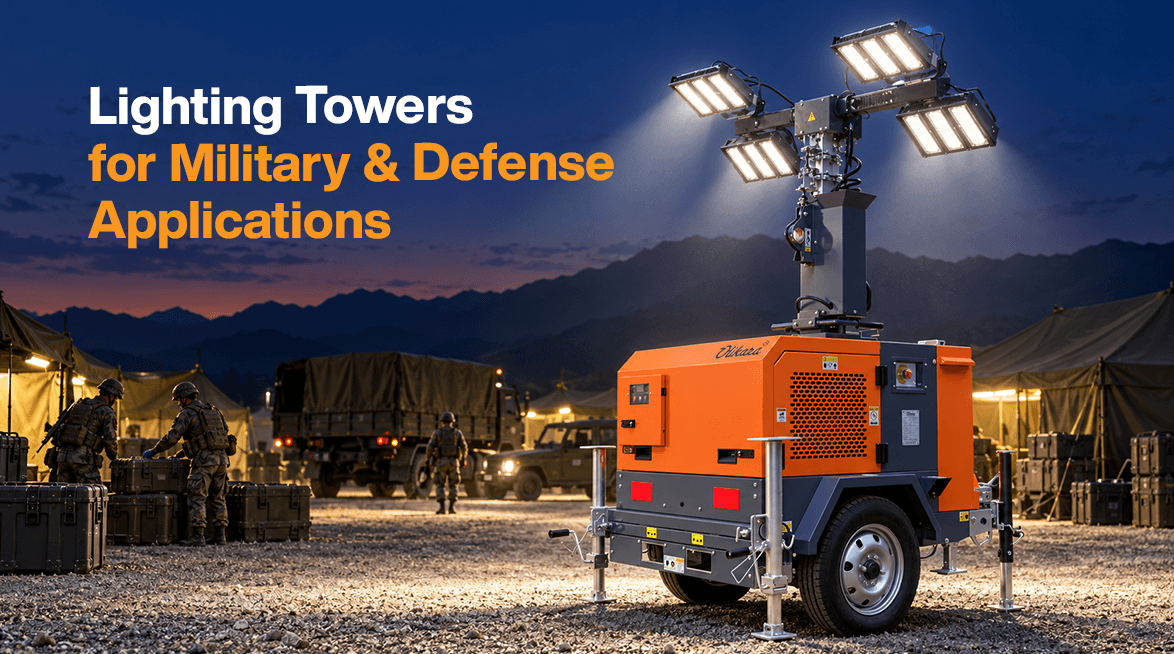
Military and defense operations frequently take place in inaccessible places, at temporary locations. These locations require continuous illumination after dark. In order to select appropriate equipment, power supply, mobility of the tower, duration of light, and conditions in the place to be illuminated.
Lighting towers manufacturers offer different types of lighting towers power. Engine-driven towers function properly in remote locations; and grid-powered towers are suitable for stationary military bases.
Defense infrastructure operates 24/7, as anything can happen at any time of the day. Thus, portable lighting helps people see and work safely in dark hours.
Let’s learn more about how lighting towers are beneficial for military and defense applications.
Why Lighting Towers Matter in Military and Defense Operations
Military bases and defense projects need light over large outdoor areas, and they can’t always depend on permanent infrastructure. Fixed lighting works well in established bases. However, for temporary camps, mobile workshops, and locations where work and operations are frequently changing, this may not be enough.
Portable lighting towers provide a solution to this issue by providing mast height and allowing for illumination in the surrounding area. Proper installation of lighting towers improves visibility around the machines, prevents shadowing of the working areas, and helps workers avoid obstacles.
However, different work tasks require different lighting levels. So, lighting should be planned based on the area, required coverage, and operating conditions.
Key Applications of Lighting Towers in Defense Infrastructure
1. Temporary Camps and Field Facilities
Proper lighting must be provided around the accommodation areas, supply points, maintenance areas, and common areas in temporary military camps. Portable towers can be used to set up a lighting system without the need for permanent towers and electrical infrastructure.
A unit like the Qube Power Mini, which has four 100 W LED lights and a 360-degree lighting distribution pattern, is a perfect example of how a small portable tower can be used for smaller work areas and temporary facilities. The right lighting solution depends on the required illumination level and the layout of the area.
2. Equipment Service and Maintenance
Typically, equipment repair work is done after sunset, especially in busier sites. In such cases, technicians require sufficient visibility to be able to inspect their units, and any leakage.
Engine-powered lighting towers are helpful when a stable power source is not available, while grid-powered lighting towers are appropriate for larger workshops that have sufficient power supplies.
For example, Olikara’s Qube Power Max is a larger engine-powered option perfect for large-scale infrastructure and defense applications. Its suitability depends on the required coverage, operating duration, and site conditions.
3. Construction and Repair of Defense Infrastructure
It may be necessary to provide temporary lighting for nighttime construction or repair operations at the runway support areas, access roads, storage areas, bridges. Lighting towers also help keep crews visible across work zones when a permanent lighting network isn’t in place.
The Qube Grid Max is a grid power solution for larger work areas at sites that have an appropriate electrical supply. When there is no access to electricity, gas-engine options are better. Selection should be guided by site assessment rather than one simple assumption about the operational environment.
Choosing the Right Power Configuration
When choosing lighting towers for defense purposes, consider electricity access. The tower that operates well in a permanent structure may be unable to function properly in remote locations where electric power does not reach. Likewise, engine-driven systems require fuel and regular maintenance, unlike systems powered by a reliable electricity supply.
The following configurations address different operating conditions.
| Factor | Engine-powered | Hybrid-powered | Grid-powered |
| Primary power source | Petrol or diesel engine | Rechargeable battery with solar technology, depending on model | Electrical supply |
| Best-suited environment | Remote work areas without reliable grid access | Sites where reduced engine dependence is desirable | Established facilities with suitable electrical infrastructure |
| Main consideration | Fuel availability, servicing, and runtime | Charging conditions, battery capacity, and operating load | Power availability, cable routing, and electrical safety |
| Example model | Qube Power Max | Qube Power Max Hybrid | Qube Grid Max |
| Practical advantage | Independent power generation | Potential to reduce engine operating time | No need to operate an onboard engine for lighting |
Engine-Powered Lighting Towers for Remote Locations
When work needs to be undertaken outside existing electrical infrastructure, engine-powered towers can be helpful. They produce their own electricity and can provide power where grid electricity is not available.
The Qube Power and Qube Power Max are two products that illustrate engine-powered models in various sizes. Their engines have a mast height between 3 and 7 m and runtime of up to 70 hours.
When preparing for implementation, it is necessary that the purchasing teams check whether the unit fits the operational schedule, fuel consumption, refueling, ease of maintenance, and the noise level. These factors have as much impact on the overall operational cost as the initial equipment price.
Hybrid Lighting Towers for Flexible Energy Use
Depending on the model, hybrid systems combine rechargeable batteries with solar technology. They can provide an alternative when the reduction in engine operation and in energy use are important. But the performance depends on charging opportunities, battery capacity, lighting demand, and local weather conditions.
The Qube Power Max Hybrid and Qube Solar showcase Olikara’s hybrid and solar-powered lighting solutions. Buyers should check the selected hybrid unit’s power specifications rather than assume all models offer the same charging and backup capabilities.
Grid-Powered Lighting Towers for Established Facilities
Generally, grid-powered towers are well-suited for places where there is a reliable power connection. They do not require the use of an on-board engine for lighting but must be considered for cable routing, electrical protection, and distance from the power source.
Olikara’s Qube Grid Base / Trailer and Qube Grid Max show an example of equipment powered by the grid. These units could be deployed in venues, or in existing areas where there is enough power supply.
What Should Buyers Evaluate Before Procurement?
The following checks provide a practical starting point before procurement:
- Illumination requirements: Measure the area, amount of light needed, height of the mast, and acceptable amount of shadows formed.
- Power and running time: Estimate the hours of labor required, amount of fuel needed, and type of electricity required.
- Transportation: Consider the tower’s dimensions and weight, lifting requirements, trailer needs, and ease of relocation between sites.
- Environmental suitability: Examine the impact of the sun, rain, dust, wind, and temperature on the unit.
- Maintenance: Check the maintenance requirements and confirm whether electricity is available on-site.
No single lighting tower suits every defence application. Buyers should assess site conditions and evaluate the equipment’s performance to ensure it meets operational requirements.
Conclusion
Lighting towers make it possible to carry out tasks that require good visibility. Depending on the terrain, the type of energy supply, and the time of use, the choice can be made between engine-powered units, hybrid devices, and grid-powered equipment.
By assessing these factors and choosing reliable lighting tower suppliers, procurement teams can select equipment that meets their operational needs.
Olikara Lighting Towers offers engine-powered, hybrid, and grid-powered options to suit different defence infrastructure and support applications, depending on project-specific technical and compliance requirements.
FAQs
- What are lighting towers used for in military and defense applications?
They supply temporary lighting for maintenance operations, field facilities, and defense infrastructure projects.
- Which power source is best for remote defense locations?
Engine-powered towers are suitable for areas where electricity is not available, as long as fuel and maintenance support can be obtained.
- Are hybrid lighting towers suitable for defense facilities?
They are suitable for applications where battery storage and solar charging can meet the required lighting duration and operating demands.
- What should buyers check before selecting a military lighting tower?
They should evaluate the light coverage, runtime, power availability, mobility, environmental constraints, maintenance requirements, and applicable defense specifications.