

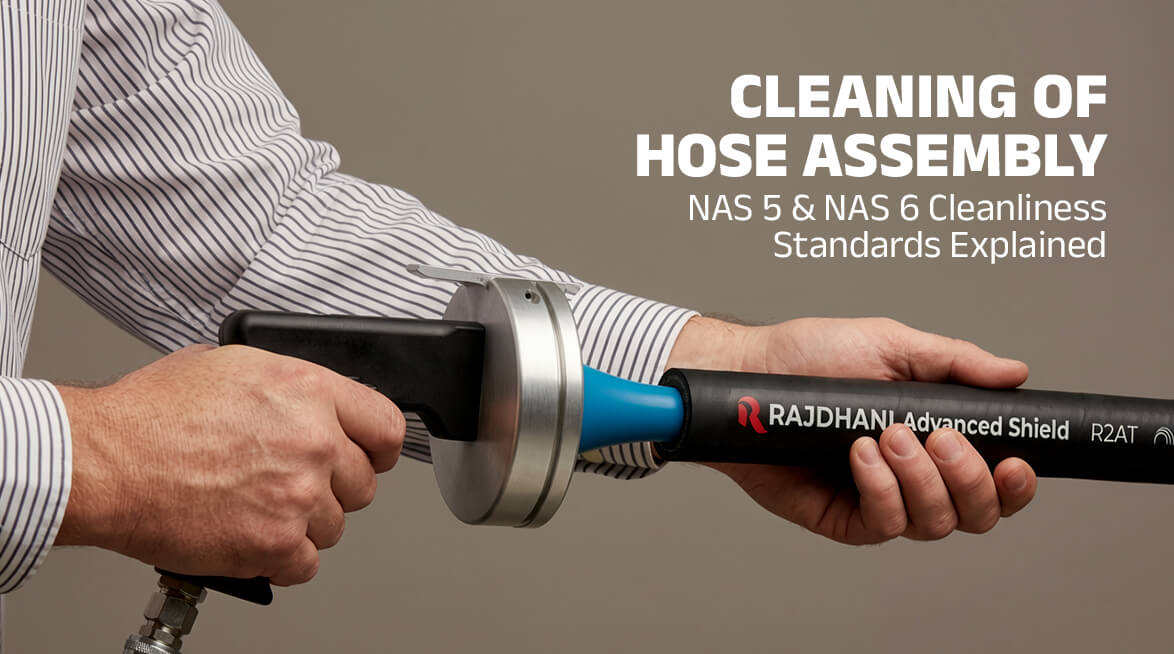
Hydraulic hose assemblies may look clean from the outside, but small particles inside the hose can damage pumps, valves, cylinders, and servo systems. For sensitive hydraulic equipment, cleaning is not an optional finishing step; it is an important part of assembly quality.
NAS 5 and NAS 6 are cleanliness classifications associated with the NAS 1638 system. They define the maximum number of particles permitted in hydraulic fluid across different particle-size ranges. NAS 1638 is a legacy standard, while SAE AS4059 is the newer classification system based on the same general concept.
What Are NAS 5 and NAS 6?
NAS 1638 classifies contamination from Class 00, the cleanest level, to Class 12, the dirtiest level. The classification is based on the maximum particle count per 100 ml of fluid in five size ranges:
- 5–15 microns.
- 15–25 microns.
- 25–50 microns.
- 50–100 microns.
- Above 100 microns.
Each increase in the NAS class generally permits approximately twice the particle count of the previous class.
NAS 5
NAS 5 represents a very clean hydraulic condition. It is suitable for sensitive systems such as servo valves, aerospace hydraulics, precision equipment, and high-performance control circuits.
NAS 6
NAS 6 is also a clean standard and is commonly considered for critical industrial, mobile, and subsea hydraulic systems where contamination can restrict small passages or damage precision components.
The required level should always be specified by the equipment manufacturer or system designer. A hose assembly does not automatically need NAS 5 or NAS 6 cleanliness; the correct level depends on the sensitivity of the complete hydraulic system.
Why Hose Assembly Cleanliness Matters
During cutting, fitting, crimping, and handling, hose assemblies can collect rubber particles, wire fragments, dust, moisture, and manufacturing residue. If these contaminants enter the hydraulic circuit, they may:
- Damage pumps and servo valves.
- Block or restrict small orifices.
- Increase component wear.
- Cause unstable machine movement.
- Reduce filter life.
- Create premature system failure.
For this reason, cleanliness is particularly important for Hydraulic Hose manufacturers in India supplying assemblies for construction equipment, industrial machinery, mining, aerospace, defence, and precision applications.
Cleaning Methods for NAS Levels
Foam projectile cleaning
A correctly sized foam projectile, also called a sponge or pellet, is pushed through the hose using clean compressed air or fluid pressure. It physically wipes loose particles and residue from the internal tube.
Projectile cleaning is effective for removing loose contamination, but the process must be correctly controlled. The projectile size, material, pressure, and number of passes should match the hose construction.
Flushing
Flushing circulates clean, filtered hydraulic fluid through the hose assembly at a controlled flow rate. The turbulent fluid carries particles out of the hose.
For critical assemblies, flushing fluid should be cleaner than the required final cleanliness level. Filtration, flow velocity, flushing time, and fluid compatibility must be controlled and documented.
Air blowing
Clean, dry, filtered compressed air can remove loose debris. However, ordinary workshop air is often not sufficient for NAS 5 or NAS 6 applications because it may contain moisture, oil, or airborne particles.
Air blowing is therefore generally used as part of a validated cleaning process rather than as the only method.
Sealing and Verification
Cleaning is only effective if the assembly remains clean afterward. Both hose ends should be capped immediately after cleaning and testing. Caps protect the internal bore during storage, transport, and installation.
The final cleanliness level may be verified through laboratory particle counting, flushed-fluid analysis, or other approved inspection methods. Automatic laser particle counters are commonly used to measure contamination in the selected particle-size ranges.
Documentation should include:
- Hose and fitting identification.
- Cleaning method.
- Cleaning fluid and filter rating.
- Test date.
- Particle-count results.
- Operator or batch information.
- Packaging and sealing details.
Best Practices for Manufacturers
Reliable Hydraulic Hose manufacturers in India should control cleanliness throughout the full production process, not only at the final inspection stage. Work areas, tools, fittings, cutting equipment, compressed air, flushing fluid, and packaging materials can all affect the result.
Important practices include using clean tools, protecting hose ends during assembly, removing cutting debris, storing assemblies away from dust, and maintaining batch traceability.
Cleanliness requirements should also be agreed with the customer before production. The British Fluid Power Association notes that the required cleanliness level is normally based on the needs of the complete hydraulic system and the customer’s specification.
Conclusion
NAS 5 and NAS 6 represent demanding cleanliness levels for hydraulic hose assemblies. Achieving them requires more than blowing air through a hose. Foam projectile cleaning, filtered-fluid flushing, immediate capping, and particle-count verification should be combined in a controlled process.
For sensitive hydraulic equipment, properly cleaned assemblies help protect components, reduce downtime, and improve system reliability. When sourcing from Hydraulic Hose manufacturers in India, buyers should request a clearly defined cleanliness specification and documented verification results.