

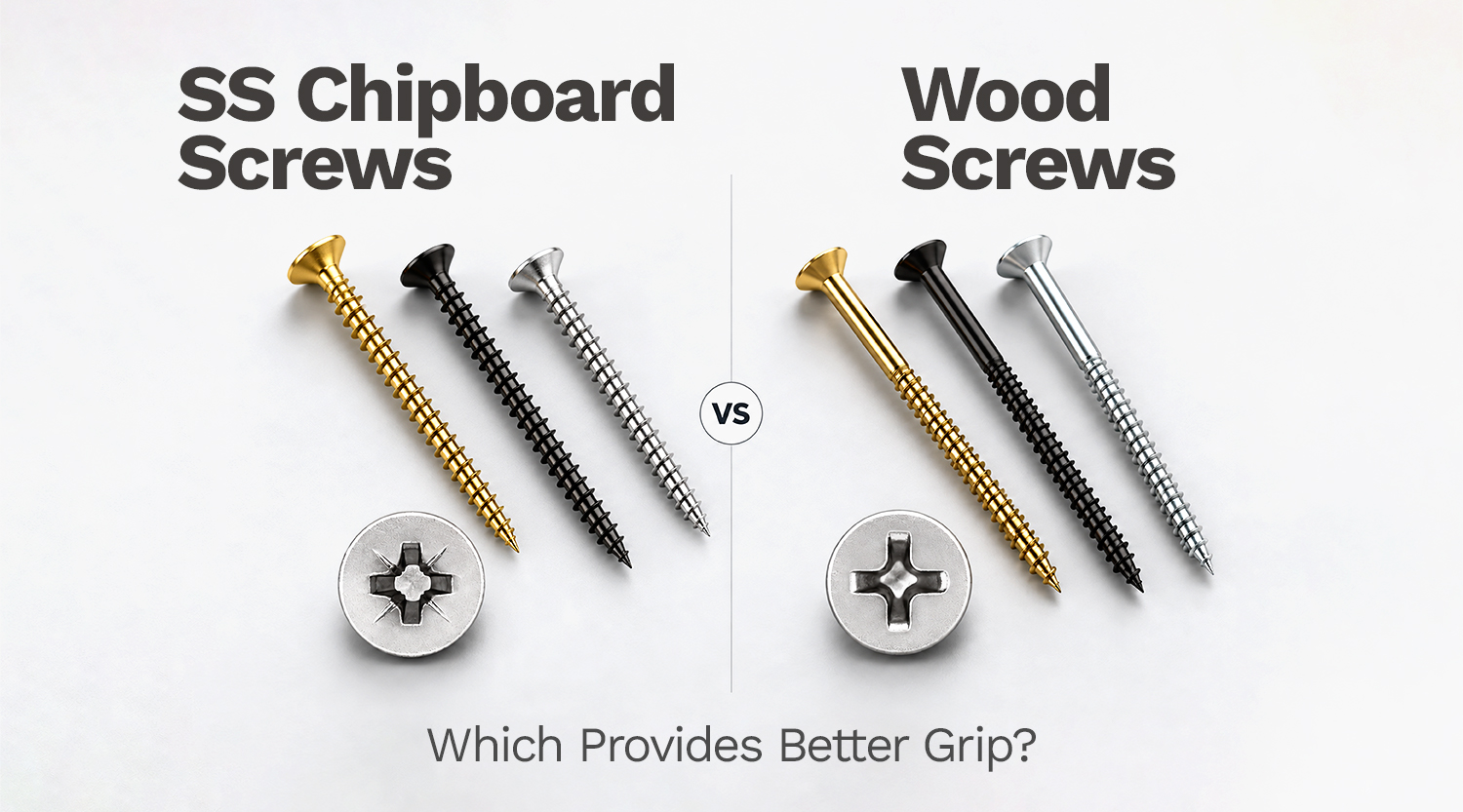
Grip is decided by what the thread bites into. The SS chipboard screws vs wood screws question keeps going round in circles on site because one person means 18mm MDF and the other means teak, and those two materials fail a screw in different ways.
The Difference Between Wood Screws and Chipboard Screws in the Thread
The first thing that differs is the thread. On a chipboard screw it runs almost up to the head and is cut deep and sharp around a core that looks thin next to the M-number printed on the pack. That proportion suits particleboard. Particleboard and MDF are compressed wood particles or fibre held together by resin, with no grain running through the sheet to hold a thread, so a thin core helps by pushing aside less board as it goes in. The panel is less likely to bulge or crack near an edge, and the deep thread reaches past the crushed zone around the hole into board that is still intact.
A traditional wood screw was designed for solid timber. It usually has a plain, unthreaded shank just below the head and a tapered threaded section under that, and its thread depends on long wood fibres to lock against. Particleboard has none. A wood screw driven into the face of a carcass panel will often feel firm on the day of fitting and then work loose once the shutter has been opened and shut through a monsoon season. The particles around its shallower thread crumble a little with every load cycle.
SS Chipboard Screws vs Wood Screws in Solid Timber
Solid timber is where the plain shank matters. Screw a batten to a frame and the batten should slide freely on the shank while only the frame below takes the thread. As the head seats, the thread pulls the frame up against the batten and the joint closes tight.
A screw threaded right up to the head bites both pieces at the same time. If the batten was not clamped hard first, it stays wherever it sat when the thread caught it, and turning harder only chews up the thread in the frame. The joint never closes. From a distance it looks shut, but a hairline gap runs along the glue line, and karigars who have repaired enough frames know this joint by feel.
Drive type is the other decision with a wood screw. The Phillips version is meant for a drill and suits production work, and the single slot version is for hand driving where a karigar wants to feel the last half turn on a hinge or a moulding. In hardwood like teak, drill first. A pilot hole in the lower piece and a clearance hole in the top piece let either version seat without splitting the timber, and the clearance hole also keeps the top piece free to slide on the shank.
A chipboard screw will go into solid timber and hold, and plenty of fitters use one there for a hinge plate or a light bracket. For a joint between two pieces of timber it loses the pulling action of the plain shank.
What the Size Labels Tell You
Labels cause the next mix-up. At the counter, chipboard screws are often sold by metric diameter and wood screws by gauge number, and the two scales overlap more than the labels suggest. LP Screw’s published chipboard range prints both, so gauge 8 appears as M4.5 and gauge 6 as M3.5. Gauge 7 is M4.0.
| Detail | SS chipboard screw | Wood screw |
| Diameter | M3.0 to M5.0 (gauge 5 to 10) | Gauge 4 to 16 |
| Length | 12mm to 100mm | 12mm to 150mm |
| Head | Countersunk | Countersunk |
| Drive | Phillips, for a drill | Phillips for a drill, or single slot for hand driving |
| Listed uses | Modular kitchens, doors, drawers, wardrobes, hinges | Ships, wooden frame partitions, shelves, cabinets |
The longer wood screw lengths exist for thick timber sections, which carcass work in 18mm board rarely calls for, and the chipboard listing tops out at M5.0 x 100mm.
How to Choose Before You Order
Start with the material the thread will sit in. If that material is particleboard, MDF or any pre-laminated board, the chipboard screw is the right choice and the wood screw is ruled out for anything that carries load, such as a drawer runner or a wardrobe shutter hinge. If it is solid timber and two pieces have to be pulled together, use the wood screw.
Moisture comes next. Stainless steel belongs anywhere near a sink, a bathroom vanity or a coastal site where chloride in the air attacks plain steel, while mild steel is only worth considering for dry indoor furniture. Then match the drive to the tool your team actually carries.
Last, read the supplier’s listing. An SS chipboard screws manufacturer worth ordering from will print the metric diameter beside the gauge number, so a fitter replacing an M4.0 screw knows it is gauge 7 without looking it up. A wood screw manufacturer should list gauge and length together for every pack. The gauge decides whether the screw fits the hinge hole while the length has to match the timber thickness, and a listing that gives only one of the two leaves the fitter guessing at the counter.
For most modular furniture in Indian homes, that sequence ends at the chipboard screw, because the fittings go into the carcass. The carcass is board. Keep wood screws for the solid timber frames, door chowkhats and shelves where two pieces of wood have to meet and stay closed.
FAQs
1. What is the difference between wood screws and chipboard screws?
Thread shape. A chipboard screw is threaded almost to the head, deep enough to hold in particleboard and MDF, while a wood screw keeps a plain shank under the head so it can pull two timber pieces tight.
2. Do wood screws hold in chipboard?
They hold, but less well than chipboard screws. A wood screw’s thread is shaped for timber fibre, and in particleboard it tends to loosen under repeated load, especially close to the board edge.
3. What should I check before buying from a wood screw manufacturer?
Check that each pack lists gauge and length together, and that stainless steel is on offer for damp or coastal sites. Also confirm the drive type suits your tools.
This article has been contributed by LP Screw, a Laxmi Industries brand from Ahmedabad, India, and one of the largest screw manufacturers, best known for its CE Certified, ISO 9001-2009 certified and DIN 7982 compliant diverse range of screws.