

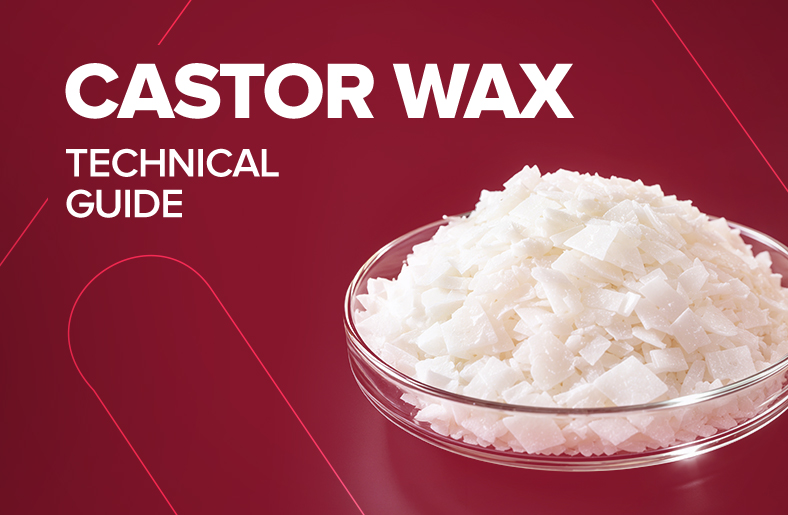
Castor wax is used in different industries. It originates from castor oil but has different characteristics. It exhibits consistent physical properties and provides functional performance in applications where liquid oils are unsuitable.
Castor wax plays an important role in determining a product’s performance, melting behaviour, final shape, and compatibility with other components. Therefore, selecting the appropriate grade of castor wax is essential to achieving the desired product characteristics.
This guide describes castor wax, how this wax is manufactured, and what to consider when buying castor wax.
What is Castor Wax?
Castor wax is also known as hydrogenated castor oil (HCO). It is a wax obtained from castor oil made from the seeds of Ricinus communis plants. The hydrogenation process involves the addition of hydrogen to unsaturated bonds in the fatty acids of the oil. This results in changes in both the chemical and physical characteristics of the oil.
Castor oil is in liquid form at room temperature, but hydrogenated castor oil is a solid. Castor wax is known for its high melting point, and hardness and it is used to stabilise mixtures.
Some properties of castor wax include the following:
- High melting point allows castor wax products to maintain their shape and structural integrity under elevated operating temperatures.
- Its hardness and rigidity enhance the structural strength of wax-based products and support consistency in various industrial formulations.
- Moisture resistance makes the wax suitable for coatings, greases, and other products that require water resistance.
- Thickening ability enables control of the thickness and flow of the mixture.
- Derived from castor oil, castor wax can serve as a plant-based alternative to certain petroleum-derived waxes, depending on the application and required performance characteristics.
However, its effectiveness depends on its quality, formulation, processing technique, and usage.
How is Castor Wax Manufactured?
Castor wax is derived through hydrogenation, which is a controlled chemical process that alters castor oil’s properties. The aim is to achieve a stable solid phase while ensuring that the material meets the performance requirements of specific industrial and personal care applications.
The production process usually consists of the following steps:
1. Castor oil preparation
Castor oil is chosen and prepared to suit the grade being made. The quality of the oil affects how consistent the final product is.
2. Hydrogenation
Hydrogen reacts with the unsaturated bonds in the oil’s fatty acid chains under controlled conditions. This saturates the oil and turns it into wax.
3. Processing and finishing
The hydrogenated product is then shaped into its final form. Depending on the grade, it can be supplied as flakes or made into powder.
4. Quality evaluation
Before supply, the material is tested against its product specifications. Key quality parameters include appearance, melting behaviour, and chemical composition.
Although hydrogenation plays a central role in determining castor wax quality, other processing conditions and material characteristics also influence the final product.Quality depends on the raw materials as well as the quality of the process that is being employed.
Understanding Castor Wax MP 70
Castor Wax MP 70 is a commercial castor wax grade with a melting point of around 70°C. Always check the exact specification and test method in the manufacturer’s technical data sheet.
This grade works well for manufacturers who want a wax that behaves predictably during production. Depending on the specification, it can be used in some cosmetic products, lubricants, coatings, and other specialty products.
When considering Castor Wax MP 70, buyers should check:
- Melting point: Does it suit your processing temperatures and intended operating conditions?
- Physical appearance: Does the form supplied suit your handling and processing needs?
- Compatibility: Is it compatible with the other ingredients in the formulation, without causing separation or affecting product performance?
- Batch consistency: Does each batch meet the required specifications?
Note: MP 70 cannot replace any grade of hydrogenated castor oil. Different grades have different melting points and melting ranges.
What is Castor Wax Micronized Powder?
Castor wax micronized powder is a powder made from hydrogenated castor oil. Micronisation reduces particle size, which can improve powder dispersion and mixing in formulations where fine particle distribution is required.
When you are purchasing micronized powder, you should take into consideration the following:
- Particle size and the measurement method used to determine it
- Powder flow properties, storage stability, and suitability for the intended operating conditions
- Dispersion performance in the final formulation
- Compatibility with manufacturing equipment and other formulation ingredients
- Complete product specifications and relevant safety documentation
It should be noted that micronisation affects only the size and shape of particles but does not influence the chemical properties of the wax. Thus, you need to make a choice between powder and flakes depending on the technological process used.
Key Industrial Applications of Castor Wax
Castor wax is considered to be a significant ingredient because it provides structure and stability to a wide range of formulations.
1. Cosmetics and Personal Care
Castor wax is employed as a thickening or structural component in products such as creams, lotions, body care, lip balms, and eye creams.
2. Lubricants and Greases
Castor wax can provide grease with thickening properties. However, performance is affected by various factors such as the oil used, properties required, and certain additives.
3. Paints, Coatings, and Polishes
Castor wax is added to a number of mixtures where it helps with product consistency, and coating properties.. It is mostly used in oil paints, coatings, polishes, and other similar products.
4. Adhesives and Sealants
Some hot-melt adhesives and sealants use castor wax or hydrogenated castor oil powder to enhance product performance.
5. Electrical and Other Industrial Uses
Castor wax is used in capacitor manufacturing and other industrial applications, with the required purity grade depending on the specific application.
In conclusion, castor wax is not a universal additive. Its benefits can be seen in specific forms and grades for a specific manufacturing purpose.
Conclusion
Castor wax is much more than hydrogenating castor oil. It is a useful material for both personal care and industrial products. Knowing the difference between Castor Wax MP 70 and micronized powder helps manufacturers pick the material that fits their production needs.
Ambuja Solvex offers castor wax solutions for industrial applications in India. Verify its specific MP 70 manufacturing capabilities before describing the company as a manufacturer of this grade.
FAQs
- What is castor wax made from?
Hydrogenation converts castor oil into a harder, solid material with properties suited to various industrial and personal care applications.
- What is Castor Wax MP 70 used for?
Castor wax MP 70 is used in cosmetic and industrial formulations where wax texture and melting characteristics are important.
- What is the difference between castor wax flakes and micronized powder?
Castor wax flakes are suited to applications requiring larger solid pieces, while micronized powder is preferable when fine particle size and uniform dispersion are essential. The choice depends on the formulation requirements and processing method.
- How do I choose a Castor Wax MP 70 manufacturer in India?
Compare product specifications, technical documentation, batch consistency, and supply capabilities. Confirm that the selected grade meets your formulation and manufacturing requirements before ordering.